


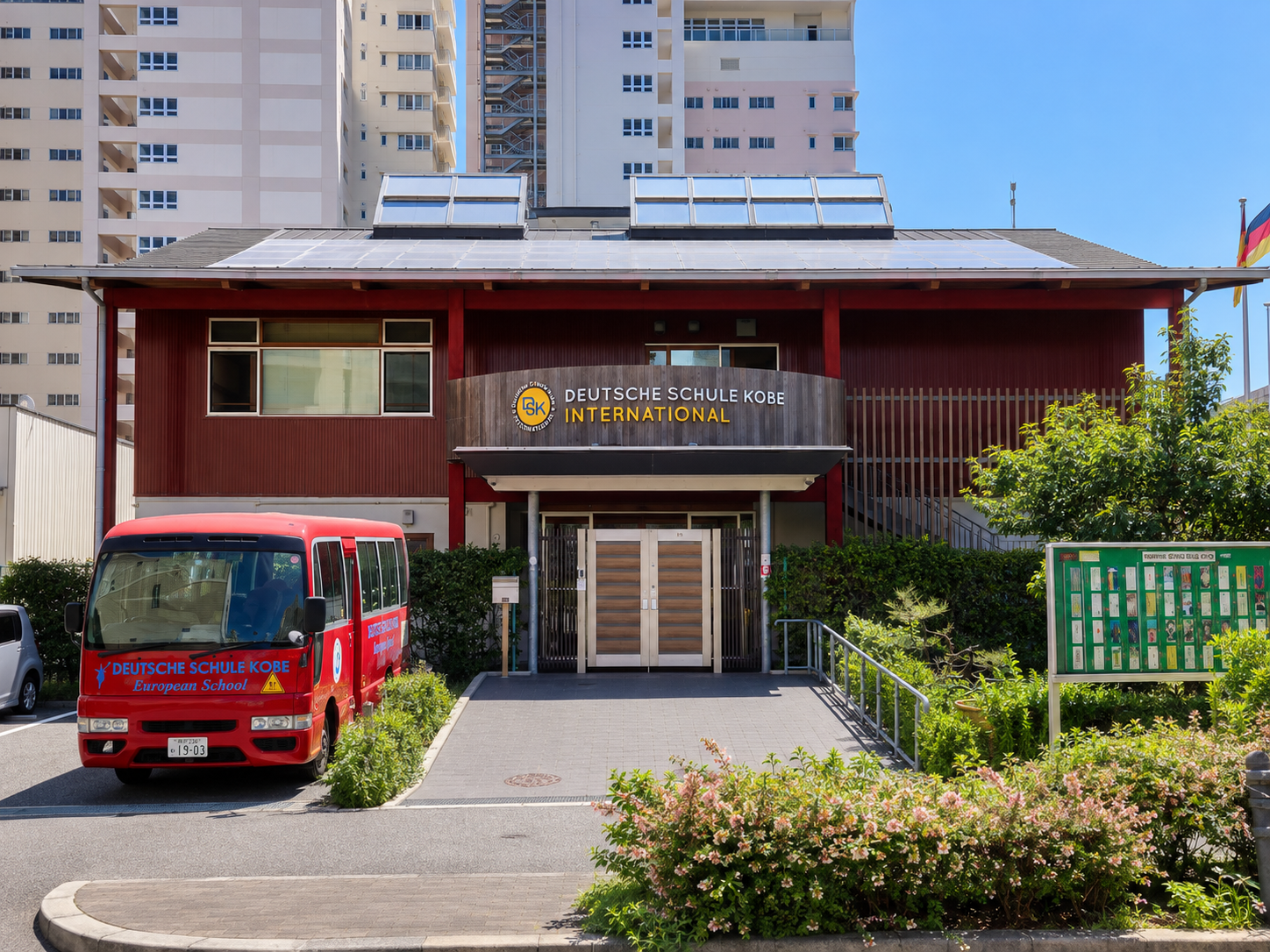
Kobe Deutsches Schulzentrum International (Deutsche Schule Kobe International · DSKI) is a European-based international school founded in 1909, located on Rokko Island in Kobe.
English serves as the primary language of instruction, while this small multilingual school ensures all students learn German and Japanese. It holds IB PYP (Primary Years Programme) authorization and Cambridge International registration. Though also referred to as "Doitsu Gakuin Kobe," its official administrative name—as listed in Hyogo Prefecture's miscellaneous school registry—is Kobe Deutsches Schulzentrum International.
Two critical updates warrant immediate attention for families considering this school.
First, German proficiency is not a prerequisite for admission. English is the primary language of instruction. The school offers EAL (English as an Additional Language) support for students with minimal English, as well as supplementary instruction for German beginners.
Second, while the school was traditionally described as serving "ages 3–14 only," it is now in a transition period where the secondary division will expand by one grade level annually from the 2026/27 academic year, extending through Grade 10 (IGCSE), with plans to introduce the IB Diploma (DP) from 2031/32 onwards. However, this is a plan in progress, not yet a completed integrated school.
This article draws from primary sources including official school materials, Hyogo Prefecture data, the IBO, Cambridge International, German government bodies (KMK/ZfA), and the Ministry of Education, Culture, Sports, Science & Technology, reflecting investigations as of August 2026. Information not confirmed in public sources is explicitly marked "unconfirmed," with a checklist of verification questions for school visits provided at the end.
DSKI Overview: A European Multilingual School on Rokko Island
DSKI's origins trace to 1909, when a small school served the German expatriate community in Kobe. The English division opened in 2002, IB PYP authorization was granted in 2006, and the school relocated to its current Rokko Island campus (Kobe, Higashinada Ward, Mukaiyama-cho, Naka 3-2-8) in 2009.
In 2015, the German and international divisions merged under the school's current name. The campus features a two-story building designed with sustainable timber and environmental considerations (including insulation and geothermal cooling), which the school notes received an eco-award from the Japan Institute of Architects. Rather than a large-scale facility, the school is characterized as small-scale, wood-based, and environmentally conscious.
In legal terms, DSKI is a miscellaneous school approved by Hyogo Prefecture—not a "School Education Act Article 1" ("1条校") institution. (This distinction matters for pathway considerations, discussed later.) The same island is home to Canadian Academy, a large IB integrated school, making Rokko Island host to two international schools with distinct characters. For a broader overview of selecting international schools in the Kansai region, see the comprehensive guide.
International School Selection Guide for the Kansai Region: Comprehensive Comparison of Leading Schools in Osaka, Kobe, and Kyoto [2026 Edition]
Precise Accreditation Status
DSKI's accreditations are frequently misunderstood based on its name. As of August 2026, primary sources confirm the following status:
Framework | Status | Notes |
|---|---|---|
IB | PYP authorization only (since 2006) | IBO school directory confirms PYP and English as medium of instruction. MYP and DP are not authorized. DP introduction from 2031/32 is in the planning stage only. |
Cambridge International | Registered school | At primary level, mathematics and language use Cambridge progression and standards. Secondary level (through IGCSE) is being introduced gradually from 2026/27. Checkpoint examination participation is unconfirmed. |
German Government School Accreditation | Not currently confirmed | The KMK accreditation list as of April 2026 lists only Deutsches Schulzentrum Tokio from Japan. The school itself states it aims to "regain" accreditation and "rejoin" the ZfA network. |
German Language Diploma (DSD) | School has announced this · Third-party confirmation pending | The school indicates future DSD I/II certification opportunities, but independent confirmation of authorization as a test center is unavailable. |
In other words, none of these commonly assumed associations currently hold: "It's an IB school, so it has the DP," "It's a Cambridge school, so IGCSE exists now," or "It's a German school, so it has German government accreditation." More precisely, DSKI combines IB PYP authorization + Cambridge registration + German language education pathways, while working toward German government network reinstatement and secondary expansion.
Curriculum and Languages: How Three Languages Are Taught
Not "Divided in Thirds"—Rather "English as Primary, with All Students Learning German and Japanese"
Families considering a multilingual school should understand this key reality. In the school's official description, English is the primary language of instruction, not a three-way equal division between English, German, and Japanese.
Within this framework, all students learn both German and Japanese.
Drawing from published sample primary schedules, mathematics occupies 250 minutes per week and language classes occupy 250 minutes per week. These two subjects are taught in either English or German depending on the class.
German as a foreign language runs 95 minutes weekly, and Japanese 180 minutes weekly. Since music and other subjects incorporate songs in all three languages, no public data breaks down the overall language distribution as a precise percentage (early years language hours are also not disclosed).
Language support structures are organized as follows:
- English: For students with minimal English, EAL is explicitly offered (individual planning via homeroom and EAL staff, supported through in-class and small-group instruction)
- German: All students learn German. Native speakers have access to a language and subject-learning pathway based on the German state curriculum (Thuringia model), while beginners receive one-to-one and small-group supplementary instruction. Students may pursue Goethe certification
- Japanese: Compulsory for all students. Native speakers follow a "Japanese language" (kokugo) pathway informed by the national curriculum; non-native speakers study Japanese as a foreign language (JLF)
Older introductory articles reference a "two-stream structure" (German-track and English-track classes); this model ended with the 2015 merger. The current reality is more accurately described as an English-primary integrated school with preserved German-native subject pathways within.
Curriculum Framework and Grade Alignment
The early years section (Pre-K through Kindergarten) is based on IB PYP inquiry-based learning. The primary section (Grade 1–5) centers on PYP while integrating Cambridge mathematics and language standards. The secondary section will introduce Cambridge Lower and Upper Secondary frameworks in phases starting 2026/27. (For an explanation of PYP itself, see the dedicated guide.)
What is the IB PYP? Is It True There Are No Subjects? A Deep Dive into Inquiry-Based Learning and Academic Achievement
The academic year begins in August, creating a calendar offset from the Japanese school year. Key grade alignments are:
DSKI Grade | Age | Japanese Grade Equivalent (approximate) |
|---|---|---|
Pre-K–Kindergarten 2 | 2–5 years | Nursery (age 2)–Kindergarten Year 2 |
Pre-School | 5–6 years | Kindergarten Year 3 |
Grade 1 | 6–7 years | Grade 1 |
Grade 5 | 10–11 years | Grade 5 |
Grade 6 (current highest tuition tier) | 11–12 years | Grade 6 |
Grade 7–10 (currently expanding) | 12–16 years | Grades 7–10 |
Grade 11–12 (IB DP planned · not yet authorized) | 16–18 years | Grades 11–12 |
School events prominently feature German and European culture—Oktoberfest, the St. Martin lantern procession, St. Nicholas Day, and Christmas—reflecting the multilingual environment and the school's distinct identity.
Tuition: Official Rates and Total First-Year Cost
Official fees listed on the school website are as follows (as of August 12, 2026; the table lacks year labels, so the applicable year must be confirmed at application):
Fee Item | Amount |
|---|---|
Application fee | ¥51,500 |
Registration fee | ¥300,000 |
Tuition: Pre-K / Early Years | ¥1,609,000 (Pre-K subject to consumption tax, approximately ¥1,769,900 including tax) |
Tuition: Pre-School / Grade 1–5 | ¥1,746,000 |
Tuition: Grade 6 (Lower Secondary) | ¥1,876,950 |
Technology fee | ¥36,500 / year |
Facilities fee | ¥155,000 / year |
Insurance, school association fees, materials, PTA, etc. | Total approximately ¥50,000–80,000 / year (varies by grade) |
Residential trips (Grade 3–6) | ¥83,000 / year |
School bus (for users only) | Approximately ¥253,000 / year (including tax) |
Combining publicly listed fees, the estimated first-year total is approximately ¥2.21–2.37 million for early years, ¥2.36–2.43 million for Grade 1–5, and ¥2.59 million for Grade 6 (add approximately ¥250,000 if using the bus). No public information on sibling discounts or general scholarships is available; expat families may access a Corporate Contribution Plan through their employers (available by inquiry).
The price positioning is clear. Canadian Academy on the same island (2026–27) charges ¥2.71 million in tuition alone for Grades 1–5, with first-year principal fees totaling approximately ¥4.1 million. DSKI's first-year cost is roughly 60% of this.
The conventional wisdom that "small European schools offer relatively modest fees" holds up in this comparison. However, Canadian Academy is a completed IB integrated school through Grade 12, differing substantially in campus scale, course variety, and completion through high school graduation, so a simple cost comparison would be misleading.
Admission Requirements and Application: Can You Enter with Zero German?
Yes. The school welcomes children of all nationalities and does not require German ties as an admission condition. For students with minimal English, EAL support is provided; for German beginners, supplementary instruction is available. The notion that "it's a German school, so admission is impossible" does not reflect current reality.
However, the school does not publicly disclose the threshold age (or Grade level) for accepting children with zero language background, so admission for older students is based on individual consultation.
The application process has six steps (inquiry → preliminary questionnaire → school visit → application documents plus three recent grade reports → trial enrollment period → admission decision), and the school explicitly states it does not administer entrance examinations.
For families resident in Japan, a trial enrollment period is required (9:00–13:00 for ages 2–5, 8:30–15:30 for ages 6+), during which teachers assess language proficiency, academic level, and school readiness. Parent communication language, grade-specific availability, and midyear admission policies are not publicly disclosed and require direct inquiry.
Secondary Expansion and Post-Graduation Pathways: Transitioning from a "14-Year Terminal" School
This is the most rapidly evolving topic for families considering DSKI.
Historically, the school's biggest limitation was its termination at the middle of secondary education, requiring families to transfer to other schools around Grade 4–5 to secure secondary-level spots—a weakness the school itself has officially acknowledged and cited as justification for secondary expansion. The current status and plan unfolds in three phases:
Timeline | Status |
|---|---|
2026/27 Academic Year | The highest grade on the tuition schedule is Grade 6 (Lower Secondary) |
Following years | Cambridge secondary curriculum will add one grade level annually through Grade 10 (IGCSE) |
2031/32 onwards | IB DP introduction is targeted (subject to successful authorization. Currently unauthorized.) |
If the plan proceeds as intended, children now in early years will have a realistic possibility of remaining at the school through high school graduation. At the same time, Grade 7+ operations, the first IGCSE cohort, DP authorization, and university placement records are all ahead—distinguishing between "pursuing integrated status" and "already an integrated school" is essential. Within this framework, three post-graduation pathways currently exist:
1. Transferring to a Kobe International School
The school does not publish an official list of destination schools, but pre-expansion practical pathways included transfer to neighboring international schools. Canadian Academy (PreK–Grade 12, IB integrated) and Marist Brothers International School (PYP–DP) are typical receiving institutions; both administer standard admission procedures (documents, interviews, and possibly tests), with waitlist situations possible depending on grade. No automatic transition or priority placement has been confirmed.
2. Continuing German Education
The only German government-accredited school in Japan serving toward the German university entrance qualification (Abitur) is Deutsches Schulzentrum Tokio, per the KMK accreditation list as of April 2026. Families seeking to continue the German pathway reliably would face transfer to Tokyo or an overseas recognized school. Should DSKI complete its planned IGCSE + IB DP + DSD combination, an alternative route would emerge within the school, but this is a future scenario.
3. Returning to a Japanese School
This is the most critical point for families holding Japanese citizenship. The Ministry of Education, Culture, Sports, Science & Technology explicitly clarifies that enrollment in a non-Article 1 international school does not fulfill compulsory education requirements, and that primary graduates from non-Article 1 schools entering Article 1 junior high schools, or midyear entry to junior high from such schools, is generally not permitted.
At high school level, simply graduating from a non-Article 1 foreign school does not automatically grant Japanese high school entrance eligibility. For Japanese citizens, questions arise regarding middle school graduation equivalency certification (shokugyo gakuryo) or similar processes. For non-Japanese nationals, some flexibility exists under principal discretion, but treatment varies significantly by nationality, timing, and receiving institution. In short, neither "you cannot return" nor "you can return anytime" is accurate; families with any possibility of transfer must conduct individual confirmation with their local board of education and prospective receiving schools before committing to a specific timeline.
Reviews and Reputation: The Reality of a Small Multilingual School
Quantifiable public data on DSKI's reputation is remarkably sparse. The school does not disclose total enrollment, class sizes, or the proportion of Japanese students, and third-party databases contain conflicting figures (120 students / 108 students, etc.) with outdated information mixed in.
Only a handful of independent reviews were found, with some positive feedback such as "my child enjoys attending" and "excellent teacher support in small classes," alongside concerns about high tuition. Since it is not possible to evaluate an entire school based on a small number of posts, this article is grounded in official materials and verifiable facts.
With that in mind, we can say the following:
First, small-scale, small-class instruction is a consistent design philosophy of the school (repeatedly emphasized in official communications).
Second, in July 2026, the school published meeting minutes from the board, management, and parent conferences, disclosing details about expansion funding, campus, and student numbers. This demonstrates that as a small school, it maintains relatively high transparency in operations.
Third, on the concerning side, an independent public page on child safeguarding policy could not be found (meaning the policy may exist but is not publicly documented), and meal provision and bus routes are also not public. This means there are relatively many items to clarify during a school visit.
Families for Whom This School Is Well-Suited and Those for Whom It May Not Be
Families likely to find a good fit
- Wanting to give English, German, and Japanese genuine educational weight (with ties to Europe, or wanting to expand future options)
- Preferring a small-scale, intimate environment and inquiry-based learning (IB PYP)
- Finding more appeal in community closeness and environmentally conscious facilities than in the amenities of large schools
- Understanding the school is in a transition period toward middle–upper school integration, and able to monitor progress thoughtfully
- Wanting to manage costs but finding English-language preschool plus public elementary school insufficient
Families who should consider carefully
- Seeking an already-established pathway through Grade 12, proven university placement records, and current IB DP accreditation (→ Canadian Academy and Marist are comparison options)
- Wanting to develop English to the maximum (the three-language design may not align)
- Returning to Japanese junior high entrance exams or mainstream schools as a predetermined path (→ statutory education and enrollment eligibility rules should be confirmed first)
- Preferring to conduct all school communication in Japanese only
As a note, for families within Kobe considering other small schools that serve only up to certain grades, St. Michael International School (ages 3–11), which follows the British curriculum, is also a comparison option. DSKI's multilingual approach and St. Michael's English-British specialization represent contrasting educational philosophies.
St. Michael's International School: Tuition, Admission Requirements, and Reputation — A British-Curriculum International Primary School in Kobe [2026 Edition]
Key Questions to Clarify During School Visits and Information Sessions
These are important matters not confirmed in publicly available materials, listed in order of priority.
- The actual highest grade currently enrolled this year and the grade-by-grade expansion schedule through Grade 10 (including current status of IB DP plans)
- Weekly instruction hours for English, German, and Japanese by grade level, and how mathematics and language instruction languages are divided (to understand which pathway applies to your child)
- Admission criteria for zero-prior-language learners (English and German), and the hours and costs of EAL and additional German instruction
- Student enrollment numbers, nationality composition, percentage of Japanese students, and class sizes (as this data is not publicly available)
- Recent transfer and progression records (outcomes to Canadian Academy, Marist, Japanese schools, and German-track schools), along with current ZfA and DSD status
- The applicable fiscal year for the tuition schedule and designation of required versus optional fees, meal provision format, and bus routes and availability
Developing English in a Multilingual Environment
Families choosing a three-language environment often face anxiety about whether any language will develop incompletely. In DSKI's design, English is the primary instructional language, so the success or failure of learning is most influenced by English.
For young children before entering school, admission with zero prior English is accepted; however, for students enrolling at higher grades, trial attendance includes assessment of English learning readiness, so prior English preparation directly affects admission decisions. Furthermore, whether the child later transitions to an IB school like Canadian Academy, or returns to a Japanese school to apply for returnee entrance exams, English proficiency becomes the key factor.
ELT is an English school founded in London in 1984. With exclusively assigned native-speaking teachers holding teaching credentials (CELTA/DELTA) or master's degrees, ELT provides customized lessons tailored to your child's age, language environment, and educational pathway. Whether preparing for admission to a multilingual school, maintaining and strengthening English, or preparing for a change in educational direction, families are welcome to consult based on their circumstances.
The Choice of Multilingual Education and the Reality of Transition
DSKI's value lies not in being "a German community school," but in providing multilingual education built on an English foundation with genuine integration of German and Japanese—a model uncommon in the Kansai region and available at relatively contained cost.
And 2026 marks a turning point: the school is moving to address its long-standing limitation of ending at age 14 by expanding to Grade 10, IGCSE, and ultimately IB DP. For families considering enrollment, what matters is distinguishing between plans and current reality, then verifying expansion progress, actual language distribution, and exit options firsthand. We hope this article's question list serves as a tool for that verification process.
For families wishing to consult about English program design in a multilingual environment or English preparation for admission and educational transitions, ELT's specialist counselors are ready to provide guidance suited to your family's circumstances.

![St. Michael's International School: Tuition, Admission Requirements, and Reputation — A British-Curriculum International Primary School in Kobe [2026 Edition]](/_next/image?url=https%3A%2F%2Fimages.microcms-assets.io%2Fassets%2Fca7dccc65bea4adfa365ca4e56aa47d9%2F7afb2f23d0894af2a569601c50da99e5%2Fog-st-michaels-international-school-review-1786544703658.png%3Fw%3D600%26h%3D300%26fit%3Dcrop&w=3840&q=75)
![International School Selection Guide for the Kansai Region: Comprehensive Comparison of Leading Schools in Osaka, Kobe, and Kyoto [2026 Edition]](/_next/image?url=https%3A%2F%2Fstorage.googleapis.com%2Felt-microcms-ai-automator-og-images%2Fcolumns%2Fkansai-international-school-guide%2Fen.png%3Fv%3D1786597029102&w=3840&q=75)
