


St. Michael's International School is an international school located near Sannomiya in Kobe, on Nakayamate-dori (at the edge of the Kitano area), offering British-curriculum early childhood and primary education for ages 3–11.
Founded in 1946 with a heritage rooted in the Anglican Church tradition, this small school combines the English EYFS and National Curriculum with IEYC and IPC, holding external accreditations from CIS and COBIS Accredited Membership. While sometimes written as "St. Michael's International School" in Japanese, the official administrative name under Hyogo Prefecture is the miscellaneous school "聖ミカエル国際学校."
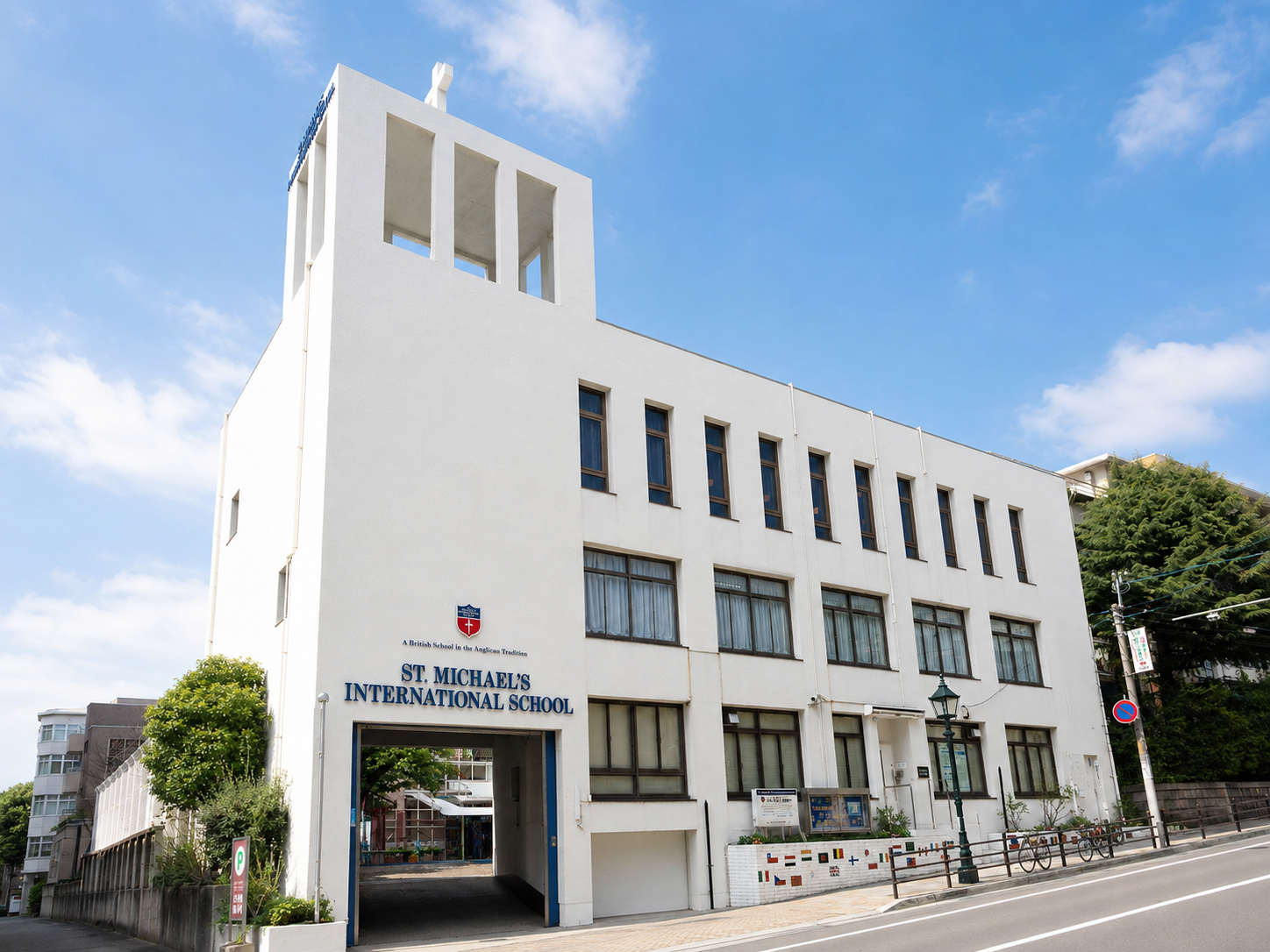
As a rare school in the Kansai region offering serious British-curriculum primary education from early childhood, Early Years (ages 3–5) explicitly welcomes English beginners.
However, there are two critical structural factors that prospective families must understand before enrollment. First, the school concludes at Year 6 (ages 10–11), which means families must select a next school around age 11 (such as reapplying to another Kobe international school). Second, because St. Michael's is a miscellaneous school rather than a school under the School Education Act, there are significant legal constraints for transitioning to a Japanese junior high school.
This article draws on primary sources from the school's official communications, Hyogo Prefecture, accrediting bodies, and the Ministry of Education, Culture, Sports, Science and Technology, presenting a 2026-August survey of tuition, admission requirements, curriculum, reputation, and post-graduation pathways. It explains which families the school suits best. Points that could not be confirmed in public sources are marked as "unconfirmed," and we provide a checklist of questions to raise during a school visit.
About St. Michael's International School: A British-Curriculum Primary International School in Central Kobe
The school's origins trace back to the English Mission School, established in 1893 at the same location. It was reconstituted in its current form in 1946 by Bishop Shinzuke Yashiro (later the Primate of the Anglican Church in Japan) and Miss Leonora Edith Lea. The school identifies itself as "an international school in the Anglican tradition, following the British curriculum," and continues to hold traditions such as St. Michael's Day chapel services and graduation ceremonies in the cathedral (details on the hours of religious education are not public).
Located at 3-17-2 Nakayamate-dori, Chuo-ku, Kobe, the school is in an urban setting within walking distance of Sannomiya and Motomachi, with school buses also available (first-come, first-served; no buses after afterschool). The school serves ages 3–11 (Nursery through Year 6) and has no secondary division. While the school does not publish total enrollment, The Good Schools Guide, an independent British schools directory, lists 142 students as of 2026—making it a small school.
Both class teachers and specialist staff hold British teaching qualifications (or internationally equivalent credentials) and a minimum of two years' experience in British-curriculum schools, with the school indicating that staff are primarily from the UK.
Accreditation Status: A Precise Breakdown
When considering a small school, external accreditation is the most critical indicator of educational quality and governance. As of August 2026, confirmed primary source information shows the following:
Organization | Status | Details |
|---|---|---|
CIS (Council of International Schools) | Accredited | Accredited since 2007; reaccredited January 2024 |
COBIS (Council of British International Schools) | Accredited Member | Obtained November 2020, via CIS accreditation pathway |
ICA (International Curriculum Association) | Accredited | June 2019; school describes this as "Japan's first" |
WASC | Accreditation not confirmed | The school website mentions connection with WASC, but accreditation cannot be verified on WASC's official accreditation directory |
A critical note: secondary sources often describe the school as "WASC-accredited," but primary sources do not confirm this as of now. The accurate reference is CIS, COBIS, and ICA accreditation. These accreditations do not guarantee academic outcomes; rather, they attest that the school undergoes ongoing external evaluation of educational quality, school governance, and child safeguarding.
St. Michael's is classified as a miscellaneous school recognized by Hyogo Prefecture, not a school under Article 1 of the School Education Act. This distinction is directly relevant to the issue discussed later: "returning to a Japanese junior high school." For broader guidance on choosing an international school in the Kansai region, please see our international school selection guide.
International School Selection Guide for the Kansai Region: Comprehensive Comparison of Leading Schools in Osaka, Kobe, and Kyoto [2026 Edition]
Curriculum: British Approach × IEYC/IPC and Misalignment with Japanese Grade Levels
The British Framework
Early Years (ages 3–5) is built on the English EYFS (Early Years Foundation Stage) paired with the theme-based international early childhood curriculum IEYC. Primary (Year 1–6) combines British-style subject learning in English and mathematics with cross-curricular topics through IPC (International Primary Curriculum, structured in 4–8 week units covering science, history, geography, and the arts). English instruction begins systematically with phonics in Early Years and progresses to more complex reading by the end of Year 2. The school publishes clear learning progressions.
Assessment combines ongoing formative evaluation in daily learning. Most students receive formal assessments in English, mathematics, and science at the end of each term. In Year 4–6, students sit the ISA (International Schools Assessment) each spring, an external benchmark test covering reading, writing, and mathematical literacy.
For an explanation of the British curriculum system as a whole (Key Stages and year structures), see our guide to British education frameworks.
The UK School System Explained: A Guide for International Families on Public, Private, and International Schools
The Easily Overlooked "One-Year Grade Offset"
The most important caution about the British system is grade correspondence. The school's admission guidance translates to Japanese grades as follows:
St. Michael's Year Level | Age | Japanese Grade Equivalent |
|---|---|---|
Nursery | 3–4 years | Kindergarten Year 1 |
Reception | 4–5 years | Kindergarten Year 2 |
Year 1 | 5–6 years | Kindergarten Year 3 |
Year 2 | 6–7 years | Grade 1 |
Year 4 | 8–9 years | Grade 3 |
Year 6 (Final Year) | 10–11 years | Grade 5 |
In other words, students who complete Year 6 are approximately one grade level younger in age than students who complete Japanese elementary school (actual grade placement varies by birth date and enrollment history). There is no simple transition such as "graduate and go directly to Japanese junior high school," so families should note this table carefully when planning post-secondary pathways.
Japanese Language and EAL Support
For Japanese families and families in international marriages, a significant feature is that St. Michael's has a dedicated Japanese language program. In Year 1, students are grouped by language proficiency level and taught by Japanese language specialists. In Year 2–6, groups are formed based on proficiency within each year level. Advanced groups use Japanese elementary school ("kokugo") materials. Adapted curricula and differentiated enrichment are available for beginners. However, the weekly hours devoted to Japanese instruction are not public, and there is no guarantee that students will complete Japanese language arts at the same pace as Japanese elementary school. Families planning for Japanese junior high entrance exams should plan for supplementary Japanese instruction.
For students whose home language is not English, ELL (English Language Learners) support is provided within regular classes, but admission capacity is limited.
Tuition: 2026–2027 Academic Year and First-Year Total Cost
The school publishes the following tuition schedule for the 2026–2027 academic year (effective 1 August 2026):
Fee Category | Nursery | Reception | Year 1–6 |
|---|---|---|---|
Application Fee | ¥50,000 | ¥50,000 | ¥50,000 |
Enrollment Registration Fee | ¥100,000 | ¥300,000 | ¥300,000 |
Annual Facilities Maintenance Fee | ¥180,000 | ¥180,000 | ¥180,000 |
Annual Insurance | ¥6,400 | ¥6,400 | ¥6,400 |
PTA Membership (per family) | ¥5,000 | ¥5,000 | ¥5,000 |
Annual Tuition | ¥1,410,900 | ¥1,410,900 | ¥1,599,000 |
Tuition includes teaching materials, stationery, swimming instruction, and one annual excursion. Payment is typically made in two installments (July and January). Families with multiple children receive a 15% discount on tuition for the second and subsequent child. Based on published fees, the first-year total cost estimate is approximately ¥1.76 million for Nursery, ¥1.96 million for Reception, and ¥2.14 million for Year 1–6.
However, two points require attention.
First, regulations stipulate that Year 1 entrants and new Year 2–6 students must pay a one-time Technology Fee, but the 2026–27 amount is not listed in public materials.
Second, uniforms, school bus fees, afterschool programs, and lunch (Cezar's Kitchen bento ordering at ¥580–680 per meal) are additional costs. Therefore, the approximately ¥2.14 million above represents "the minimum confirmed from public information." Families must request a detailed estimate from the school before applying. Note that mid-year admissions are charged tuition on a monthly-prorated basis, which is useful for families with reassignments or relocations.
For comparison, Canadian Academy in Kobe (2026–27) charges ¥2.71 million in tuition alone for Grades 1–5; including new-student fees, the first-year total for major categories exceeds ¥4.1 million. St. Michael's offers a lower price point among Kobe's major international schools, but families should understand that Year 6 is the final year, so the fee structure differs fundamentally from a dual-curriculum or secondary-inclusive school.
Admission Requirements: Japanese Families, English Proficiency, and Application Process
Japanese families may apply. The admission policy explicitly states "welcoming children of all nationalities," with no publicly stated nationality quotas or restrictions. The determining factor is not nationality but rather ability to adapt to a British-curriculum, all-English environment. Age-specific English requirements are understood as follows:
- Early Years (ages 3–5): English beginners are explicitly welcomed. However, age-appropriate language development in the child's home language is expected.
- Year 1: Lacking international preschool experience, an international preschool background or one parent being a native English speaker is described as "advantageous" (not an absolute requirement).
- Year 2–6: Students are expected to manage all-English instruction, and the school does not assume zero English entry at these levels. (Separately, the school offers an individually designed immersion program for Year 5–6 students transferring with limited English from overseas; fees on request).
Regarding parents, report cards and conferences are conducted entirely in English, so it is considered "helpful" if at least one parent can communicate in English. No formal score requirement exists, and the school provides English classes for parents; however, families expecting to conduct all school communication in Japanese should be aware of the burden.
Applications are submitted online with an application fee, photographs, past report cards, and a teacher recommendation. Applicants proceed to an interview and assessment (Year 2–6 applications require a transcript; trial attendance may be requested in some cases). New-year applications typically open around January; if enrollment exceeds capacity, applicants enter a waitpool. Mid-year admission is possible if spaces become available. Grade-level availability is not public, so direct inquiry is necessary.
Post-Graduation Pathways: Exit Planning for a School That Ends at Year 6
This is the largest consideration when evaluating St. Michael's. The school does not publish a list of graduate destinations. Based on available information, we summarize each pathway:
Pathway 1: Transition to a Kobe International School (Reportedly the Most Common Path)
The independent Good Schools Guide notes that many graduates transition to international schools in the Kobe area, citing Canadian Academy and Marist Brothers International School as examples (this is third-party research, not an official school statistic).
Age-wise, St. Michael's Year 6 to Canadian Academy's Grade 6 (MYP) is a natural progression; however, both schools conduct standard admissions through documentation, interview, and testing, and no automatic promotion or formal priority admission is confirmed. Spaces may not be available, and applicants may enter the waitpool. See individual school reviews for details.
Pathway 2: Returning to a Japanese Junior High School (Legal Verification Essential)
This is the pathway requiring the most careful attention for Japanese families. The Ministry of Education, Culture, Sports, Science and Technology has stated that enrollment at an international school that is not an Article 1 school does not fulfill compulsory education obligations under the School Education Act, and that graduates of a non-Article 1 elementary division are generally not permitted to enroll in an Article 1 junior high school. St. Michael's, as a miscellaneous school, falls squarely within this category.
Additionally, as noted earlier, Year 6 completion corresponds to approximately Grade 5 age in Japan. Families with any possibility of returning to the Japanese school system should, by no later than Year 4–5, individually confirm with their local education board and any target schools (1) at what point to transfer to an Article 1 school, (2) what grade level the board will assign at transfer, and (3) whether the desired private junior high school's admissions criteria accept their background. Private school entrance-exam criteria vary considerably; eligibility for "returnee" (帰国生) admissions is not standardized across institutions.
Pathway 3: Continuing British Curriculum
In the British system, the step after Year 6 is Year 7. No private school in the Kansai region offers British-curriculum secondary education as a day-student progression. Options are limited to UK boarding schools or domestic boarding schools such as Harrow Akiu (Iwate, boarding-only).
Harrow Appi: Fees, Ranking & Reputation? First Graduates' University Placements & Expert Admission Tips [2026 Edition]
Across all pathways, a shared reality is that St. Michael's is a "Year-6-terminal British primary school," requiring families to plan the next educational step from the point of enrollment. School guidance structures (progress counseling, recommendation procedures) are not detailed in public sources and should be a top priority to confirm during a visit.
Reputation and Reviews: Strengths and Limitations of a Small School
The third-party assessment with the highest reference value is the independent review by The Good Schools Guide, which highlights parents' appreciation for structured learning, a family-like environment, and British character.
The school itself champions the vision of a "small school with a big heart," emphasizing its system of placing British-trained class teachers and assistants in each classroom, as well as its multi-generational alumni community. On child safeguarding, the school publishes detailed policies based on international standards (ITFCP and JCIS), including locked gates, visitor badges, and a 24-hour reporting requirement—reassuring measures for a small school.
However, there are important considerations to note.
First, as mentioned repeatedly, the school ends at Year 6. Compared to Canadian Academy, Marist, and Kansai International School—which offer continuous education through secondary—this is not a matter of educational quality but a structural difference in the school model.
Second, as a small school in the city center, families seeking expansive integrated campuses may find it limiting (the school's admissions policy also explicitly notes that the buildings are not fully accessible).
Families for Whom This School Is—and Isn't—a Good Fit
Families likely to be well-suited
- Those seeking to develop English literacy from the early years (ages 3–5) through explicit British methods (phonics, EYFS, and National Curriculum) rather than an IB-based approach
- Those who prioritize a small, family-like environment and substantial teacher support
- Those who value convenience of commute from Sannomiya and Motomachi
- Those prepared to accept that school selection begins again at age 11 (and may actually prefer to keep options open)
- Those where at least one parent can manage school communications in English
Families who should consider carefully
- Those wishing to continue at the same school through upper secondary (→ in Kobe, IB integrated schools would be the comparison point)
- Those prioritizing re-entry to Japanese secondary schools and state-school systems as the primary goal (→ confirmation of compulsory education requirements and application eligibility comes first)
- Those who wish to manage school communications exclusively in Japanese
- Those enrolling after age 6 with children whose English is virtually non-existent
Questions to Confirm During School Tours and Information Sessions
These are important matters not fully covered in published materials. Listed in order of importance:
- Recent graduates' destinations (number of students per school, track record of admission to Canadian Academy and Marist, and the mechanism of recommendations and support)
- Technology Fee amount and total out-of-pocket expenditure for the first year, including uniforms and school bus costs
- Availability of the desired year level and actual wait pool status
- Class size, total student population, proportion of Japanese families, and availability of ELL support spaces
- Weekly hours of Japanese instruction and alignment with the Japanese language curriculum
English Preparation Before and After Admission
English preparation for families considering admission to St. Michael's varies depending on the child's entry age. Admission from Early Years welcomes children with minimal English; however, entry at Year 2 or beyond requires the foundational ability to learn through English as a prerequisite for assessment.
The later the timing of arrival, the more critical the child's English maintenance and development becomes to admission eligibility. The English required also depends on post-graduation pathways. For families proceeding to an international school in Kobe, English assessment preparation is essential; for those returning to Japanese schools, sustaining English while managing Japanese language and entrance exam preparation becomes the challenge.
ELT is an English school founded in London in 1984. With native-speaking instructors holding teaching credentials (CELTA/DELTA) and master's degrees, we provide fully dedicated one-to-one instruction tailored to your family's circumstances and educational goals. We offer guidance on preparation for entry to British-curriculum schools, maintaining English proficiency after repatriation, and English for school communications—all adapted to your specific situation.
If You Choose British Education, Plan the Exit Strategy Too
St. Michael's International School is a rare choice in the Kansai region, offering authentic British primary education in a small, highly supportive environment in central Kobe. CIS and COBIS accreditation externally assures educational quality, and admission from Early Years is open to children with no prior English.
However, choosing this school also means simultaneously accepting "school selection again at age 11" and "the institutional implications of choosing a non-compulsory-education primary school." With the same weight given to tuition and reputation, mapping your vision for your child's post-graduation pathway before admission is the key to making the most of this school.
If you would like to discuss English preparation before admission or English learning tailored to your child's educational path, ELT's specialist counselors are here to guide your family according to your circumstances.

![International School Selection Guide for the Kansai Region: Comprehensive Comparison of Leading Schools in Osaka, Kobe, and Kyoto [2026 Edition]](/_next/image?url=https%3A%2F%2Fstorage.googleapis.com%2Felt-microcms-ai-automator-og-images%2Fcolumns%2Fkansai-international-school-guide%2Fen.png%3Fv%3D1786597029102&w=3840&q=75)
![Harrow Appi: Fees, Ranking & Reputation? First Graduates' University Placements & Expert Admission Tips [2026 Edition]](/_next/image?url=https%3A%2F%2Fstorage.googleapis.com%2Felt-microcms-ai-automator-og-images%2Fcolumns%2Fharrow-appi-japan-review%2Fen.png%3Fv%3D1781936105811&w=3840&q=75)
