


When considering an international school or an IB World School, one of the first terms you'll encounter is the 'PYP (Primary Years Programme)'.
This primary education programme for ages 3-12 takes a completely different approach from traditional, subject-based education, which often leads to common concerns from parents:
- "Is it true there are no subject-specific textbooks? How do children learn math or language?"
- "When I hear 'inquiry-based learning,' I worry it might just look like unstructured play…"
- "Without traditional drills like worksheets for spelling and math, will my child be able to keep up with their studies in middle school and beyond?"
To put it simply, the PYP is not just unstructured free time. It is a highly structured, world-class curriculum that systematically develops 'Concepts' and 'Skills for learning.'
In this article, we will provide an expert's perspective on the PYP framework, offer concrete examples of transdisciplinary learning, and reveal the truth about academic achievement as proven by data.
1. The Core of the PYP: What Are the Six 'Transdisciplinary Themes'?
The most distinctive feature of the PYP is that the timetable is not structured around separate subjects like 'Language,' 'Math,' and 'Science.'
Instead, learning is organized around six 'Transdisciplinary Themes.'
The Six Universal Themes
In the PYP, students explore the following six themes every year, delving deeper as they advance through the grades.
- Who we are: The self, family, human relationships, rights and responsibilities, etc.
- Where we are in place and time: History, geography, human migration, etc.
- How we express ourselves: Language, arts, culture, emotional expression, etc.
- How the world works: Laws of the natural world, science and technology, societal impact, etc.
- How we organize ourselves: Social systems, economics, organizations, decision-making, etc.
- Sharing the planet: Environmental issues, resource allocation, peace, coexistence, etc.
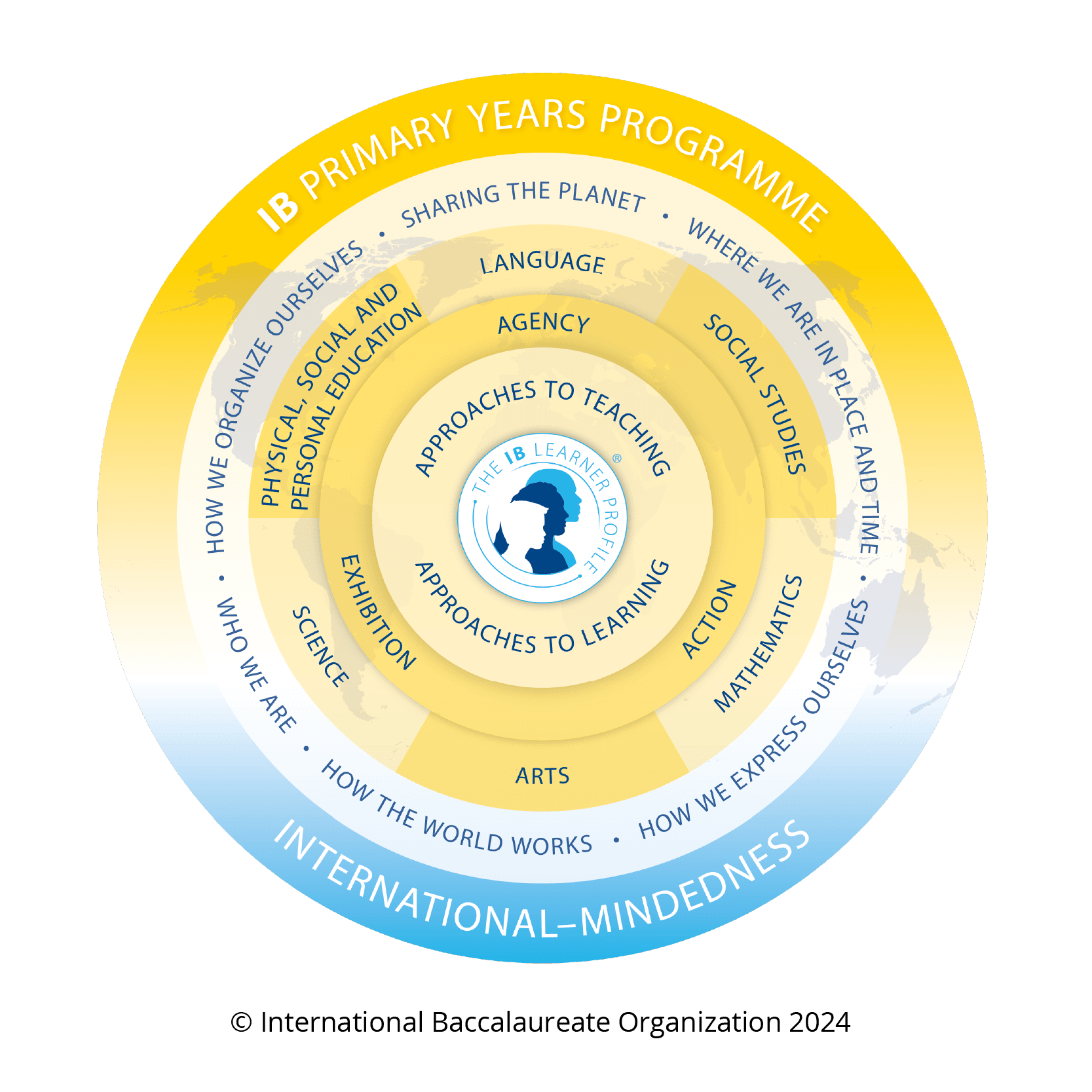
Source: International Baccalaureate Organization
How Are Subjects Integrated?
What does it mean to "learn subjects within a theme"?
Let's take a Unit of Inquiry on "Environment and Sustainability" under the theme of "Sharing the Planet" as an example.
Subject | Learning Activities in This Unit (Examples) |
Science | Conduct scientific experiments and observations on the mechanisms of global warming and ecosystem services. |
Math | Collect climate change data and perform graphing and statistical analysis (e.g., tracking average temperature trends). |
Language | Read and comprehend literature on environmental issues (reading comprehension) and write a persuasive opinion piece (Opinion Writing) summarizing their research findings. |
Social Studies | Investigate global environmental protection initiatives and local community challenges, and discuss potential solutions. |
Art | Design posters to convey an environmental message or create artwork using recycled materials. |
As you can see, in the PYP, students don't create a graph just because it's 'math time.' Instead, they use math (graphing) because data analysis is necessary to solve an environmental problem.
Because knowledge is not siloed but linked to real-world issues, it becomes established as 'deep learning.'
2. Teaching Style: The Inquiry Cycle and Student-Led Learning
In a PYP classroom, you rarely see a teacher standing at the front of the room, lecturing. Instead, children drive their own learning by following an 'Inquiry Cycle.'
The 4 Steps of the Inquiry Cycle
- Question: Before the teacher provides answers, children generate their own questions like 'I wonder why?' or 'I want to know more.'
- Research: They gather information themselves using books, the internet, experiments, and interviews.
- Organize & Conclude: They analyze the information they've collected to draw their own conclusions.
- Take Action: They connect their learning to the real world by giving presentations or taking action, such as organizing a community clean-up.
Student Agency
A key component of this process is 'Student Agency.'
Students are encouraged to have 'Voice, Choice, and Ownership' over what and how they learn.
This experience of 'learning because I chose to,' rather than 'learning because I have to,' fosters high self-esteem and a lifelong love of learning.
3. The Scientific Answer: Are Core Academic Skills Developed?
Regarding the most common parental concern—'Will my child develop core academic skills without drills?'—global research data provides a clear answer.
Conclusion: PYP students perform at or above standard academic levels.
- Results from the International Schools' Assessment (ISA):
A study from 2009-2011 showed that PYP students achieved higher scores than non-IB students in all areas: 'Math,' 'Reading,' and 'Writing.'
- Science Performance (Australia):
In a nationwide assessment, students at PYP schools scored above the national average in science.
Why Do They Achieve These Results?
The PYP does not neglect knowledge. The knowledge required by national curricula is skillfully integrated into the six themes (in the Programme of Inquiry, or POI).
Because students understand concepts deeply rather than through rote memorization, they can apply their knowledge effectively and perform well on assessments.
Furthermore, the PYP assesses not only knowledge but also 'Approaches to Learning' (ATL) skills.
- Thinking skills
- Communication skills
- Social skills
- Self-management skills
- Research skills
These are the transferable skills considered most crucial in the age of AI, where specific knowledge can quickly become obsolete.
4. The PYP Culmination: The Exhibition
In the final year of the PYP (Grade 5 or 6), students undertake a culminating project known as the 'PYP Exhibition.'
This is far more than a simple presentation. It is a 'capstone project' where students choose a real-world issue (such as poverty, discrimination, or the environment), conduct research as a team over several months, and propose solutions.
- Research Skills: Conducting literature reviews and interviewing experts.
- Collaboration Skills: Engaging in team discussions and reaching a consensus.
- Presentation Skills: Delivering a logical presentation in English and handling a Q&A session.
After completing the Exhibition, students possess research skills and confidence comparable to middle schoolers, ready to transition to the next stage of their education (such as the MYP or another middle school program).
5. Maximizing PYP's Impact: The Role of Home and ELT
The PYP is an outstanding curriculum that fosters the ability to tackle open-ended problems—a crucial skill for the future.
However, due to its high degree of freedom, there is a risk that without a solid foundation in language (English) and inquiry skills, the experience can end up feeling like 'just play.'
Especially for children for whom English is a second language,
- "Lacking the English proficiency to participate in discussions."
- "Not knowing how to conduct research, leading to simply copying and pasting from the internet."
they may encounter challenges such as:
ELT's Approach
At ELT, we support children in the PYP to help them fully enjoy inquiry-based learning by building their foundational 'Inquiry Fitness.'
- Strengthening Academic English: We teach the vocabulary and logical writing structures necessary for inquiry.
- Mentoring the Inquiry Process: For Exhibitions and Unit of Inquiry projects, we guide students on how to formulate questions and conduct research, helping them become independent learners.
To make the most of the excellent learning environment the PYP provides.
We invite you to take advantage of our individualized inquiry support, which complements what is offered at school.


![The Complete Guide to International Baccalaureate (IB): Understanding PYP, MYP, and DP, Subject Selection, and University Admission [2026 Edition]](/_next/image?url=https%3A%2F%2Fstorage.googleapis.com%2Felt-microcms-ai-automator-og-images%2Fcolumns%2Fib-curriculum-guide%2Fen.png%3Fv%3D1775750383600&w=3840&q=75)


