


As a parent, are you satisfied with your child simply memorizing words like "Hello" and "Apple" or playing fun-only games in their English classes? Of course, becoming familiar with English is important. However, in an era of advancing AI translation, the skill of merely "speaking English" is becoming a commodity.
The approach that is now becoming the standard in education worldwide is one that "develops the ability to think 'in' English, rather than just learning 'about' English."
The method that makes this possible is CLIL (Content and Language Integrated Learning), which originated in Europe. This article will explain how CLIL works, its scientifically-proven learning benefits, and provide perspectives on how to choose an authentic CLIL program in Japan.
What is CLIL?
CLIL is an educational approach proposed in 1994 by David Marsh and others in Finland. It is defined as "a dual-focused approach in which a subject (like math, science, or social studies) is taught through a foreign language (such as English)."
While traditional English education (EFL: English as a Foreign Language) focuses on acquiring grammar and vocabulary, CLIL's primary focus is on "using English to learn intellectual content (such as math and science)."
Why is CLIL Effective?
The human brain, especially in children, has the capacity for incidental learning—acquiring language subconsciously while immersed in meaningful content. Instead of tedious syntax drills like "This is a pen," CLIL stimulates intellectual curiosity (Content) with questions like, "Why does ice float on water?" This transforms English from an object of study into a tool for learning.
The "4Cs" Framework of CLIL
What sets CLIL apart from simple "English immersion" is its systematic theoretical foundation. Let's look at the "4Cs Framework," a concept also promoted by experts such as Professor Makoto Ikeda of Sophia University.
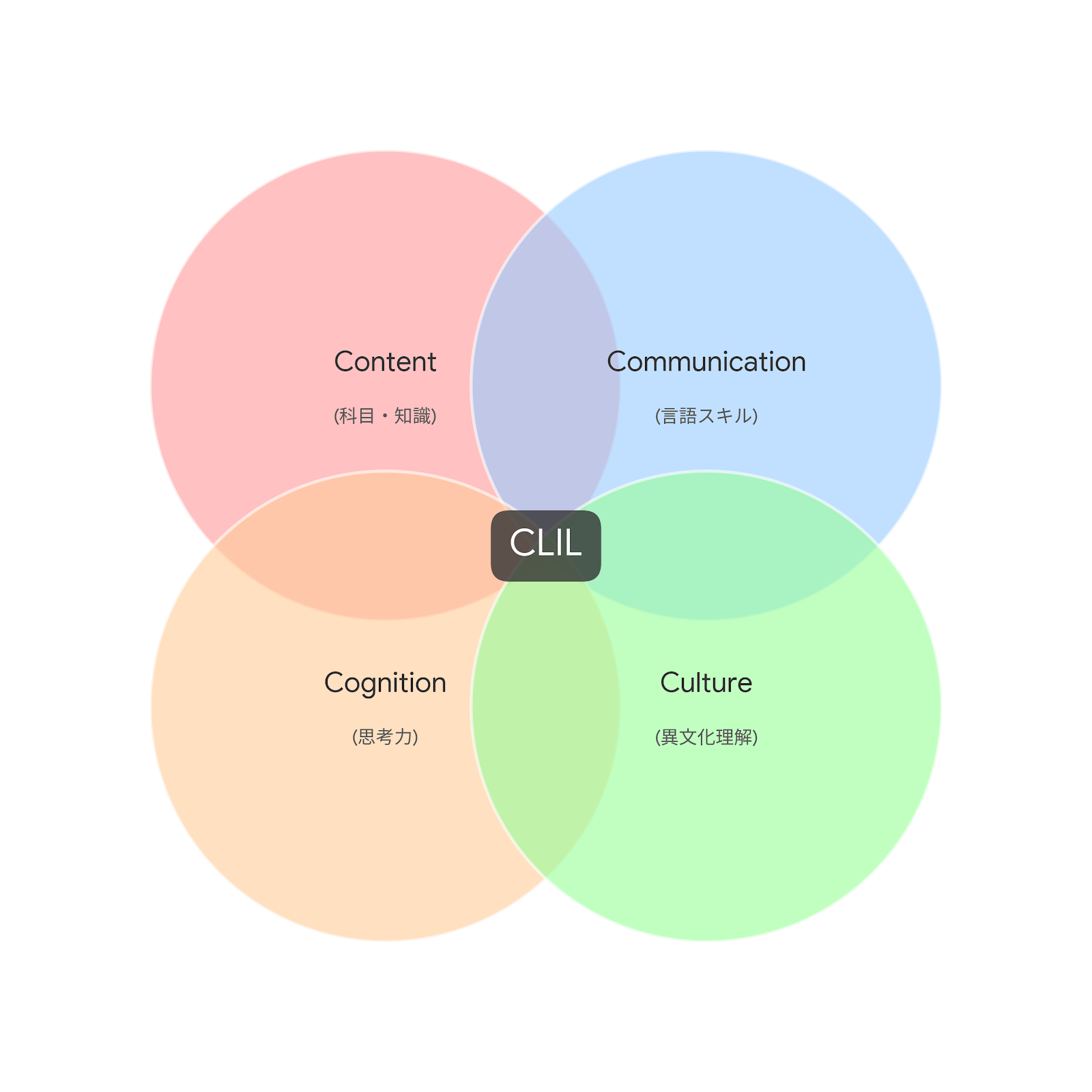
The Four Elements of CLIL (4Cs Framework)
- Content: Subject knowledge such as math, science, and history.
- Communication: The four skills of reading, writing, speaking, and listening.
- Cognition: Thinking skills like comparing, classifying, and reasoning. This is the most crucial element.
- Culture: Intercultural understanding and diverse perspectives.
The Critical Role of Cognition
Traditional English conversation classes often focus on "lower-order thinking," such as remembering. In contrast, CLIL engages students in "Higher Order Thinking Skills (HOTS)" in English, asking questions like, "What is the difference between this triangle and that one? (analysis)" or "What would happen if...? (hypothesizing)." Combining this kind of deep, mentally engaging thought with language learning dramatically improves retention.
The Difference Between "Playful English" and "Authentic Learning": Soft vs. Hard CLIL
In Japan, an increasing number of schools claim to offer "CLIL," but they generally fall into two distinct types. It is crucial to understand this distinction.
Feature | Soft CLIL | Hard CLIL |
|---|---|---|
Primary Content | Crafts, cooking, songs, and simple daily routines in English | Academic subjects like math, science, social studies, and history |
Time Allocation | Language Learning > Content Learning | Content Learning ≥ Language Learning |
Objective | To become familiar and comfortable with English | To improve academic ability and thinking skills; to acquire academic English |
Situation in Japan | Most English conversation schools fall into this category | A minority, including international schools and programs like ELT |
For Developing Thinking Skills, "Hard CLIL" is the Clear Choice
While "Soft CLIL" can be a good introduction, activities like crafts and cooking have limitations when it comes to developing "Cognition" (deep thinking). To satisfy your child's intellectual curiosity and equip them with the Cognitive Academic Language Proficiency (CALP) needed for future success in international schools or universities abroad, a "Hard CLIL" approach that covers subjects like math and science is essential.
3 Key Benefits of CLIL for a Child's Brain
- Enhanced Cognitive Flexibility: Research shows that processing different languages and thoughts simultaneously strengthens the brain's executive functions, improving skills in multitasking and problem-solving.
- Sustained Motivation: Few children are excited by the command, "Study English." However, "discovering the secrets of dinosaurs in English" or "solving math puzzles in English" becomes a fun "inquiry" for a child.
- Builds Academic Confidence: The experience of "I did math in English!" gives a child a powerful sense of self-esteem. This is a type of confidence that cannot be gained from casual conversation alone.
Where to Find Authentic CLIL in Japan
Implementing Hard CLIL requires instructors who not only have high English proficiency but also the "pedagogical skills to teach academic subjects." A typical English conversation teacher would find it difficult to teach mathematical concepts or scientific experiments, which is why authentic CLIL programs are limited in Japan.
ELT's Approach: British Curriculum × Hard CLIL
ELT is one of the few schools in Japan that offers "Hard CLIL" online.
- Use of British Textbooks: We use textbooks designed for native speakers from publishers like Oxford University Press (for Math, Science).
- Instruction by Professional Tutors: Our tutors, who have a track record of teaching children of expatriates in London, teach subjects 'in' English.
- Focus on Thinking Skills: Rather than just memorizing terminology, we constantly ask "Why?" to cultivate logical thinking skills.
Reference: What are the Benefits of Learning with the British Curriculum?
Conclusion: Towards an Era Where "Learning in English" is the Norm
In an age where AI handles translation, the value of simple "English chatter" will decline. However, the "ability to gather information, think logically, and debate using English" is a core human skill that AI cannot replace.
It's time to graduate from the stage of "learning English" and enter the world of "learning in English." We encourage you to let your child experience a CLIL education that harnesses their intellectual curiosity as a powerful tool.


