


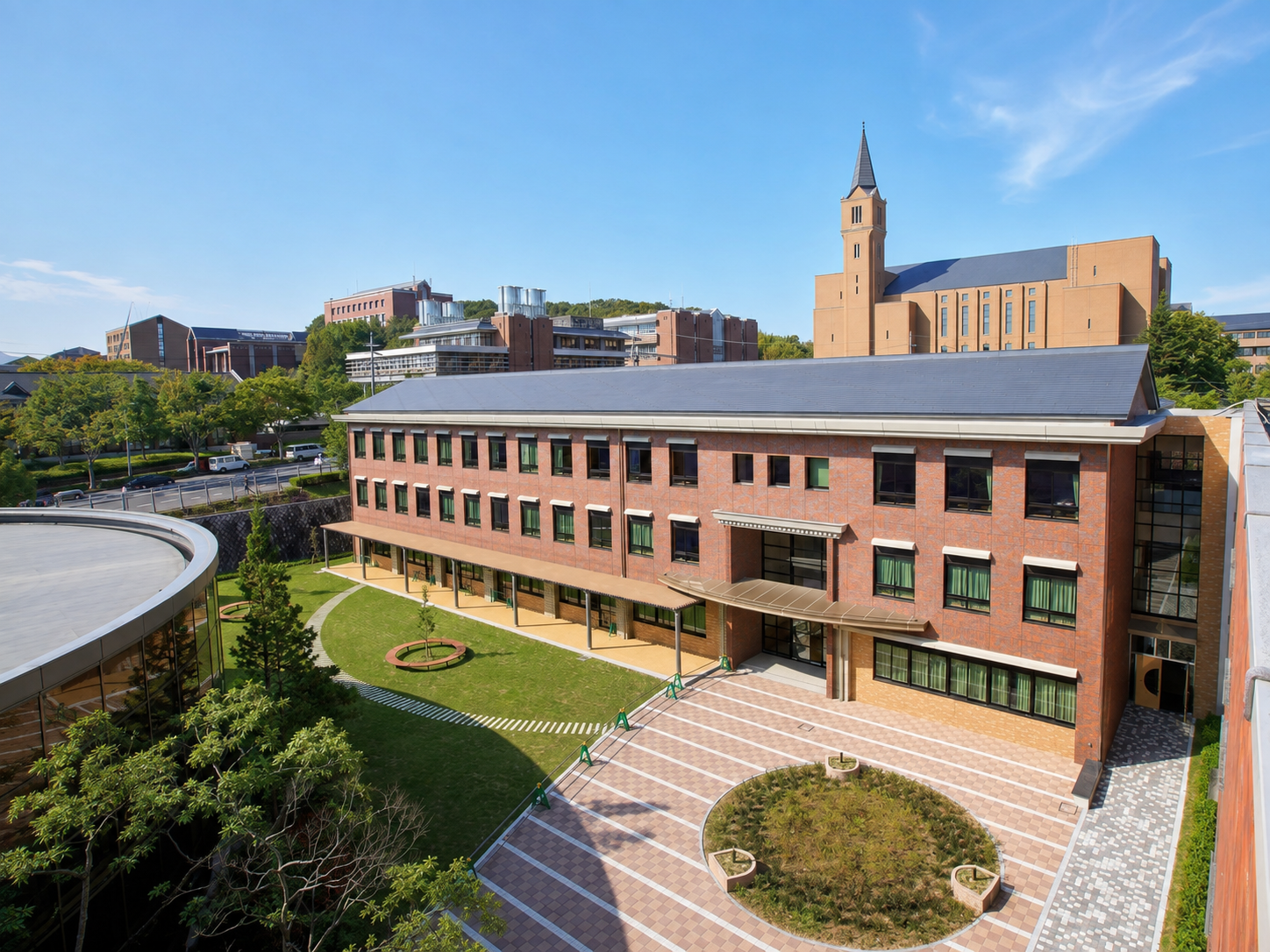
Doshisha International School (Junior and Senior High School) is a combined junior-senior high school under the Doshisha Educational Foundation, located in Kyotanabe, Kyoto Prefecture (a private junior and senior high school as defined under Article 1 of the School Education Act).
Established in 1980 with the purpose of accepting returnee students, it is a pioneer in returnee education in Japan. As of April 2026, among the 1,215 students in the combined school, 682 are returnees (56.1%). Though not an IB school, it offers English instruction across six proficiency levels, six languages to choose from, mid-year transfer entrance exams, high school educational dormitories designed with overseas-based parents in mind, and internal recommendations to Doshisha University and Doshisha Women's University (with over 90% advancing according to school information)—a complete system of support for returnee families integrated into a single school.
To summarize upfront: For families seeking "the design to maintain languages acquired overseas while readapting to Japanese school life and progressing toward the stable outcome of the Doshisha network," this is one of the most fully realized options in the Kansai region. However, there are three preliminary considerations.
First, the returnee entrance exams have entirely different competitive structures between Track A (foreign language essay/qualification type) and Track B (Japanese-style subject exams), and the choice of which to apply through significantly affects pass/fail outcomes.
Second, the detailed rules regarding whether students can maintain their Doshisha University recommendation while applying to other universities or overseas universities are not publicly disclosed. Third, following a major accident during a study trip in March 2026, the safety management system is currently undergoing reconstruction.
This article organizes entrance exams, transfers, English education, tuition, dormitories, and university placement results based on the school's official 2027 recruitment guidelines, school data, and August 2026 research from the Doshisha Educational Foundation's official materials. Information is presented with distinctions between what is publicly confirmed, what is not confirmed, and opinions (word-of-mouth).
Doshisha International: A Pioneer School in Returnee Education
Against the backdrop of the 1970s, when education for returnee children became a social issue, Doshisha International was conceived as part of Doshisha's 100th anniversary projects and opened its senior high school in 1980 as a "specialist school for accepting returnee students" designated by the Ministry of Education (the junior high opened in 1988). Unlike typical affiliated schools that later added an international track, accepting returnees itself is the foundational purpose—a decisive difference from other junior-senior high schools within the foundation such as Doshisha Chukoh and Doshisha Kori. The educational foundation is rooted in Doshisha's Christian principles (Protestant tradition).
The school is located on the Kyotanabe campus (Tatara-tsuya, Kyotanabe City), adjacent to the Doshisha University Kyotanabe campus.
The school is often described as "two-thirds returnee students," but the latest actual numbers are as follows (as of April 1, 2026—official school data).
Category | Returnee Students | Domestic General Students | International Students | Returnee Ratio |
|---|---|---|---|---|
Junior High School (392 students) | 193 | 197 | 2 | 49.2% |
Senior High School (823 students) | 489 | 328 | 6 | 59.4% |
Combined (1,215 students) | 682 | 525 | 8 | 56.1% |
The school's educational introduction pages retain language suggesting "approximately two-thirds are returnees," but as of 2026, the actual enrollment is 56.1%.
Meanwhile, the 2027 recruitment design (Grade 7: approximately 55 returnees and 25 domestic students / Grade 10: approximately 90 returnees and 45 domestic students, with returnees comprising roughly 70% in each cohort) shows that the design philosophy of "a school centered on returnees" remains clear. For an overview of the full landscape of international education in schools under the School Education Act, please also see our explanatory article.
What are "Almost-International Schools"? A Guide to Japan's Article 1 International Courses for University Abroad at a Quarter of the Cost
Note: "Doshisha International School, Kyoto" listed in the IBO directory is a different school. Doshisha International Junior and Senior High School in Kyotanabe is not an IBDP school (this distinction will be addressed in the English education section).
Returnee Entrance Exams and Transfers: Track A and Track B Have Different Structures
Application Eligibility
For the 2027 admission year, returnee status is determined by combining nationality/residency requirements with overseas residence history requirements.
The residency requirement is generally "18 months or more of overseas residence," and the period from final return to the exam date must not exceed the overseas residence period (or meet alternative conditions for long-term overseas residents). The residence period includes time living with parents for three or more consecutive months. Students attending full-time Japanese schools overseas as well as those at local schools or international schools are considered. Senior high has a pathway recognizing extended residence during elementary school, and the conditions are not identical to those for junior high. Because the system cannot be simplified to "up to ○ years after returning," individual cases require verification in the recruitment guidelines.
Selection Method: Which Track You Apply Through Is the Critical First Decision
Category (2027) | Content | Japanese Language Treatment |
|---|---|---|
Grade 7 Track A ⟨Exclusive⟩ | English qualification (TOEFL iBT 68 or higher, EIKEN Grade 1 or equivalent, TOEIC 730 or higher, IELTS 5.5 or higher, etc.) + document review + interview | Interview conducted in Japanese (with parents) |
Grade 7 Track A ⟨Concurrent⟩ | Foreign language essay (in a language other than Japanese acquired during overseas residence) (60 minutes, 2 sheets of B4 paper) + documents + interview | Japanese not permitted in essay; interview conducted in Japanese |
Grade 7 Track B ⟨Concurrent⟩ | Japanese, Mathematics + one subject from Science, Social Studies, or English (each 50 minutes, 100 points) | Written Japanese exam included |
Grade 10 Special Recommendation | Language qualification type (TOEFL iBT 79 or higher, EIKEN Grade 1, TOEIC 780 or higher, IELTS 6.5 or higher, etc.; advanced qualifications in German, French, Spanish, Chinese, and Korean also accepted) or junior high school grades type | Online interview possible if overseas residence makes in-person interview difficult |
Grade 10 Track A | Foreign language essay (60 minutes, 2 sheets of B4 paper) + documents + interview | Interview conducted in Japanese |
Grade 10 Track B | Japanese, Mathematics, English (each 50 minutes, 100 points) | Written Japanese exam included |
Importantly, applicants can take exams in languages other than English. The Track A essay/thesis is "in a foreign language other than Japanese acquired during overseas residence," and for the senior high special recommendation, advanced qualifications in German, French, Spanish, Chinese, and Korean are also recognized. The exam system itself reflects that this is not exclusively a school for English-speaking returnees.
However, interviews are conducted in Japanese, and Track B includes Japanese, meaning this is not a school where "students with zero Japanese can enroll" (Japanese language proficiency standards are not publicly disclosed; Japanese support curriculum is available after admission).
Acceptance Ratios: "Returnee Exams Are Easier" Depends on the Selection Track
These are acceptance ratios (calculated as applicants ÷ accepted) based on official school applicant and acceptance numbers.
Grade 7 Exam | 2024 | 2025 | 2026 |
|---|---|---|---|
Track A ⟨Exclusive⟩ | 1.36x | 1.31x | 1.72x |
Track A ⟨Concurrent⟩ | 1.75x | 5.09x | 3.00x |
Track B ⟨Concurrent⟩ | 3.00x | 3.60x | 5.25x |
Track G (Domestic General) | 3.41x | 4.32x | 5.22x |
Grade 10 Exam | 2024 | 2025 | 2026 |
|---|---|---|---|
Special Recommendation | 1.17x | 1.53x | 1.73x |
Track A | 1.69x | 3.85x | 4.38x |
Track B | 2.37x | 2.81x | 3.52x |
Track G ⟨Exclusive⟩ | 2.36x | 3.10x | 2.78x |
Recent years show an overall upward trend, with Grade 10 Track A reaching 4.38x in 2026, and Grade 7 Track B and domestic general exams exceeding 5x. Relatively lower pressure is found on the exclusive and special recommendation routes (1.2–1.7x range), where qualifications are secured beforehand.
In other words, whether language qualifications can be secured before application becomes the most critical decision point in exam strategy for this school. The 2027 Grade 7 returnee exam dates are December 8, 2026 (Track A), January 19, 2027 (Track B), and February 9, 2027 (Track A). Overseas exam sites are not offered (online interviews are available only for senior high special recommendations), and application documents must be sent from overseas via trackable international mail.
Transfers, Domestic General, and Deviation Values
Multiple transfer pathways are a major strength of this school. In addition to summer transfers (a small number for Grades 7–9 and 10–11 in 2026), the 2027 calendar shows multiple opportunities for Grades 8–9: December Track A, January Track B, February Track A, and summer (Grade 9 Track A Exclusive requires TOEFL iBT 79 or higher, EIKEN Grade 1, etc.).
However, transfer applicant numbers and acceptance ratios are not disclosed, so difficulty must be confirmed by contacting the school. Domestic general admissions allocate approximately 25 spots for Grade 7 and 45 for Grade 10, with the senior high divided into three categories: recommendation (combined grades across 9 subjects of 42 or higher), exclusive, and concurrent. Deviation values include a reference figure of 53 for Grade 7 from Nichinoken R4 (secondhand citation) and 68 for senior high from review sites, but both are reference values only; pass/fail on Track A cannot be predicted by domestic test deviation values (success depends on combined evaluation of foreign language essays, qualifications, overseas transcripts, and interviews).
English and Language Education: How Language Skills Are Maintained Without IB
Doshisha International's design does not isolate returnees into separate tracks; rather, homerooms mix returnees and domestic students, while classes are organized by proficiency level by subject.
English is offered in six levels at the junior high (Ob, Oa, Eb, Ea, Ib, Ia) and four levels at the senior high (O, Eb, Ea, I). Level O is for students with high four-skills English acquired through long-term study in English-speaking countries or international schools, with all instruction in English; Level E is for those with overseas experience; and Level I is for those with relatively limited English experience.
The junior high curriculum shows six periods per week of required English, with additional language elective slots. The senior high centers on Japanese national curriculum subjects (English Communication, Logic and Expression) while layering multiple English Electives across grades—an approach that "significantly differentiates English levels and content within Japan's high school completion requirements." Textbooks, target proficiency levels (CEFR equivalent), and class-level adjustment criteria are not publicly disclosed (these are items to confirm at school information sessions).
Another distinctive feature is multilingual education. Language selections include English, German, French, Spanish, Korean, and Chinese—six languages in total—with both continuing and beginner classes for the five non-English languages.
This design allows returnees from Chinese-speaking regions and Europe to maintain languages acquired locally, without consolidation into English alone. Student qualification achievements include DELF, DELE, Goethe Certificate, HSK, and TOPIK. Japanese language support is also systematized, with specialized curriculum and subjects such as "Japanese I and III" for students requiring Japanese instruction following extended overseas residence.
Not being an IBDP school is a design philosophy here, not a weakness. In place of IB's TOK, Extended Essay, and CAS frameworks, the school offers proprietary inquiry subjects such as Sustainable Society Study, Research, and Design, along with WL experiences. For overseas university aspirants, the school formally provides TOEFL preparation seminars, SAT/ACT test scheduling support, university recruiter briefings, and application counseling.
If the IB Diploma credential itself is required, Ritsumeikan Uji (discussed later) becomes the comparison choice; but for families wanting "language maintenance and curricular flexibility without IB's workload," this non-IB model becomes an advantage. Study abroad options include short-term, semester, and full-year programs (one-year study abroad is available only to students who progressed internally from junior high).
Tuition and Dormitory: Single-Student Return Designed into the System
Tuition is the same for junior and senior high: admission fee ¥100,000, annual tuition ¥850,000, educational enrichment fee ¥130,000 per year (base first-year total ¥1,080,000). There is no difference between returnee and domestic students; textbooks, devices, and miscellaneous fees are separate. The base tuition is roughly comparable to Ritsumeikan Uji (2026 base first-year ¥1,114,000), but Doshisha International has no large additional course fees like IB program costs.
The educational dormitory is for senior high students only (not available for junior high) and houses 96 male and 96 female students in 2–3 person rooms, with breakfast and dinner in the dormitory cafeteria. Costs are: dormitory admission fee ¥50,000, annual dormitory fee ¥480,000, air conditioning fee ¥6,000 per year, and meal costs of ¥1,900 per day (breakfast and dinner), multiplied by days of residence—a method without a set annual total.
Dormitory eligibility is for students whose parents are overseas residents or those requiring more than approximately 90 minutes to commute, with a required guarantor (an adult reachable within roughly three hours of school; if parents are overseas, a designated domestic contact outside school also qualifies). This means the pathway of a child returning alone to board at high school while parents remain overseas is explicitly designed into the system—but it is not a framework for depositing a child without domestic contact information. Curfews, weekend leave policies, availability details, and other operational rules are not publicly disclosed and must be confirmed before application.
Senior high tuition is eligible for the national tuition support grant (new system maximum ¥457,200 per year, no income limits, subject to application and domestic address requirements) from 2026. Kyoto Prefecture's educational support requires "parents or guardians resident within the prefecture" as a basic condition, so boarding students with overseas parents are likely ineligible—resource planning should not rely on this assumption.
University Placement and Internal Recommendation: Doshisha University as the Outcome
The school explains on its career guidance page that through recommendation systems to Doshisha University and Doshisha Women's University, over 90% advance to both universities. The actual numbers of students advancing through internal recommendations are as follows.
Placement Year | Doshisha University | Doshisha Women's University | Total |
|---|---|---|---|
2024 | 223 students | 1 student | 224 students |
2025 | 232 students | 2 students | 234 students |
2026 | 235 students | 4 students | 239 students |
In 2026, students are advancing to a diverse range of faculties without concentration in any particular department—Faculty of Law (43 students), Faculty of Commerce (30 students), Faculty of Economics (26 students), Faculty of Science and Engineering (25 students), and others. External pathways exist as well. In addition to recommended admission (2026: ICU 2 students, Sophia 2 students, Waseda 2 students, Rikkyo 1 student), general admission results include acceptances to Waseda, Keio, Sophia, and Osaka University.
For overseas universities, admission results listed include Princeton, Yale, UC Berkeley, NYU, and University of Toronto. However, these are offers of admission (with some students receiving multiple acceptances), and the school's Q&A explains that actual enrollment at overseas universities is "a few students each year."
The specific terms for concurrent applications—such as whether students can apply to domestic national/private universities or overseas institutions while holding their recommendation slot to Doshisha University—could not be confirmed in publicly available materials. The evaluation criteria required for the recommendation and the method for distributing slots among faculties are also not disclosed. While it is true that the school supports multiple pathways in parallel, this cannot be interpreted as "the recommendation serves as insurance while students freely apply to external institutions." This point is the highest priority question to clarify at an information session.
Reputation and Safety: Free School Culture and What Happened in 2026
Regarding school culture, the institution itself emphasizes a "free school culture," and reviews frequently mention positive sentiment toward its international character and open atmosphere (current uniform and dress code policies cannot be confirmed in public materials; please verify during a campus visit). Returnees and domestic students are mixed in homerooms, and the distribution of language proficiency is significantly broader than typical private secondary schools—whether you value this environment itself is the most significant factor determining whether this school is the right fit.
A concern raised by some is the commute distance to Kyotanabe. Reviews are voluntary submissions representing individual "opinions" and are not statistical evaluations.
On the other hand, there is a factual matter that cannot be omitted from a 2026 review. On March 16, 2026, during the high school's study trip to Okinawa, two boats capsized off Henoko in Nago City, resulting in the deaths of one student and one boat captain. In May of that year, the Ministry of Education, Culture, Sports, Science and Technology evaluated the school's safety management as "significantly inappropriate," citing insufficient pre-activity safety confirmation and student safety instruction. The ministry also indicated that certain educational activities related to the study trip required correction in relation to Article 14, Paragraph 2 of the Fundamental Law of Education (political neutrality of education).
An external special investigation committee established by the Doshisha Educational Institution submitted its report on July 31, acknowledging a breach of the institution's duty of care regarding safety. The committee recommended a review of crisis management manuals, a multi-checkpoint approval system for external activities, enhanced pre-activity explanation to parents, and organizational culture reform. The institution is currently developing preventive measures in response to the report.
In other words, as of August 2026, Doshisha International is in the process of fundamentally reconstructing its safety management system. Families considering enrollment are advised to factor this reality into their decision and directly confirm at information sessions the implementation status of preventive measures (manual revisions, approval procedures for external activities, and methods for communicating with parents).
Choosing Between Doshisha International and Ritsumeikan Uji: A Comparison of the Kansai Region's Leading Returnee Schools
These two schools are often compared due to shared characteristics—both located in southern Kyoto Prefecture, affiliated with universities, accepting returnee students, and offering residential facilities—but their educational approaches differ significantly.
Comparison Dimension | Doshisha International | Ritsumeikan Uji |
|---|---|---|
International Education Model | Language Maintenance Model: English in six or four levels with pull-out instruction plus six-language multilingual choice | Course Model: IG, IM, IB. In the IB course, all subjects except Japanese are taught in English |
IB | Not an IBDP school (proprietary inquiry-based curriculum plus SAT/TOEFL support) | IBDP-authorized school (since 2009). Designed for dual acquisition of IB diploma and Japanese high school diploma |
Returnee Entrance Exam | Stream A = Foreign language essay and qualification type (languages other than English acceptable) / Stream B = Subject-based type | International entrance exams and international recommendations (based on criteria such as EIKEN Grade Pre-1, TOEFL iBT 80, IELTS 6.5, etc.) with overseas test sites available |
Student Composition | 56.1% returnees (as of April 2026) integrated throughout the school | Character differs by course (IB program has international orientation; approximately 90% of all students pursue internal advancement) |
First-Year Tuition | ¥1,080,000 (no substantial course fees) | ¥1,114,000 + course fees (IB ¥750,000/year, etc.) |
Dormitory | High school only; 2-3 person rooms; dormitory fees ¥480,000/year + meals per day | High school exclusive RUD (opening 2026); all single rooms; approximately ¥107,000/month |
Primary University Outcomes | Over 90% admission to Doshisha and Doshisha Women's Universities via recommendation (school report) | Approximately 90% to Ritsumeikan University and APU; over half of IB course students advance to overseas universities (school report) |
In conditional terms, choose Doshisha International if you want to maintain the language (not limited to English) acquired abroad while prioritizing the stability of the Doshisha pathway. Choose Ritsumeikan Uji's IB course if you want to obtain the IB Diploma as an international qualification and pursue overseas university applications as part of the school's curriculum. Neither school has published detailed policies on external applications while retaining internal recommendations, so clarification at school information sessions is necessary for both.
Ritsumeikan Uji: Academic Standards, Tuition, and Reputation — IB Programme, Returnee Admissions, and Boarding Facilities Explained [2026 Edition]
Families for Whom This School May Be a Good Fit and Those Who Should Consider Alternatives
Families likely to be a good fit
- Prioritize creating an environment where your child can maintain their language skills (English or German, French, Spanish, Mandarin, Korean) after returning home
- Value stability of university outcomes such as admission to Doshisha or Doshisha Women's University, and wish to avoid a high school experience focused entirely on university entrance exams
- Looking for a school with multiple entry points for mid-year transfers that don't align with the standard academic calendar
- Considering single-child repatriation with dormitory as a premise due to a period when parents remain overseas
- Can obtain language qualifications (EIKEN Grade Pre-1, TOEFL, etc.) before application and pursue exclusive or recommendation-based admission routes
Families who should consider carefully
- Obtaining the IB Diploma is the primary goal (→ Compare with IB-accredited schools such as Ritsumeikan Uji's IB program; for IB at public school costs, Suito International is also an option)
- Want to center high school life on general entrance exams for national/public universities, medical schools, or highly competitive private universities (→ Requires confirmation on whether external applications while retaining recommendations are permitted, as this is unpublished)
- Considering general admission track within Japan but prefer selecting the school based on university outcomes rather than English environment (→ The domestic admission track is limited; clarify whether you value the linguistic diversity of the classroom itself)
- Want your child to enter the dormitory from junior high school (→ Dormitory is for high school students only)
Suito Kokusai Middle and High School: Academic Rigor, Admissions Ratios, Tuition, and Reputation — Japan's Premier Public IB School (2026 Edition)
Key Questions to Confirm at School Information Sessions
Important matters not available in public materials, listed in order of priority.
- Application rules: Can students maintain their recommendation eligibility for Doshisha University while applying to national/public, other private, or overseas universities? Withdrawal deadlines and conditions
- Recommendation criteria: Required academic record standards and attendance thresholds; how distribution is handled if preferred departments are oversubscribed
- Current state of safety management: Implementation status of accident prevention measures (manual revisions, approval procedures for off-campus activities) following the 2026 incident
- English class structure: Teaching materials for each of the O/E/I classes, proficiency targets (CEFR equivalent), and criteria for class advancement and demotion
- Practical details of mid-year transfers and dormitory: Expected implementation by grade level for transfers and historical competitiveness; dormitory availability, curfew, and weekend operations
English Preparation to Begin Before Repatriation
Admission strategy for Doshisha International largely depends on how many language qualification credentials you can secure before application. Exclusive application and special recommendation routes (1.2–1.7x competition ratio) have criteria such as TOEFL iBT 68–79, EIKEN Grade Pre-1, and IELTS 5.5–6.5. Even if pursuing A-track concurrent applications, the ability to write academic essays and short compositions in a foreign language within 60 minutes is essential.
Developing a qualification exam plan and strengthening writing skills while residing overseas maximizes your options after repatriation. After admission, whether you enter the O class (entirely English instruction) or aim to advance from the E class will shape English proficiency growth. Therefore, maintaining consistent learning habits that preserve English proficiency after repatriation itself remains a continuous requirement.
ELT is an English school founded in London in 1984. Through our fully committed native-speaking instructors—each holding teaching qualifications (CELTA/DELTA) and/or a master's degree—we provide tailored lessons designed specifically for your child's current English level and academic goals. Our expertise spans maintaining English proficiency for returnees, preparing for examinations such as EIKEN, TOEFL, and IELTS, and developing academic writing skills in English. We are happy to discuss flexible arrangements, including online lessons for families living abroad, to suit your family's circumstances.

![Ritsumeikan Uji: Academic Standards, Tuition, and Reputation — IB Programme, Returnee Admissions, and Boarding Facilities Explained [2026 Edition]](/_next/image?url=https%3A%2F%2Fstorage.googleapis.com%2Felt-microcms-ai-automator-og-images%2Fcolumns%2Fritsumeikan-uji-review%2Fen.png%3Fv%3D1786590415146&w=3840&q=75)

