


Ritsumeikan Uji Junior and Senior High School is a junior-senior high school (private, accredited) operated by Ritsumeikan Educational Foundation, located in Uji City, Kyoto Prefecture.
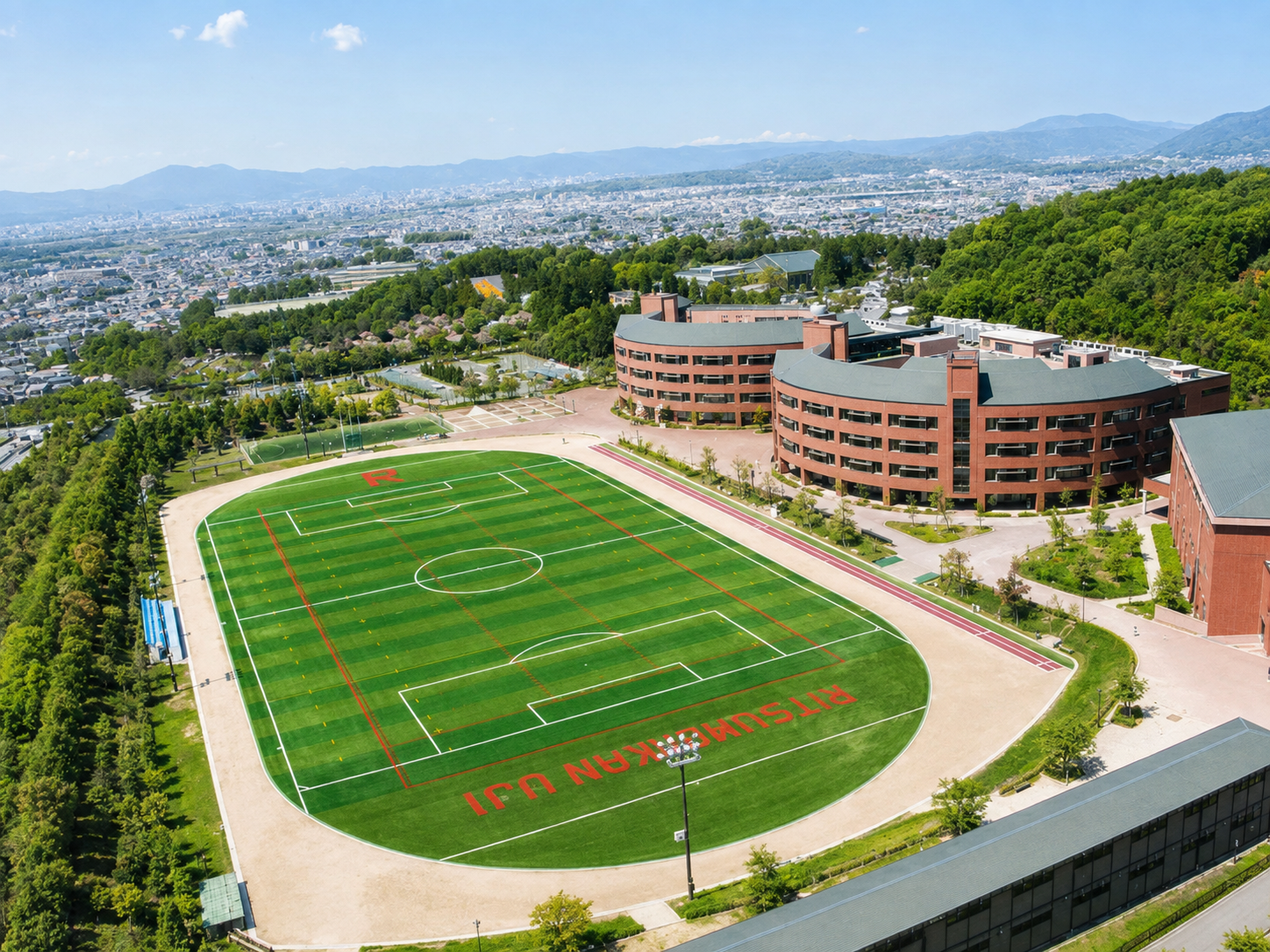
The junior high offers two courses (IC and IP), while the senior high offers three courses (IG, IM, and IB). The defining feature is that the senior high IB programme enables students to pursue both Japanese high school graduation and the IB Diploma simultaneously. While approximately 90% of school graduates advance internally to Ritsumeikan University or Ritsumeikan Asia Pacific University (APU), the IB course maintains a distinctly different pathway, with the school noting that more than half of each cohort advance to overseas universities.
In April 2026, Ritsumeikan Uji opened a residential dormitory exclusively for senior high students, "Ritsumeikan Uji Dormitory (RUD)," reducing barriers to entry for students from distant locations and overseas.
To state the conclusion upfront: The dual-pathway structure—combining both internal advancement (to Ritsumeikan universities) and overseas pathways (via IB to international universities)—is supported by primary sources.
However, the specific conditions for the dual-application arrangement that many families expect—"maintaining the right to internal recommendation while applying to overseas universities"—could not be confirmed in publicly available materials. This is the single most important point to clarify directly with the school before admission. Additionally, because courses vary significantly in admissions, costs, and academic intensity, it is essential to distinguish which course is under discussion.
This article synthesises course structure, admissions, tuition, IB results, university advancement data, and dormitory information based on primary sources from school publications, Ritsumeikan Foundation, the IBO, and Kyoto Prefecture, as of August 2026. Unconfirmed details are explicitly marked as such, and key questions are compiled for school briefing sessions.
About Ritsumeikan Uji: An International Junior-Senior High School in the Ritsumeikan Network
The school traces its origins to Uji High School, established in 1965. After merging with Ritsumeikan Educational Foundation in 1994, it was renamed Ritsumeikan Uji High School. The junior high school opened in 2003. Located in Hirono-cho, Uji City, the school is large, with 578 junior high students and 1,223 senior high students (as of May 2026). The school has a long history in international education. It launched the APU Immersion Programme (IP course) in 2000 and became IB DP-authorised in September 2009 (DP only; language of instruction is English, as confirmed in the IBO school directory). The school operates an International Centre to support returnee and international students, manage exchange programmes, and provide overseas university guidance—making it the primary international hub among Ritsumeikan's affiliated schools.
Accessibility: the school is not within walking distance of the nearest station and requires a bus connection—approximately 10 minutes from Kintetsu-Okubo Station or 15 minutes from JR Uji Station. Commuting from Osaka and Shiga prefectures is feasible alongside Kyoto City commuters.
For an overview of "international course" options at accredited schools, please see our explanatory article.
What are "Almost-International Schools"? A Guide to Japan's Article 1 International Courses for University Abroad at a Quarter of the Cost
The New Dormitory "RUD" Opening in April 2026
A major development in 2026 is the opening of RUD, a residential dormitory exclusively for senior high students, located on campus approximately 3 minutes' walk from the main buildings. It features 156 fully private rooms (10.12 m²), segregated male and female residential areas, IC card security, and resident house masters. Meals are provided twice daily (breakfast and dinner). Monthly costs are dormitory fee of ¥69,000 + meal fee of ¥36,000 + communication fee of ¥1,760, totalling approximately ¥107,000 per month (approximately ¥1.28 million annually), plus an entry fee of ¥200,000, deposit of ¥50,000, and electricity charges. The curfew is nominally 20:00, extendable to 22:00 with approval. Admission to the dormitory requires residential selection conducted after senior high admission, with selection criteria and competition ratios undisclosed. Junior high students are not eligible, so the notion of "entering the dormitory from first year of junior high" is a misunderstanding.
Course Structure: Selecting Among Two Junior High and Three Senior High Courses
Level | Course | Characteristics (as confirmed in official materials) |
|---|---|---|
Junior High | IC | Standard course emphasising foundational skills |
Junior High | IP | Immersion-style course where students study major subjects (English, mathematics, science, social studies, etc.) in English, with the understanding of progressing to senior high IB. Prospective students are expected to have English proficiency at the level of Cambridge English Scale 160–179 or equivalent. Japanese and JSL instruction is included. |
Senior High | IG | Interdisciplinary subject selection and inquiry-based learning. TOEFL ITP 430+ is set as a common target. |
Senior High | IM | Students typically undertake a one-year study abroad in Canada, Australia, or New Zealand and graduate within three years. Study abroad costs are approximately ¥3.8 million (2025 actual; subject to variation). |
Senior High | IB | From grade 10, students study all subjects except Japanese primarily in English, pursuing the IBDP pathway toward overseas universities. |
As a decision framework: if you already have strong English skills and want overseas universities as a realistic option, choose IB; if you want to gain international experience while graduating in three years, choose IM; if you want to keep a broad range of pathways open, choose IG.
Junior high IP is designed as a continuous pathway to senior high IB, but conditions such as "whether IP students automatically progress to senior high IB" or "whether IC students can transfer to IB"—relating to internal advancement and selection—could not be confirmed in publicly available materials (this is a key clarification point at school briefings). The same applies to conditions for course changes after senior high admission.
Academic Standards, Competition Ratios, and Admissions
Overall Competition Ratios and Academic Standards
According to Ritsumeikan Foundation's published data, for 2026 admissions, the junior high received 658 applications with 299 offers (approximately 2.2:1 ratio), excluding internal progressing students; the senior high received 624 applications with 298 offers (approximately 2.1:1 ratio). Official breakdowns by course are not disclosed.
Academic standard reference: Nichinoken's 2026 R4 results (80% pass probability benchmark) indicate junior high entrance targets of 45 (boys, first sitting) and 50 (boys and girls, second sitting). However, IP and IB admissions use specialised formats with essays and mathematics in English, making it inappropriate to assess difficulty by general standardised test standards alone.
Junior High Admissions (2026 Cohort)
Recruitment is 180 students, including 35 returnee and international students. Two sittings: First on January 17 and Second on January 18. The IP format comprises an essay (in English), mathematics (in English), and an interview (primarily in English). IC self-recommended applicants choosing IP-format evaluation must meet an explicit requirement of Cambridge English Scale 150+ or equivalent.
Self-recommended applicants must provide proof of English qualifications (Cambridge, TOEFL, IELTS, etc.).
Senior High Admissions and IB Course English Requirements
For 2026 domestic admissions, the first sitting is February 10 and the second is February 11. The IB course first-sitting assessment includes an English-language essay (approximately 300–500 words), mathematics in English, and an individual interview (primarily in English, with one parent attending).
For 2027 international recommendation and IB-track admissions, explicit English qualification benchmarks are specified: Cambridge English Scale 180+, TOEFL iBT 80+, IELTS 6.5+, TOEIC 800+, or Cambridge FCE or higher. An important caveat: these qualification standards are conditions for international recommendation and should not be generalised as "all IB course applicants must have Cambridge English Scale 180+". However, because the admissions process itself requires thinking and writing in English, it is reasonable to expect operational proficiency at that level as a foundation.
Returnee Admissions and Overseas Testing
The 2027 international admissions programme includes overseas test sites in Shanghai, Singapore, Frankfurt, New York, and other locations. The overseas format comprises an online interview on November 22, 2026, and a written examination on November 28 (not entirely online). Eligibility requires either international nationality or, for Japanese citizens, a minimum of 18 months of overseas schooling. Applicants from overseas local schools and international schools (both domestic and international) are considered under the admissions guidelines.
Mid-year international transfer admissions are also offered, though availability varies by grade, course, and timing; individual confirmation is necessary once a return date is confirmed. Note: 2027 domestic admissions guidelines are scheduled for release in mid-September 2026; always verify the most current recruitment details and dates in the new guidelines.
Tuition: Total Costs by Course and Dormitory Fees
For 2026 entrants, base tuition comprises admission fee of ¥120,000, annual tuition of ¥681,000, and annual educational enrichment fee of ¥313,000 (first-year base total of ¥1,114,000). Course-specific fees are added to this base.
Additional Expenses | Amount | Notes |
|---|---|---|
Junior High IP Course Fee | ¥150,000/year | 2026 cohort; official admissions materials |
Senior High IB Course Fee | ¥750,000/year | Listed on official English-language website; however, that page retains prior-year base tuition figures, so 2026 confirmation is advised |
Senior High IM Course Fee | ¥70,000/year + approximately ¥3.8 million study abroad | Course fee from third-party data; study abroad costs from official source (2025 actual; subject to change) |
IB Miscellaneous Fees | ¥65,000 (2025; third-party data) | Breakdown of DP exam fees and current amounts unconfirmed |
Using published figures and calculating mechanically (excluding uniforms, materials, laptops, retreats, etc.): senior high IB over three years totals approximately ¥5.35 million; junior high IP to senior high IB over six years totals approximately ¥8.8–8.9 million. With dormitory residence, approximately ¥1.28 million is added per year plus entry fees; three years of senior high IB combined with dormitory residence approaches approximately ¥9.45 million.
This is among the highest fee levels for private schools in the region. In contrast, public schools offering IB, such as Suito International (tuition-based district charges of approximately ¥220,000 for three years of junior high and ¥130,000 for three years of senior high, plus IB exam costs), differ by an order of magnitude due to the presence of affiliated university pathways and residential facilities.
Suito Kokusai Middle and High School: Academic Rigor, Admissions Ratios, Tuition, and Reputation — Japan's Premier Public IB School (2026 Edition)
Since 2026, Japan's school tuition support system has been revised, with private high schools eligible for a support ceiling of ¥457,200 annually regardless of household income. Residents of Kyoto Prefecture may also qualify for the prefectural school support system, but support applies only to tuition; course fees, dormitory fees, and study abroad costs are excluded. Residents of other prefectures should check their home local government's system.
The IB Course in Practice: Dual Credentialing with Japanese High School Diploma and IBDP
The IB course is explicitly described in the school's official English-language materials as a programme where students earn both the International Baccalaureate Diploma and the Japanese high school diploma. Using curriculum exceptions approved by Japan's Ministry of Education, Culture, Sports, Science and Technology, IB subjects are mapped to corresponding Japanese curriculum requirements (e.g., "Mathematics I," "Chemistry Basics"), allowing DP and the Japanese high school curriculum to overlap in the timetable.
An important caveat: the IB Diploma is awarded only upon meeting DP assessment requirements (final examinations, Extended Essay, Theory of Knowledge, CAS, etc.); enrolment in the course does not automatically result in both credentials.
DP course offerings include Japanese A Literature / English A Language & Literature (Group 1), Japanese B / English B (Group 2), Business Management, Economics, History (Group 3), Chemistry, Biology, Physics, Environmental Systems and Societies (Group 4), Mathematics AA and AI (Group 5), Visual Arts (Group 6), plus the core components of Theory of Knowledge, CAS, and Extended Essay (specific courses offered each year should be confirmed).
For an overview of the DP system itself, see our DP curriculum guide.
IBDP (IB Diploma) Complete Mastery Guide: Subject Selection, TOK/EE, and Score Strategy Explained【2026 Edition】
Score results are communicated as "achieving high standards" by the school, but year-by-year data remains undisclosed—a precise characterisation of the transparency level. Published figures by the school are: 2024 spring graduates averaged 33.7 points (world average at that time was 30.24), 2025 May announcement reported "97.7% diploma award rate with 34.4-point average over the past five years," and 2026 April announcement reported "97% award rate with 31.3-point average over the past six years."
Only cumulative figures over specified periods are published; year-by-year data on test-taker numbers, diploma recipients, and average scores remain undisclosed (a 2025 reference noting 31 grade-12 students completing the DP in March 2025 is on record, but this is a separate figure from test-taker and award numbers). The 97% award rate substantially exceeds the global average of approximately 80%, though for precise comparisons, it is recommended that you ask the school about year-by-year results during a briefing.
University Advancement and Dual-Pathway Design: Internal Progression and Overseas Universities
Official school advancement data (aggregated from publicly disclosed categories) is as follows:
Graduation Year | Ritsumeikan University | APU | Overseas Universities | Internal Progression % |
|---|---|---|---|---|
March 2024 | 369 | 5 | 6 | ~88.6% |
March 2025 | 340 | 5 | 16 | ~89.6% |
March 2026 | 338 | 2 | 23 | ~88.5% |
Across the entire school, approximately 90% advance internally to Ritsumeikan University or APU. In the March 2026 cohort, advancement was distributed across diverse faculties including Law, Economics, Management, International Relations, Information and Science Engineering, and Pharmacy. Meanwhile, overseas university placements have accelerated significantly: the 2026 cohort includes offers and admissions to Imperial College London, UCL, University of Toronto, University of Edinburgh, King's College London, McGill University, and UC San Diego (prior years have included Harvard, Columbia, and UC Berkeley, among others). Because year-to-year listings mix "offers" and "matriculations" inconsistently, percentage calculations are not feasible). For the IB course specifically, the school reports that "more than half of each cohort advance to overseas universities," a pathway culture entirely distinct from the school-wide 90% internal progression average.
Here is the most critical caveat in this article: "Whether students can maintain internal recommendation rights to Ritsumeikan University while applying to overseas, national public, and other private universities"—the dual-application framework—cannot be confirmed in publicly available primary sources.
Conditions for internal recommendation eligibility (academic record, attendance, English qualifications), adjustment procedures in the event of faculty overlap, and specific terms for IB students' use of recommendations remain undisclosed. It is a fact that the school actively supports both pathways, but "the school offers both routes" and "an individual student can simultaneously retain both sets of rights" are distinct propositions. If you are considering this school as a place to pursue overseas universities while retaining internal recommendation as a safety net, clarifying the dual-application framework directly with the school before admission is an absolute prerequisite.
The institutional support for overseas university progression is substantial. The International Centre coordinates guidance, and a September 2026 university fair featuring 100 overseas institutions is planned.
Reputation and Reviews: A Large School with Balanced Academics and Athletics
Online review platforms contain 102 senior high reviews (3.69/5 stars) and 50 junior high reviews (4.05/5 stars), though anonymous and year-mixed data cannot be treated as statistically valid satisfaction measures.
From objective facts, the school's strengths include
- International character as a system: IP, IM, and IB programmes, plus the International Centre and overseas university fairs
- Athletic achievement: American football team won two consecutive Kansai regional championships (2026); baseball team won the 108th Kyoto prefecture tournament and qualified for the national tournament
- Sustained infrastructure investment: new building C in 2021; new dormitory in 2026
Areas of concern include the significant cost premiums for course fees, study abroad, and dormitory residence atop base tuition; the requirement for bus transit beyond walking distance from the nearest station; and critically, the stark difference between the IB course's diverse international pathway and the 90% internal-progression environment that dominates the school, making course selection an essential decision point. The IB curriculum is described by the school itself as a "demanding two-year course," requiring sustained intensity; selecting IB with the expectation of an affiliated-school environment of leisurely academics and bypassed examinations would result in a poor fit.
Families Best Suited and Less Suited to This School
Families likely to be well suited:
- Your child already has strong English skills (reference points: Cambridge English Scale 180+, TOEFL iBT 80+, IELTS 6.5+, or prior experience learning academic subjects in English) and you want them to pursue inquiry-based and essay-driven IB learning
- You view overseas universities as a realistic pathway while also wanting Japanese high school credentials and domestic university options preserved
- Your family is returning to an overseas posting, and you wish to leverage the overseas-site admissions and senior high dormitory to enable single-student arrival (family-separate return also feasible)
- You prefer a large-school environment with multiple exit routes—internal progression, overseas, and domestic universities—offering your child diverse options
Families warranting careful consideration:
- Prioritizing cost (→ the price difference with Suido Kokusai, a public IB school, is very significant)
- Premised on "securing internal admission before taking a risk-free challenge to overseas universities" (→ whether this is possible is not publicly disclosed. Confirm this before making your decision)
- Placing students who are still developing their English into the IB course (→ both entrance exams and classes require the ability to think in English. Consider the IG course and similar options first)
- Choosing IB with the goal of reducing the burden of entrance exam preparation
When comparing with international courses at one-condition schools in the Greater Tokyo area (such as Hiroo Gakuen), please also review the individual school assessment.
hiroo-gakuen-international-review
If you wish to compare across all international schools and internationally-focused institutions in the Kansai region, the selection guide is a good starting point.
kansai-international-school-guide
Questions to Confirm at Information Sessions
These are important matters that could not be confirmed from publicly available materials. They are listed in order of importance.
- Dual-application rules: Can you apply to overseas universities, national/public institutions, or other private universities while retaining your eligibility for internal recommendations (Ritsumeikan University and APU)? What is the deadline for declining offers?
- Internal recommendation criteria: Required grades, attendance records, English qualifications, and how course preferences are adjusted if there is competition. IB student conditions for using internal recommendations
- Year-by-year IB results: Number of DP exam takers, full diploma recipients, and average scores for the past three years
- Middle to high school IB progression: Conditions for advancing from IP, possibility of moving from IC to IB, and course-change policies during high school
- Confirmed costs: Total additional expenses over three years for the 2026 IB course fee (750,000 yen) plus IB miscellaneous fees and DP exam fees; boarding selection criteria and recruitment quota
English Preparation with a View to Admission and Beyond
Ritsumeikan Uji's IB and IP entrance exams require both preparation for English proficiency tests and the ability to "think and write in English." For those aiming for international recommendations, there are clear numerical targets: Eiken Grade 1, TOEFL iBT 80, and IELTS 6.5. Even in domestic IB selection, students must write 300–500-word English essays and handle mathematics in English, so it is necessary to prepare by simultaneously acquiring certification scores and developing academic English skills to process subject content in English.
After admission, students learn all subjects except Japanese in English, so the processing speed of listening and reading, and the writing skills required for TOK and EE, determine success in learning. For returnee students, conversely, balancing Japanese-language learning (Japanese A and Japanese for domestic university applications) becomes a challenge.
ELT is an English school founded in London in 1984. With fully dedicated native instructors holding teaching qualifications (CELTA/DELTA) or master's degrees, we design customized lessons working backward from your child's current level and goals, covering everything from English proficiency exam preparation to developing academic skills in thinking and writing in English. Whether for IB course entrance exams, returnee admissions, or post-admission IB English, we welcome your consultation tailored to your family's circumstances.
A Dual-Track Design: Confirm the Final Piece Yourself
Ritsumeikan Uji's distinction lies in formally structuring dual qualification for both a Japanese high school diploma and an IB diploma, combining the internal admission system to Ritsumeikan University and APU (used by approximately 90 percent of students), the IB course with over half its students advancing to overseas universities, and the new on-campus dormitory opening in 2026—all within a single school. The school is one of the most concrete institutions in Kansai for mapping out a "dual-track" domestic and overseas future, which is supported by primary sources.
The remaining piece—whether you can pursue overseas universities while retaining internal recommendation eligibility—is not publicly disclosed. Please confirm this point at an information session, then make your decision by comparing your child's English ability and learning style with course compatibility.
For those seeking consultation on English proficiency exam preparation for the IB course and returnee admissions, or preparation for learning in English after admission, ELT's specialist counselors will guide you according to your family's circumstances.


