


Can You Prepare for IELTS Speaking with AI Apps? Understanding Estimated Band Score Reliability and Smart Tool Selection
Let me start with the conclusion. Part 2 and Part 3 format drills, daily speaking volume, and pronunciation acoustic diagnosis can all be addressed with AI apps. Many free services now offer full mock tests with estimated band scores, removing the financial barrier almost entirely. Where online conversation partners often fail to create the abstract discussion format of Part 3, AI can dramatically increase repetition volume—helping you move beyond the 6.5 speaking plateau that appears test after test.
However, estimated band scores displayed by AI are not scores calibrated against official test standards. Providers themselves do not guarantee perfect alignment with actual scores, and some services openly acknowledge that certain scoring criteria lack sufficient precision for AI-only evaluation. Therefore, before the actual exam, you need a mock interview conducted by someone who understands the scoring rubric to determine your true level and set your preparation strategy.
This article draws on official materials from each provider as of August 2026 and explains how to use AI apps effectively for IELTS speaking preparation and how to work with estimated band scores. For a broader overview of AI conversation app selection—including technology method, pricing, and comparison with affordable online English lessons—please refer to our comprehensive guide.
AI English Conversation Apps Recommended Comparison [Intermediate Level]
IELTS Speaking Scoring Criteria and What AI Can Handle
IELTS Speaking assesses a face-to-face interview (11–14 minutes) with a trained certified examiner using four criteria: Fluency and Coherence, Lexical Resource, Grammatical Range and Accuracy, and Pronunciation. In Part 2, you prepare for one minute and then speak for 1–2 minutes; in Part 3, you and the examiner discuss abstract themes related to the Part 2 topic.
When you overlay AI app capabilities against these four criteria, the boundaries become clear.
Scoring Criterion | What the Examiner Observes | AI App Capability |
|---|---|---|
Fluency and Coherence | Not just speech rate, but self-corrections, pauses, logical flow, discourse markers | Rate and pauses are measurable. However, some providers acknowledge that coherence and interaction evaluation by AI alone has insufficient precision |
Lexical Resource | Breadth of vocabulary plus contextual appropriateness, collocations, paraphrasing | Strong at generating paraphrasing suggestions. Weak at judging whether an expression is vocabulary you naturally use in the actual exam |
Grammatical Range and Accuracy | Use of complex structures and frequency of error-free sentences | Good at correction. However, speech recognition sometimes autocorrects articles and word-final -s to "correct" forms, missing detection |
Pronunciation | Individual sounds plus stress, rhythm, intonation, and overall intelligibility | Some apps handle acoustic evaluation of phonemes and stress. Overall intelligibility of longer stretches of speech is not guaranteed |
In other words, AI can reliably contribute to "securing adequate practice volume" and "improving measurable elements," but the holistic judgment that synthesizes all four criteria into a single band score is outside AI's current scope. With this premise, let's examine apps by their specific roles.
AI Apps for IELTS Preparation Compared (August 2026)
Role | App | Free Tier | Pricing (August 2026) | IELTS-Relevant Features |
|---|---|---|---|---|
Full Format Drills | Full mock test and band estimate free | Check official site for paid plans | Part 1–3 mock tests, timed Part 2, estimated band display. Browser-only | |
Pronunciation and Speech Post-Analysis | 7-day trial | Varies by campaign; around ¥2,100/month | Acoustic evaluation from phoneme to intonation; breakdown analysis of longer utterances | |
Daily Speaking Volume | 7-day trial | Premium ¥3,800/month or ¥19,800/year | Free conversation on unfamiliar topics, challenging follow-up questions, paraphrasing practice | |
Part 3-Style Abstract Discussion | 3 minutes/day | Regional pricing; check official site | Debates, current affairs discussion, custom prompts, strict grammar correction | |
Budget-Friendly Problem Supply | Basic practice free | App Store ¥700–¥1,500/month | Timed cue card practice, AI interviewer mock tests |
※ Pricing varies by campaign and purchase channel. Always confirm on the official payment screen before subscribing.
For Full Format Drills: SmallTalk2Me
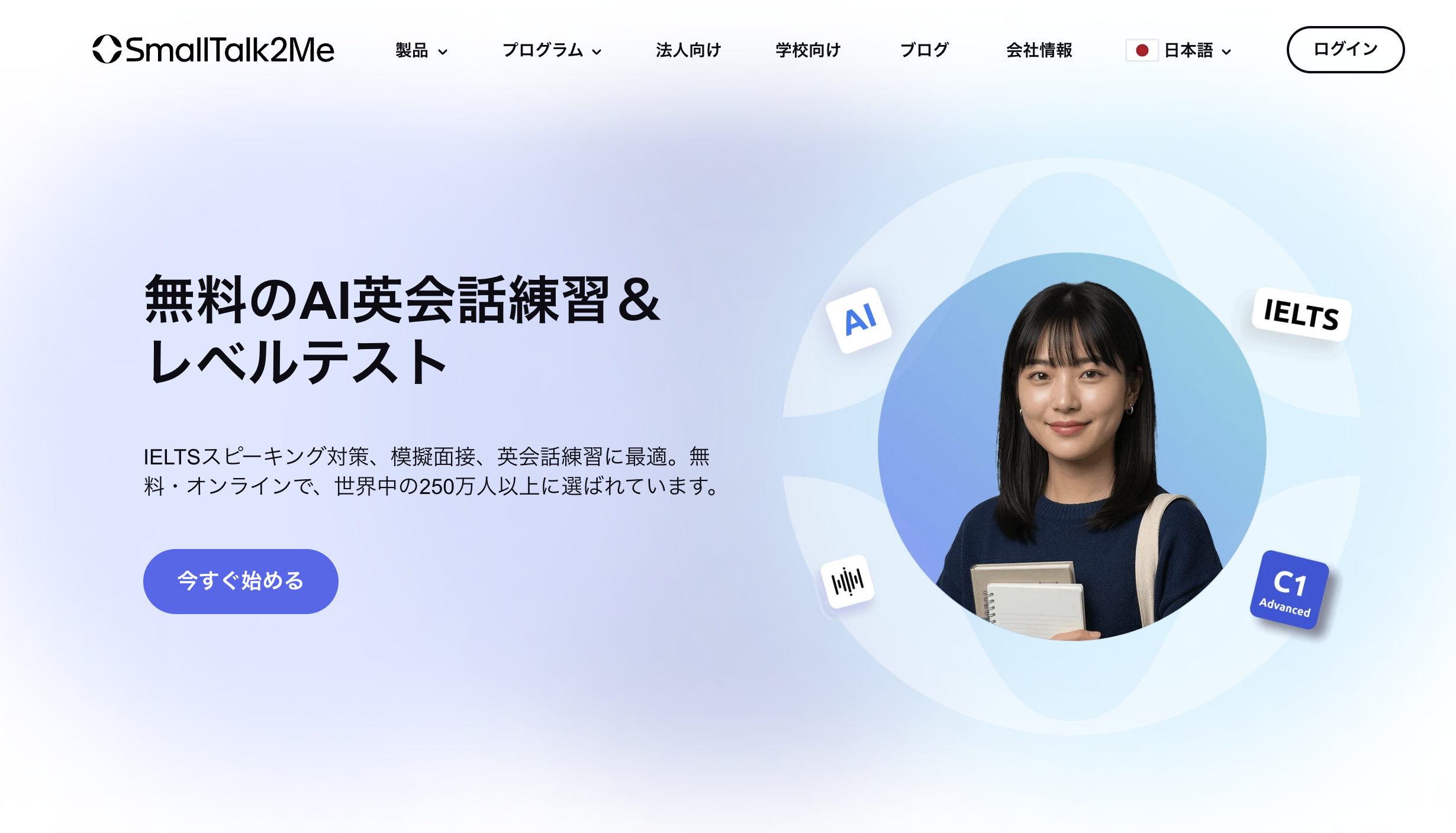
SmallTalk2Me stands out for reproducing the IELTS test format. It offers full Part 1–3 mock tests, timed Part 2 speech (1–2 minutes) matching exam conditions, and estimated band 1–9 scores—all free and running in a browser with no installation needed. It's worth trying first as a tool for gaining experience speaking through the entire test format.
However, as discussed below, the displayed band is an estimate. It's unclear from public documentation how dynamically the app probes follow-up responses in Part 3 (as a real examiner would).
For Pronunciation Work: ELSA Speak
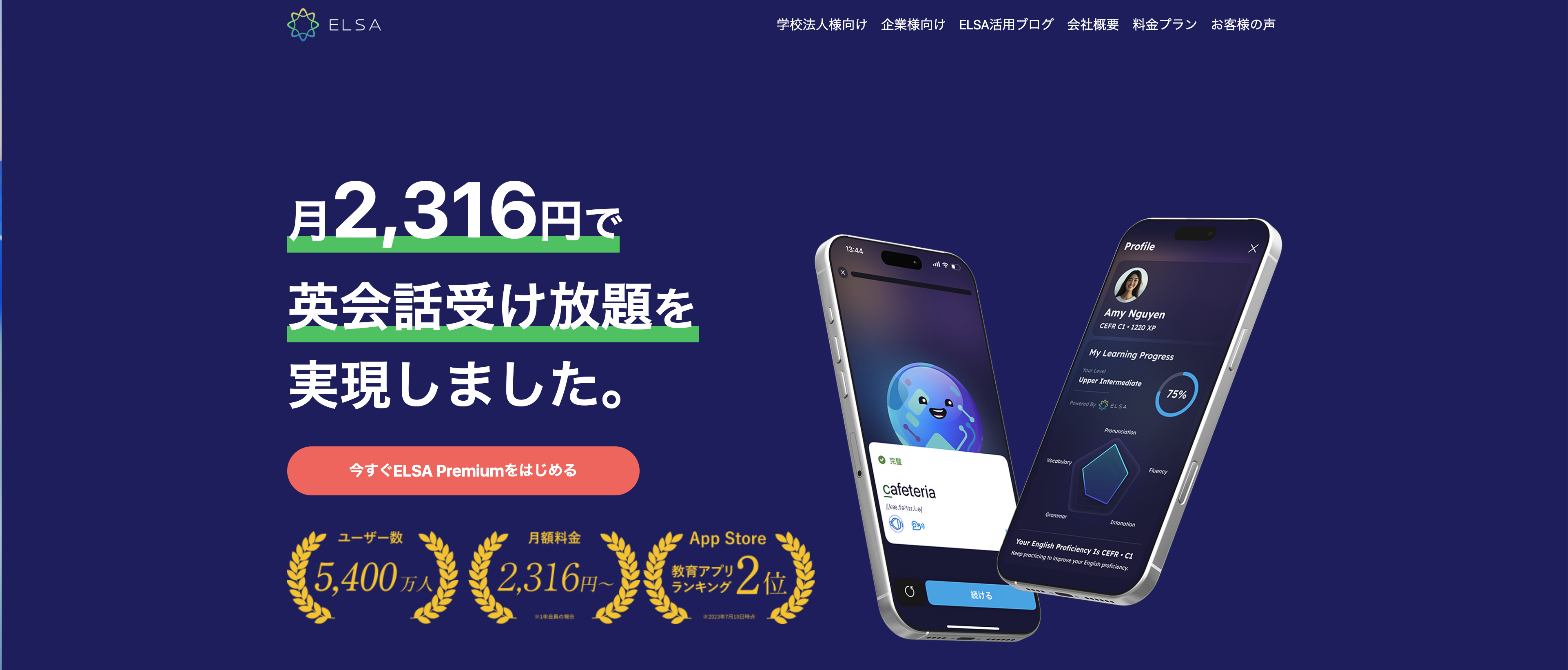
ELSA Speak is one of the few apps confirmed in official materials to evaluate individual phonemes, stress, intonation, and rhythm acoustically. The Speech Analyzer function breaks down a 2-minute Part 2 recording into pronunciation, fluency, grammar, and vocabulary—converting "it doesn't quite come across clearly" into "which specific sounds or elements are the problem." It's the top choice when pronunciation is the ceiling keeping you at Band 6.5.
For Speaking Volume and Part 3 Discussion: Speak and Langua
The typical reason for collapsing in Part 3 is weak improvisation when given an unfamiliar theme. Speak makes it easy to build speaking volume through free conversation and an AI tutor on unfamiliar topics; pronunciation is also analyzed at the phoneme level. Langua focuses on debates, current affairs discussion, and abstract dialogue through custom prompts, with five strictness levels for correction so you don't leave feeling your mistakes were glossed over. Neither reproduces test format, but both strengthen the "thinking while speaking" ability that underpins Part 3.
For Affordable Problem Volume: Stimuler
Stimuler bundles timed cue card practice and AI interviewer mock tests at a few hundred to around ¥1,000/month. It's worth using alongside SmallTalk2Me as an alternative problem source, though the transparency of its pronunciation evaluation technology and estimated score validation lags behind ELSA and Speak.
How Much Can You Trust AI Estimated Band Scores?
The most common misunderstanding about using AI apps for test prep is how to interpret estimated band scores. To put the conclusion upfront: estimated band scores are useful as a "trend indicator of progress" but cannot reliably predict "what band you will score on test day." There are three reasons.
First, the accuracy figures cited by each provider are the provider's own validation, not independent verification by the test authority. For example, ELSA's published figure of "93.88% agreement within ±1 CEFR band with human raters" is their own validation. SmallTalk2Me explains that it trained on vast data including certified examiner scores, yet does not guarantee perfect alignment with actual scores.
Second, SmallTalk2Me has publicly acknowledged in its own evaluation methodology that assessing coherence and interaction by AI alone still lacks sufficient precision. This honest disclosure is commendable, but it implies that other services claiming to deliver comprehensive AI-generated scores likely carry similar limitations without disclosing them.
Third, even Cambridge—a leader in automatic speech assessment research—uses a hybrid approach incorporating human raters to ensure reliability. Your actual score varies with nervousness, the examiner, and question difficulty.
Here's the practical approach: use estimated band to track weekly practice trends (improving or stalled), but rely on human-conducted mock interviews for final level assessment and test-date decisions. The comparison of official materials and human-scored mock tests is covered in detail in our mock test guide.
ielts-mock-test-guide
Weekly Part 2 and Part 3 Practice Schedule
Breaking down the role distribution into a week's practice looks like this:
Frequency | Content | Provider |
|---|---|---|
Daily, 15–30 min | Impromptu responses to unfamiliar topics, self-corrections, paraphrasing practice | AI app (Speak / Langua, etc.) |
2–3 times/week | Timed Part 2 cue card drills and Part 3-style abstract discussion | AI app (SmallTalk2Me / Stimuler, etc.) |
Once weekly, brief | Post-analysis of Part 2 recording and focused practice on weak sounds | AI app (ELSA Speak) |
Every 1–2 weeks | Mock interview for level calibration and priority-setting for the next 2 weeks | Professional instructor |
Two key points: First, Part 2 must always be practiced with time limits. The skill of composing in one minute and speaking for two cannot be learned any other way than through repetition. Second, Part 3 preparation should not be memorizing model answers but rather building the volume of impromptu speech on abstract themes. Having AI ask for reasons, counterexamples, and future predictions is well-suited to this purpose.
For guidance on reviewing recordings and designing independent study, see our article on speaking practice methods.
Effective IELTS Speaking Practice: 5 Steps to Break Band 7.0 with AI and Self-Study
What AI Cannot Do: The Band 7 Wall
The Band 6.5 to 7.0 jump is not about vocabulary or syntax inventory—it's about synthesizing all four criteria.
Band 7 requires
"producing error-free sentences frequently,"
"flexibly deploying vocabulary even on unfamiliar topics,"
"sustaining long turns effortlessly."
This is territory where AI excels at local measurement—"pointing out 10 errors" or "displaying a pronunciation score"—but cannot make the holistic judgments needed for assessment or instruction.
Three things are particularly hard for AI to replace:
- Authentic Part 3 interaction: Real examiners pick up on your previous answer and probe deeper: "Besides that advantage, what else?" "What about the drawbacks?" AI can generate similar follow-ups, but it cannot replicate the examiner's trained, consistent calibration of difficulty or scoring judgment.
- Judging vocabulary "appropriateness":" Moving to Band 7–8 isn't about learning harder words—it's about distinguishing meaning precisely, using natural collocations, and being able to paraphrase when needed. Only in dialogue can you confirm that the sophisticated expression AI suggests is vocabulary you can naturally reproduce in the actual exam.
- Exam-level psychological load: In the real exam, you face a certified examiner for 11–14 minutes while being recorded. Practicing with AI, which is forgiving and low-stakes, is psychologically different from the actual test conditions.
For concrete Band 7 requirements and how to read the scoring rubric, see our detailed article.
The Complete Guide to Achieving IELTS Speaking Band 7.0 | Scoring Criteria and Strategies
This is why building volume with AI while having a trained instructor conduct mock interviews every 1–2 weeks to calibrate "current band level" and "next priority fixes" is the most efficient structure for intermediate learners stuck on a plateau.
AI for Volume; Mock Interview for Calibration
AI apps have made securing adequate IELTS speaking practice volume virtually free. We recommend starting with SmallTalk2Me's free mock test to establish your baseline, then moving your daily practice to AI following the weekly schedule in this article.
To close the gap between estimated band and actual performance and to break through the Band 7 wall, you will need diagnosis from someone trained in the scoring criteria.
ELT, founded in London in 1984, is a premium English school for professionals. With fully qualified native instructors (CELTA/DELTA and master's degree holders) in a dedicated one-to-one teaching model, we handle test prep including IELTS with mock interviews for level calibration, learning strategy design, and the diagnostic role in the AI-collaboration framework presented in this article.
In a trial lesson, a Japanese-speaking counselor and a native instructor assess your current English level and the gaps to your target score, proposing a preparation plan that includes strategic use of AI apps.
For the full IELTS preparation roadmap, see our comprehensive guide.

![AI English Conversation Apps Recommended Comparison [Intermediate Level]](/_next/image?url=https%3A%2F%2Fstorage.googleapis.com%2Felt-microcms-ai-automator-og-images%2Fcolumns%2Fai-english-conversation-app-guide%2Fen.png%3Fv%3D1786522132164&w=3840&q=75)

