


Let me get straight to the point. For intermediate learners at CEFR B1 and above (approximately TOEIC 700 and above), AI conversation apps have become a compelling alternative to budget online English lessons as a means of securing daily speaking volume.
They are available 24/7 without reservation, and monthly fees are in most cases equal to or lower than budget online lessons with daily plans. If you've begun to notice that you're repeating the same kind of free conversation each time, with instructors' feedback limited to grammar mistakes and word substitutions, the conditions for switching are in place.
However, the effects of AI apps primarily extend to the "quantity" of speech and the "accuracy" of grammar and pronunciation. The appropriateness of expressions that build trust in a business setting, comprehensive evaluation aligned with IELTS and TOEFL scoring criteria, and the design of learning strategies based on backward planning from your goals—these remain tasks only human professionals can accomplish.
In this article, based on each company's official materials (technical documents, pricing pages, and privacy policies) as of August 2026, we investigated eight AI conversation apps and organized six with clearly defined roles as "role-based functional separation." For intermediate learners considering switching from budget online lessons, we explain the most cost-effective combination approach.
What Are AI English Conversation Apps? How Do They Differ from Budget Online Lessons?
AI conversation apps combine automatic speech recognition (ASR) and large language models (LLM) to provide English voice conversation practice and immediate feedback without human instructors.
Compared with budget online lessons from instructors such as those from the Philippines and lessons from professional instructors, the characteristics of each can be organized as follows.
Comparison Axis | AI Conversation Apps | Budget Online Lessons | Professional Instructor Lessons |
|---|---|---|---|
Estimated Monthly Cost | Free to approximately 6,000 yen | Approximately 6,000 to 10,000 yen | Tens of thousands of yen and above |
Reservation | Not required (24/7 immediate access) | Required (competition for popular instructors) | Required |
Time per Session | As short as 5 minutes | Typically 25-minute units | Typically 50–60 minutes |
Feedback | Immediate correction of grammar and pronunciation (accuracy varies by app) | Depends on instructor's ability; tends to be glossed over in free conversation | Systematic instruction aligned with scoring criteria and business context |
Psychological Burden | Low (mistakes feel less consequential) | Moderate (concern for the instructor arises) | Moderate |
Skills Developed | Speaking volume, fluency, foundational accuracy | Speaking volume, confidence | Expression appropriateness, test scores, learning strategy |
The value of budget online lessons is "building a habit of speaking daily at low cost," which remains valid today.
However, when intermediate learners begin to notice:
"I repeat the same expressions in every free conversation"
"Instructor quality varies, and mistakes go uncorrected as the conversation moves on"
they have reached a stage where AI apps can more affordably and flexibly fulfill the role of securing speaking volume.
The Often-Overlooked Implementation Difference in "Pronunciation Evaluation"
Before comparison, there is one critical caveat. The advertising phrase "AI evaluates pronunciation" is not synonymous with "actually scoring sound waveforms at the phoneme and word level."
Upon reviewing each company's official technical materials, implementations fall into two broad categories.
- Apps that directly evaluate audio: ELSA Speak and Speak explicitly state in their official materials that they analyze pronunciation at the level of individual phonemes (phoneme).
- Apps that rely on transcription: For example, Langua explains in its official FAQ that when pronunciation is inaccurate, the audio recognition "transcribes it as a different word"—using that transcription discrepancy itself as a cue for pronunciation feedback. It is not direct acoustic evaluation during normal conversation.
It is not a matter of one being superior to the other; rather, selecting a transcription-dependent app when your goal is "to improve pronunciation" can lead to mismatched expectations. This implementation difference becomes a key consideration when selecting apps, discussed in detail below.
What Are the Effects of AI Conversation Apps? Why Intermediate Learners (CEFR B1 and Above) See Greater Progress
The Bottleneck for Intermediate Learners Is Not Knowledge but Speaking Volume
Learners at B1 and above have already reached a state of "knowing" grammar and vocabulary. The primary cause of plateauing is insufficient speaking volume to automate the retrieval and production of known knowledge. Research in second language acquisition shows that in addition to comprehensible input, actually speaking (producing output) contributes to grammar consolidation and improved fluency. AI conversation apps work directly on this intermediate learner bottleneck by allowing "volume" to be accumulated without reservations, during spare moments, and at low cost.
They Have Reached a Level Where They Can "Notice" Their Own Mistakes
AI feedback is imperfect. Incorrect flagging and missed errors occur. Beginners cannot detect this and become confused, but B1 and above learners can to some extent judge the validity of corrections themselves. The effectiveness of AI apps is heavily influenced by the English proficiency of the user; this is why our editorial team recommends AI apps especially to intermediate learners.
Psychological Safety Without Concern for an Instructor
With a human instructor, psychology such as "it's embarrassing to make mistakes" and "silence feels awkward" takes hold, and one naturally structures speech using only "expressions I can confidently say." With an AI, there is no social cost to experimentally using recently learned structures or uncertain vocabulary, failing, and self-correcting. This "volume of experimentation" is key to breaking through the intermediate ceiling.
【By Use Case】Recommended AI Conversation Apps Comparison (As of August 2026)
Our editorial team investigated eight AI conversation apps available in Japan (ELSA Speak, Speak, SmallTalk2Me, Stimuler, Praktika, Loora, TalkPal, and Langua) using their official materials. The conclusion upfront: no all-in-one universal app exists. Because different apps excel at "speaking volume," "pronunciation diagnosis," and "repeated test-format practice," it is most rational to narrow down to six with clear roles and use them separately according to their defined functions.
Role | App | Free Tier | Pricing Guide (August 2026) | Notes |
|---|---|---|---|---|
Securing Speaking Volume | 7-day trial | Premium: 3,800 yen/month, 19,800 yen/year | Phoneme-level pronunciation analysis + free conversation. iOS/Android | |
Speaking Volume + Strict Grammar Correction | 3 minutes/day of conversation | Paid plans are region-specific (check official website) | Correction strictness selectable from 5 levels | |
Pronunciation Diagnosis | 7-day trial | Campaigns vary; approximately 2,100 yen/month | Phoneme, stress, and intonation analyzed acoustically | |
Repeated IELTS Test Format Practice | Full mock test and band estimate free | Paid plans: check official website | Browser only. Full mock test Parts 1–3 | |
Low-Cost Test Prep Support | Basic practice free | App Store: approximately 700–1,500 yen/month | Cue card practice, AI mock interviewer | |
Try Free First | 10 minutes/day free | US$19.99/month | Limited specialized features but sufficient for getting started |
※Pricing fluctuates with campaigns and purchase channels (App Store / Web). Services priced only in USD are shown in USD because yen conversion varies with exchange rates. Always confirm pricing on the official payment screen before purchase.
Maximizing Speaking Volume: Speak and Langua
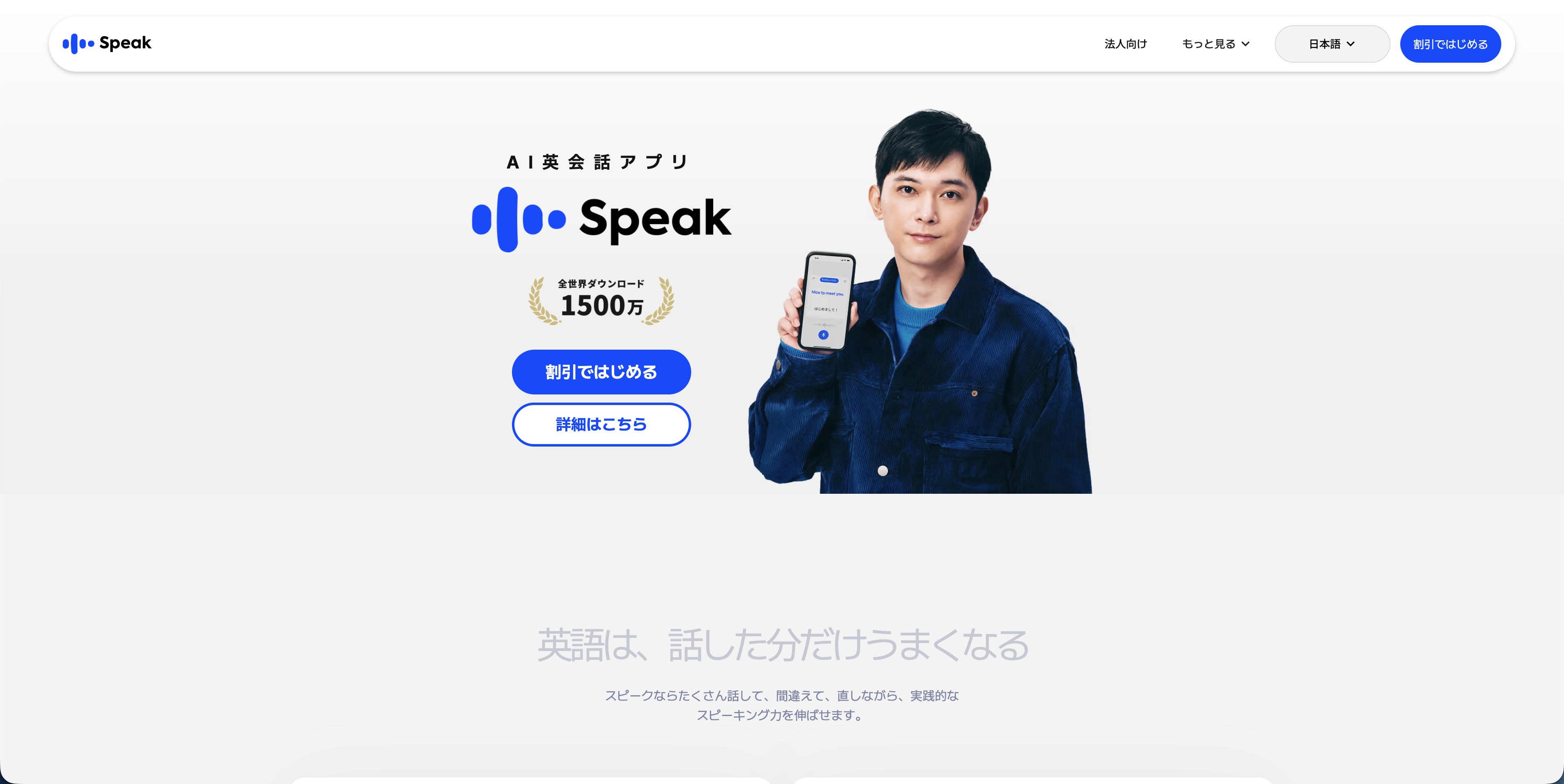
The best fit for replacing "25 minutes daily" from budget online lessons is Speak. Its proprietary speech recognition has learned from vast amounts of non-native speaker audio and explicitly states in official technical materials that it analyzes pronunciation and accent at the phoneme level. Freeform conversation, AI tutor, and custom lessons make it easy to generate large volumes of speech, addressing the intermediate learner's challenge of "falling apart when given an unfamiliar topic."
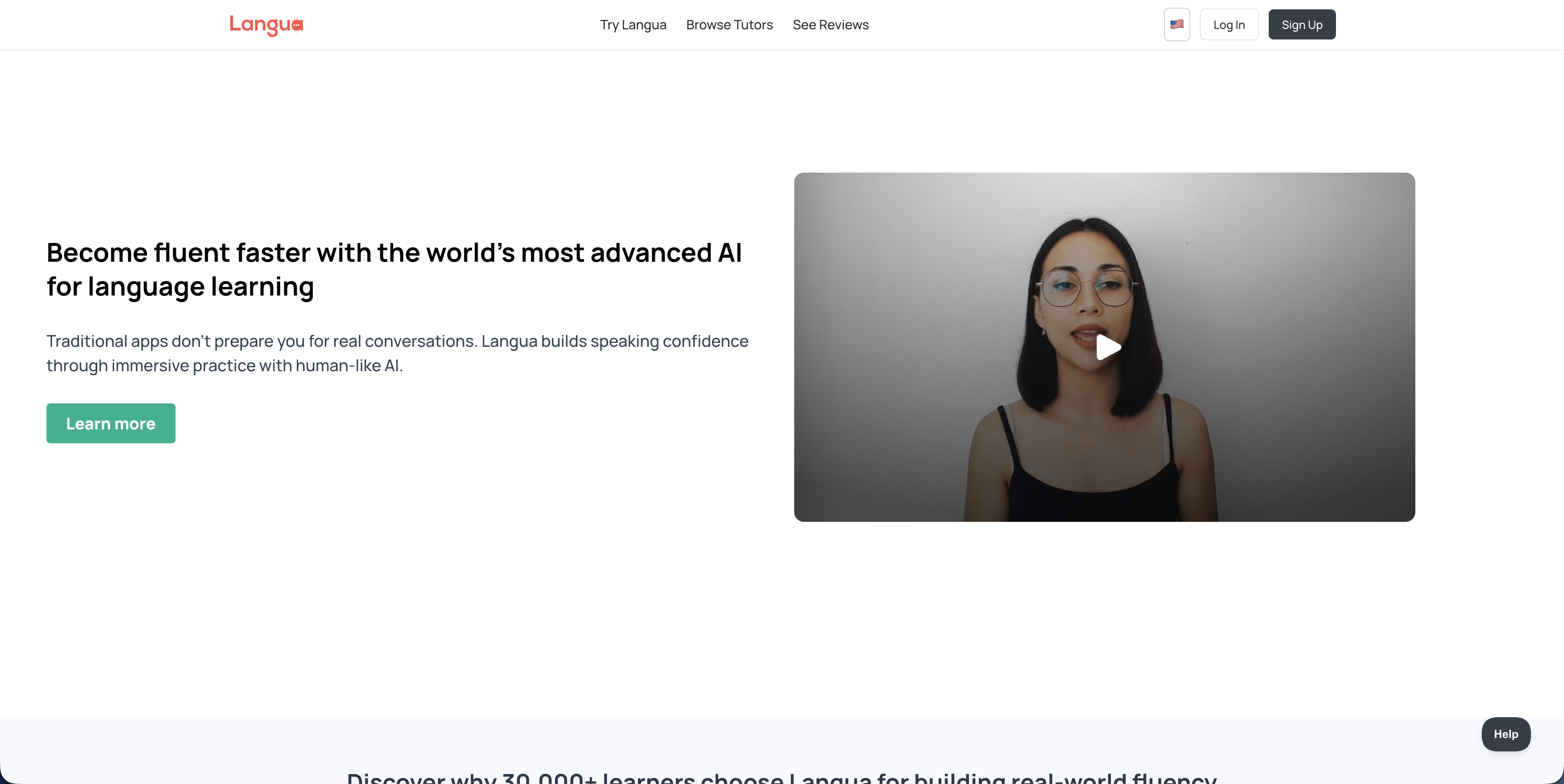
Langua is less suitable for pronunciation diagnosis (as mentioned, it is transcription-dependent), but excels in grammar and vocabulary correction design. You can choose correction levels from off to implicit, explicit, and "have the learner rephrase," allowing you to reduce the laxity typical of AI conversation apps. It is also well-suited to abstract topics such as debate and current events discussion. Note that during roleplay, automatic correction is turned off to maintain conversational flow, and you review corrections afterward in the report—it is helpful to understand this design.
Diagnosing Pronunciation as "Sound": ELSA Speak
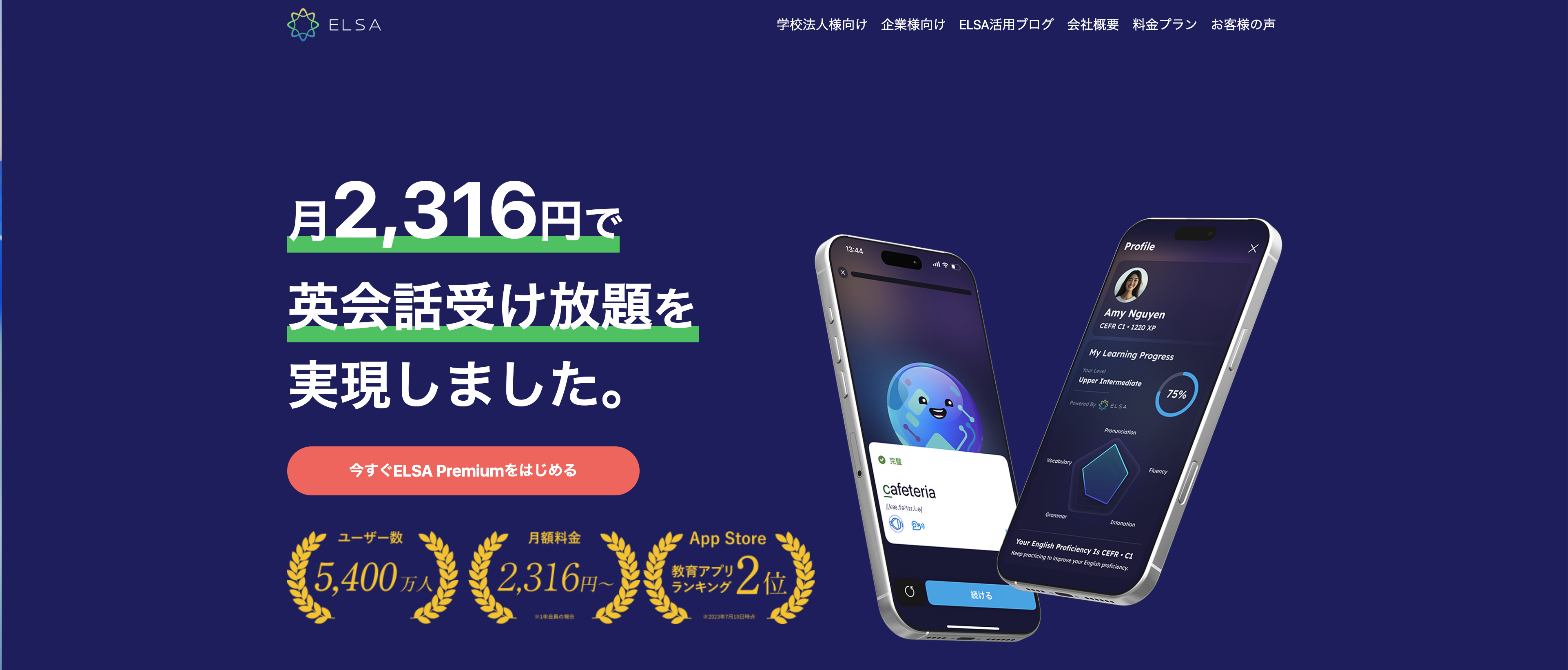
If pronunciation correction is your goal, ELSA Speak is the first choice. It is one of few apps where we could confirm in official materials that it evaluates from individual phonemes to stress, intonation, and rhythm acoustically. The Speech Analyzer feature—which records longer utterances and breaks them down by pronunciation, fluency, grammar, and vocabulary—works well for speech and presentation practice and post-session analysis of IELTS Part 2 format 2-minute speeches.
Note that ELSA's published figure of "93.88% agreement with human raters within ±1 CEFR band" represents the company's own validation, not independent certification by a test authority. It is an excellent diagnostic tool, but treating the score judgment as a "reference standard" would be excessive.
Repeating IELTS Test Format: SmallTalk2Me and Stimuler
For IELTS preparation specifically, SmallTalk2Me stands out in format fidelity. Full mock tests of Parts 1–3, Part 2 speech (1–2 minutes) with real test time constraints, and estimated band score display are all available for free (browser only).
However, two reservations apply. First, the estimated band is an "estimate," and the company itself does not guarantee perfect agreement with actual scores. Second, the company publicly acknowledges that evaluating Coherence and Interaction with AI alone is not yet sufficiently accurate. This honest disclosure is commendable, but in reality, other services touting "AI produces a comprehensive score" have the same limitations.
Stimuler is inexpensive at a few hundred to a thousand yen per month and consolidates cue card practice and AI mock interview features. It has value as a separate question source used alongside SmallTalk2Me, though its transparency regarding pronunciation evaluation technology lags behind ELSA and Speak.
"Self-Testing" Performance Before Switching
Regarding articles, noun number, and third-person singular -s—typical weak points for non-native intermediate learners—none of the apps we surveyed publicly released detection accuracy by item. Furthermore, a structural problem exists: speech recognition may "correct" transcription of speech errors into proper form, preventing subsequent AI from flagging the original mistake (Langua publicly explains this constraint).
We recommend conducting the following test during the free trial period.
- Prepare a 30-utterance script intentionally embedding 10 examples each of article omission, plural -s omission, and third-person singular -s omission
- Speak the script to each app and record "how many it correctly flagged," "whether it incorrectly corrected correct utterances," and review transcription results
- Verify that mistakes are not automatically "corrected into proper English"
In about 30 minutes, you can compare "practical accuracy relative to your specific weaknesses"—something advertising alone cannot reveal.
AI Conversation App Drawbacks and Limitations: Three "Cannot Do" Scenarios You Should Know
Precisely because we recommend AI apps, we must clarify what they cannot do.
1. Small Grammar Mistakes May Be "Overlooked"
As mentioned in the "Self-Testing" section, if article or -s errors are corrected during transcription, the AI cannot even recognize the mistake. Plural and third-person singular -s sit at the intersection of pronunciation and grammar—the zone where intermediate learners perform at 70% accuracy and miss the remaining 30%. Relying solely on transcription-based feedback as your grammar monitoring tool risks erasing the very mistakes you most want to correct.
2. "Grammatically Correct English" and "Contextually Appropriate Business English" Are Not the Same
AI can judge grammatical correctness but cannot assess whether an expression is appropriate to the relationship, negotiation stage, and cultural context. Whether a price reduction response risks offending, whether an instruction to a subordinate sounds heavy-handed, whether a refusal email preserves trust—these factors determine business outcomes and fall within the domain of experienced professionals.
There is another important consideration for practitioners. The handling of audio data varies significantly by application. While some services like Speak explicitly state that audio may be used to improve speech recognition technology, others like TalkPal explicitly state they do not retain recordings, and some services lack publicly available details. In any case, the safest approach is to avoid making confidential business information or customer data part of conversation topics.
3. IELTS and TOEFL band scores cannot be assessed
IELTS Speaking is an examination where trained examiners conduct a holistic assessment across four dimensions: fluency and coherence, vocabulary, grammar, and pronunciation. Band 7 requires the ability to "frequently produce error-free sentences" and "use vocabulary flexibly even on unfamiliar topics"—something that cannot be determined by accumulating isolated metrics such as "10 grammatical errors identified" or "pronunciation score of 83 points".
In fact, even Cambridge, which leads research in automated speaking assessment, employs a hybrid approach that incorporates human evaluators for quality assurance. While AI-estimated band scores should be used as a learning trend indicator, calibrating your actual proficiency before the exam and determining your preparation strategy through a mock interview conducted by an instructor who is thoroughly familiar with the assessment criteria is the safer approach.
The Optimal Solution: Hybrid Learning with AI and Professional Instructors
Applying the above points to practice, the division of responsibilities looks as follows: assign daily speaking volume to AI, and ask your professional instructor to handle only what AI cannot do, at low frequency.
Frequency | Content | Responsibility |
|---|---|---|
Daily, 15–30 minutes | Free conversation, paraphrasing practice, spontaneous responses to unfamiliar topics | AI apps (Speak, Langua, etc.) |
2–3 times per week | Exam format repetition (IELTS Part 2/3) or business scenario role-plays | AI apps (SmallTalk2Me, Stimuler, etc.) |
Once per week, short duration | Pronunciation diagnosis and intensive practice on weak sounds | AI apps (ELSA Speak) |
Once every 1–2 weeks | Holistic assessment, identification of weaknesses, design of learning strategy for the following week | Professional instructor |
Since the majority of time and cost previously allocated to "daily lessons with human instructors" can now be replaced by AI, you can reduce total costs while concentrating professional instruction on the highest-value activities: diagnosis and strategy design. Daily speaking practice becomes even more efficient when combined with AI self-study methods such as shadowing.
Is Expensive English Coaching Obsolete? Build the Ultimate Self-Study System with AI Shadowing, Material Selection, and Prompt Techniques
For Business English
In daily AI practice, you work through impromptu speeches and role-played Q&A scenarios based on topics close to your upcoming week's meeting agenda (confidential information is handled in generalized form). In lessons with a professional instructor, you verify what AI cannot assess: "How will this phrasing resonate with the negotiating partner?" and "Is this expression appropriate for someone in my position?" Since ELT was founded in London in 1984, we have specialized in English instruction grounded in real business contexts, and our instructors are equipped to serve this diagnostic role.
Choosing applications for business use—considering the fidelity of negotiation role-play simulation and handling of confidential information—is explained in detail in our dedicated comparison article.
Is AI Conversation App Sufficient for Business English? 8 Recommended AI Conversation Apps
For guidance on structuring your overall learning (what to handle through self-study and AI, and what to entrust to professionals), please also refer to our article on business English learning strategies.
Business English for Intermediate Learners: How to Break Through the 'I Can Read and Write, But Can't Speak' Barrier
For IELTS and TOEFL Preparation
Use AI to build volume through Part 2 cue card repetition and Part 3 abstract discussion formats, tracking progress through estimated scores. Meanwhile, attend a mock interview with an instructor familiar with the assessment criteria once every 1–2 weeks to calibrate the gap between AI estimates and actual evaluation, and to determine "what can be improved in the next two weeks to raise the band score?" Rather than mindless repetition, use professional diagnosis to set direction, and use AI to build volume—this division of labor is the most rational shortest path for intermediate learners whose scores have plateaued.
Effective IELTS Speaking Practice: 5 Steps to Break Band 7.0 with AI and Self-Study
AI for Volume, Professional Instruction for Quality
The advent of AI English conversation apps has dramatically reduced the cost of securing speaking volume. If you are an intermediate learner who feels unsatisfied with budget online English lessons, we recommend first trying the free tier of applications based on our comparison guide in this article, and then shifting your daily practice to AI.
For those who need English communication skills in a business context or IELTS and TOEFL scores as a tangible result, entrust diagnosis and strategy design—tasks AI cannot handle—to professionals.
ELT is an English school founded in London in 1984, serving professionals. With dedicated native-speaking instructors holding teaching qualifications (CELTA/DELTA) or master's degrees, we provide both business-focused instruction grounded in real-world contexts and exam preparation. We are positioned to handle "diagnosis and strategy design" with the premise of using AI apps in complementary roles. In a trial lesson, our Japanese counselor and native instructor will assess your current English proficiency and challenges, and propose a learning plan that includes how AI apps and professional instruction will work together.


