


Have you heard of the "incredibly popular international school in the heart of Sukhumvit" that nearly every expatriate family considers when first moving to Bangkok?
That school is St. Andrews International School Bangkok, part of Nord Anglia Education, one of the world's largest premium education groups.
The school's greatest appeal is undoubtedly its unbeatable location along the BTS Skytrain line. The convenience of being able to commute without facing Bangkok's notorious traffic congestion, combined with its robust support systems, has made it immensely popular among expatriate families.
On the other hand, as a popular school, it also attracts common concerns, such as, "I've heard it's inclusive (not academically selective), but are its university placements strong?" and "With so many students from one nationality, will my child's English development be affected?"
In this article, ELT, experts in international school admissions and overseas university placement, will provide a thorough analysis of St. Andrews' prime location, its partnership programs with world-class institutions (MIT, Juilliard), strategies for turning the large community of non-native speakers into a key advantage for achieving success in the IBDP, and a breakdown of the real school fees.
1. What is St. Andrews Bangkok? Location and its "Two Campuses"
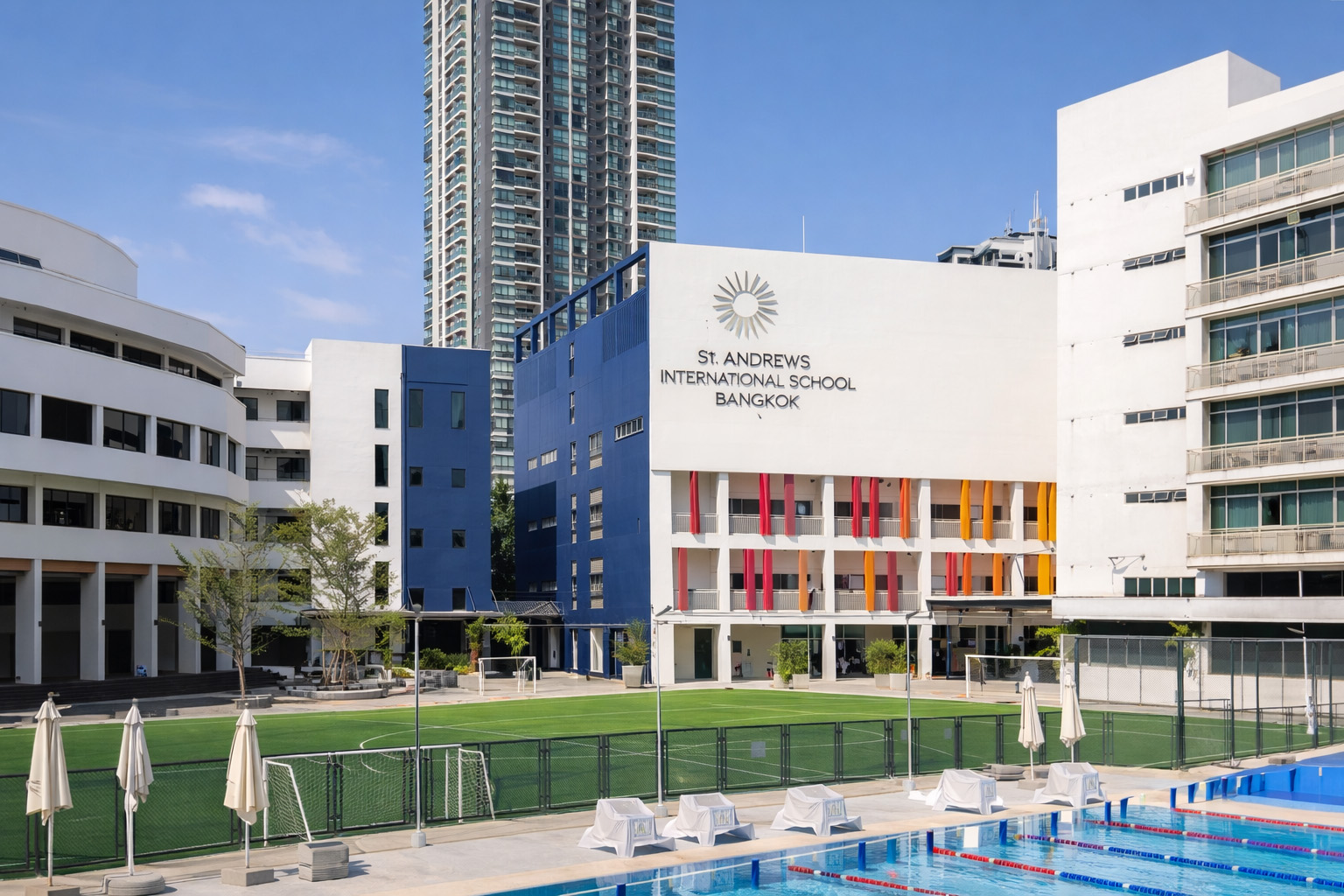
St. Andrews Bangkok is a large school with over 2,000 students from Early Years to High School, operating across two distinct campuses in the Sukhumvit area, tailored to different age groups.
An Unbeatable, Traffic-Free Location (Ekamai & Phra Khanong)
- Primary School (Early Years to Primary): Located about a 10-minute drive from BTS Ekamai and Phra Khanong stations (near Pridi Banomyong), it is close to the central residential areas of Sukhumvit.
- High School (Middle & High School): Miraculously located for a Bangkok international school, it is just a 3-minute walk (approx. 250m) from BTS Phra Khanong station (Exit 4).
While it's not uncommon for students at suburban international schools in Bangkok to spend 2-3 hours on a school bus every day, St. Andrews offers the overwhelming advantage of an easy commute for parents. Middle and high school students can safely travel to and from school (including after-school activities) on their own using the BTS.
2. The Nord Anglia Advantage and its Partnership Programs
The strength of the Nord Anglia group, which operates premium schools worldwide, lies in its collaborations with world-class institutions.
- STEAM Education with MIT (Massachusetts Institute of Technology):
Students from Nord Anglia schools around the world work in teams on high-level challenges set by MIT professors, such as "developing a water filtration system on Mars." Teachers also receive training at MIT, integrating university-level inquiry-based learning into daily school life.
- Performing Arts Education with The Juilliard School:
Through a curriculum curated by the world's leading performing arts conservatory, all students, not just those aspiring to be professionals, receive high-quality education in music, dance, and drama.
- Tackling Global Challenges with UNICEF:
Students engage in research and discussions based on the Sustainable Development Goals (SDGs), and outstanding students have the opportunity to be invited to events at the UN Headquarters in New York.
3. The British Curriculum x IBDP and the True Value of 'Inclusive Education'
St. Andrews follows a classic pathway, using the English National Curriculum (with IGCSE in Years 10-11) as its foundation and offering the globally recognized IBDP (International Baccalaureate Diploma Programme) for the final two years of high school (Years 12-13).
'Inclusive' Does Not Mean 'Lower Academic Standards': A Common Misconception
The school officially states it is "fully inclusive, non-selective." This is a profoundly welcoming policy that embraces a diverse range of students, from those with Special Educational Needs (SEN) to gifted students, and aims to unlock their potential through individualized support plans (like ILHPs). It has received an "Outstanding" rating (the highest possible) from the British Schools Overseas (BSO) inspection, an external audit approved by the UK government.
University Placements to Top Universities Prove the Quality of Education
Despite its inclusive approach, the school's academic results are excellent.
- IB Scores (2025): 95% pass rate, with an average score of 33 points (the world average is approx. 30). The school also produced 13 students who scored 40 points or more (equivalent to the top 5%).
- University Destinations: Top universities in the US and UK, including the University of Oxford, Brown University, UCLA, UCL, and Imperial College London. The school also has a strong track record of placements in Japan, including the University of Tokyo, Waseda University, Sophia University, and ICU.
4. The Reality: Admission, EAL Limitations, and How to Thrive in an Environment with Many Non-Native Speakers
Here, we address the two biggest concerns for expatriate families: the limits of English language support and the reality of the large community of non-native English speakers.
EAL (English as an Additional Language) Support: The Critical Window up to Year 9
While the school is inclusive, it doesn't mean that older students can join with zero English proficiency.
The EAL support at St. Andrews is primarily designed as "Literacy Support" for middle school students (Years 7-9). From Year 10 onwards (when IGCSE and IBDP studies begin), the support model shifts to subject choices like ESL or English B. Therefore, students transferring at this stage will struggle significantly without a certain level of Academic English (the ability to keep up with lessons).
The Pros and Cons of a Large Non-Native English Speaking Community
External audit reports note that "the largest nationality is Thai, followed by Japanese," indicating a significant number of Japanese students.
- Pros: Children are less likely to feel isolated when first moving abroad, and the support from the PTA (which includes a very active Japanese parent community) is extremely helpful, significantly reducing stress for parents. The school also believes that "maintaining the mother tongue helps in acquiring English" and offers robust Japanese language classes.
- Cons: If students tend to stick together with others of the same nationality during breaks and after school, their exposure to English can decrease, despite being in an international school environment.
【Success Strategy for Families from Non-English Speaking Backgrounds】
Instead of relying solely on the comfort of the home-country community, the key to achieving high scores in the IBDP is for parents to proactively design their child's after-school community to be in the "English-speaking sphere." This can be done by encouraging participation in the school's multinational sports clubs, Juilliard's music and drama programs, and SDG activities.
5. The Real Cost: St. Andrews' Tuition and Initial Fees
Reflecting its prime location and extensive support, the school fees are on par with other top-tier schools in Bangkok.
First-Year Cost Breakdown (Assuming a New Student in Year 10)
The following is an estimate of the total "cash-out" (mandatory payments) for the first year, combining the 2025-26 tuition fees with the initial fees based on the latest official regulations (2024-25 version). All amounts are in Thai Baht (THB).
Fee Item | Amount (THB) | Refundability & Notes |
Application Fee | 6,500 | Billed upon acceptance of an offer |
Enrolment Fee | 90,000 | For new students in Years 7-13, one-time payment (non-refundable)* |
Annual Tuition Fee (Year 10) | 800,400 | 2025-26 academic year, total for 3 terms |
Total First-Year Cash-Out | Approx. 896,900 THB | *Estimate of mandatory costs for the first year |
*An installment option for the High School Enrolment Fee is available: 35,000 THB x 3 terms (total 105,000 THB).
*Additional costs will apply, such as EAL support fees (approx. 30,000-80,000 THB/year), first language programs (e.g., Japanese: approx. 36,000 THB/year), school bus fees, and lunch fees.
Conclusion: 'The Safest and Most Convenient Top School' for Expatriate Families
St. Andrews International School Bangkok is an outstanding school that successfully combines a "prime location" easily accessible from Sukhumvit, a warm community that helps families settle in, and a world-class educational program.
However, families should not be complacent and assume it's easy to get in just because it's inclusive and has a large non-native English speaking population. Especially for students transferring in middle or high school, prior preparation in English (particularly reading and writing) is crucial and will determine their future success in IGCSE and IBDP.
"Is my child's English level sufficient to qualify for the comprehensive Literacy Support in Years 7-9?"
"How can we leverage the comfort of a large home-country community while ensuring our child's English proficiency grows?"
"We need practical preparation for the assessments and interviews at an inclusive school."
If you have such concerns, we encourage you to use ELT's one-on-one counseling and trial lessons. Our professionals, who have in-depth knowledge of international school admissions and IB education in Thailand, will provide complete support, from mapping out the optimal timeline for admission to St. Andrews to fundamentally improving your child's English skills.
