


Rugby School Japan (RSJ) is a British-style international boarding school that opened in September 2023 in Kashiwa-no-ha Smart City, Chiba. It is the second international sister school of the prestigious Rugby School (founded in 1567), one of the UK's nine elite 'Clarendon' public schools. It offers the IGCSE and A-Level curriculum for students in Years 7 to 13 (ages 11-18), with options for Day Pupils, Weekly Boarders, and Full Boarders. The school is set to reach a milestone of 300 students in the 2025-26 academic year, and is rapidly building a track record of placements at top global universities despite being a new school, with 3 out of 15 students in the 2026 graduating class receiving early offers from Oxbridge. Annual fees, including meals, range from ¥4.73 million to ¥9.53 million (for 2025-26), with the total first-year cost for a Year 7 student, including one-time payments, amounting to approximately ¥10.07 million.
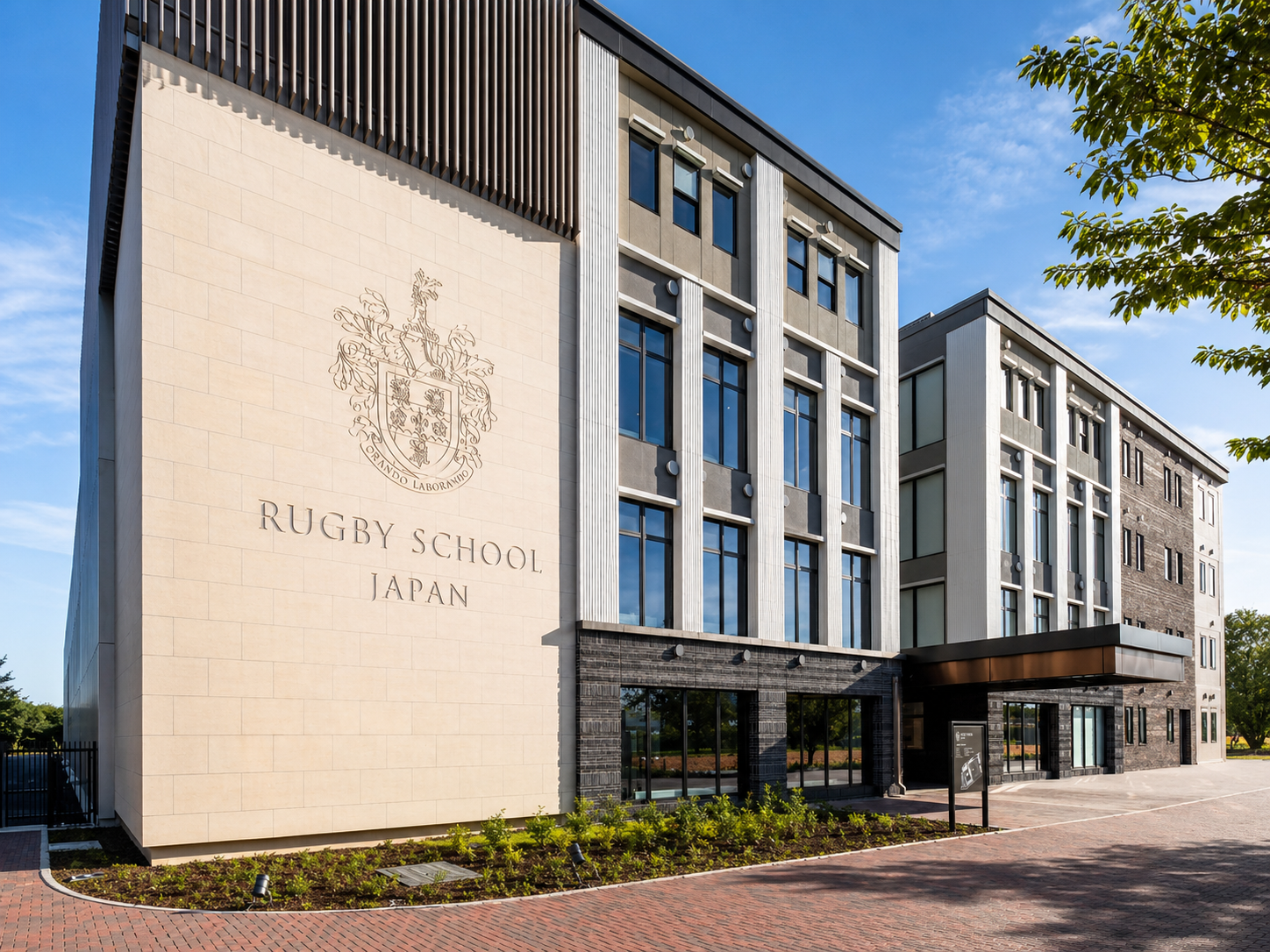
"Is it true there's a prestigious British boarding school accessible from central Tokyo?" "What are its academic standards?" "What are the actual total costs?" "What preparation is needed to get in?" — In this article, ELT, having successfully supported numerous applicants to RSJ, provides an in-depth analysis of RSJ's "true value" and the "strategies needed to secure admission," based on official data and our unique coaching expertise.
1. What is Rugby School Japan (RSJ)? The Basics in 5 Minutes
Rugby School Japan is the second international sister school of the prestigious Rugby School, a renowned public school founded in 1567 in Warwickshire, UK. The first was Rugby School Thailand, which opened in 2017 in Chonburi. The Japan campus was originally scheduled to open in 2022 but was delayed due to the COVID-19 pandemic, officially opening in September 2023 in Kashiwa-no-ha Smart City, Kashiwa, Chiba.
Location: A British Boarding School 30 Minutes from Central Tokyo
RSJ is located in Kashiwa-no-ha Smart City, Chiba Prefecture. It is conveniently situated approximately 30 minutes from Akihabara Station in Tokyo via the Tsukuba Express line to Kashiwa-no-ha Campus Station. The adjacent Kashiwa-no-ha Park offers a baseball field, soccer field, lake, and running track, providing students with an enriched sports environment even off-campus.
In Japan's international school landscape, where boarding schools are often perceived as remote or isolated, the existence of a British-style boarding school within a day-trip commuting distance from the city center is RSJ's greatest geographical advantage.
School's Basic Information
Item | Details |
|---|---|
Official Name | Rugby School Japan (Gakko Hojin Rugby School Japan) |
Opening Year | September 2023 |
Location | Kashiwa-no-ha Smart City, Kashiwa, Chiba |
Year Groups | Years 7 to 13 (Ages 11-18) |
Number of Students | Approx. 300 (as of 2025-26 academic year; planned capacity of 750) |
Curriculum | IGCSE (Years 10-11), A-Level (Years 12-13) |
Language | English (All instruction is in English) |
Number of Teachers | Approx. 40 (primarily from the UK) |
Head Master | Tony Darby (14 years as a Housemaster at Rugby School UK) |
Operating Company | Clarence Education Asia (CEA) |
Accreditations | Member of COBIS / FOBISIA, BSA / ABSA |
Boarding Options | 3 options: Day Pupil / Weekly Boarder / Full Boarder |
International Recognition: Selected as One of Carfax Education's 'Top 25 New Schools to Watch'
Shortly after its opening in 2023, RSJ was selected as one of 'The Best 25 Private Schools to Watch 2023' in the 'New Schools to Watch' category by 'The Schools Index,' published by the UK educational institution Carfax Education. RSJ is the first international school in Japan to be featured in this index.
2. 'The Whole Person, The Whole Point': A System that Implements Holistic Education Through Daily Life Design
The most distinctive feature of RSJ is that it fully implements its educational philosophy, inherited from the UK parent school, 'The Whole Person, The Whole Point,' not as a mere slogan, but as a tangible part of daily life through its timetable, boarding, house system, and co-curricular activities.
The Difference in Activity Volume: 1,000 Hours vs. 3,000 Hours Annually
According to the official FAQ, while a typical day school in Japan provides about 1,000 hours of learning time per year, at RSJ, 'intellectual and co-curricular activities' are scheduled from 7:00 to 22:00, Monday to Friday, plus Saturday mornings, bringing the total annual activity time to approximately 3,000 hours. Through not only classes but also sports, music, art, community action, and supervised self-study, the school maintains a philosophy of fostering not just academic achievement but also physical, creative, and emotional growth.
Note that on Saturdays, there are classes or external matches in the morning, with only the fourth Saturday of each month being a holiday.
The House System: Where Even Day Pupils Grow Within the Boarding School Ethos
The most crucial system at RSJ is the House System. All students, whether Day, Weekly, or Full Boarders, belong to a 'House.' Each House has a dedicated Housemaster/Housemistress who, along with support staff (Tutors), looks after the students' wellbeing.
This system was established at Rugby School UK over 200 years ago. The core value of RSJ lies not in 'whether you sleep in a dorm,' but in 'honing daily decision-making, learning, and relationships within the small community of a House.' Even Day Pupils spend their time in their House from its opening at 7 a.m. until the evening study period, allowing them to experience the boarding school ethos on a daily basis.
Low Student-to-Staff Ratio and Individual Mentoring
The official FAQ explicitly states that a 'low student-to-staff ratio' is a prerequisite for its holistic education. Individual mentoring by teachers, Housemasters, and Tutors is a daily practice, creating a system where each student's academic and pastoral progress is continuously monitored.
3. A Complete Guide to Rugby School Japan's Fees: The Reality of '¥10 Million a Year'
'What are the actual costs?' This is the most pressing question for all families considering RSJ. Based on official information, we will provide a complete breakdown of both the 'published annual fees' and the 'actual total payment amount.'
Official Annual Fee Table (Tuition + Boarding) [2025-26 Academic Year]
Year Group | Day Pupil | Weekly Boarder | Full Boarder |
|---|---|---|---|
Year 7 | ¥4,500,000 | ¥7,400,000 | ¥7,700,000 |
Years 8-9 | ¥4,750,000 | ¥7,650,000 | ¥7,950,000 |
Years 10-11 (IGCSE) | ¥5,300,000 | ¥8,200,000 | ¥8,500,000 |
Years 12-13 (A-Level) | ¥5,500,000 | ¥8,400,000 | ¥8,700,000 |
*Note: While the fee schedule lists Weekly Boarders as '5-day (Mon-Fri),' the School Life page describes it as 'Monday to Saturday boarding.' There is a discrepancy in the official information. Please be sure to confirm the latest policy with the school before signing any contract.
The Reality of Meal Costs: An Additional ¥230,000 Annually Even for Day Pupils
The official Fees page clearly states that meal costs are billed separately from tuition and boarding fees. The estimated annual costs for all three terms are as follows:
Option | Meals Covered | Estimated Annual Cost |
|---|---|---|
Day Pupil | Lunch only | Approx. ¥230,000 |
Weekly Boarder | Breakfast, Lunch, Dinner (Mon-Fri) | Approx. ¥620,000 |
Full Boarder | Breakfast, Lunch, Dinner (including weekends) | Approx. ¥830,000 |
Actual Annual Cost Table (Including Meals)
The 'actual annual cost,' which combines tuition, boarding, and meal fees, is as follows. This is the figure that families considering RSJ should be aware of.
Year Group | Day Pupil | Weekly Boarder | Full Boarder |
|---|---|---|---|
Year 7 | Approx. ¥4,730,000 | Approx. ¥8,020,000 | Approx. ¥8,530,000 |
Years 8-9 | Approx. ¥4,980,000 | Approx. ¥8,270,000 | Approx. ¥8,780,000 |
Years 10-11 | Approx. ¥5,530,000 | Approx. ¥8,820,000 | Approx. ¥9,330,000 |
Years 12-13 | Approx. ¥5,730,000 | Approx. ¥9,020,000 | Approx. ¥9,530,000 |
One-Time and Annual Fees at Admission
Category | Amount | Notes |
|---|---|---|
Application Fee | ¥40,000 | One-time, non-refundable |
Enrolment Fee | ¥500,000 | At enrolment, non-refundable |
School Development Fee | ¥500,000 | At enrolment, pro-rated for mid-term entry |
Annual Facility Maintenance | ¥500,000 | Annually |
Security Deposit | Undisclosed (may be required) | Non-interest bearing, refundable upon withdrawal, used to offset unpaid fees |
Potential Additional Costs
The official Finance & Fees Policy states that the following costs may be billed separately:
- External examination fees for IGCSE / A-Level, etc.
- Additional learning support such as EAL / EFL (upon assessment and with parental consent)
- School uniform
- Personal PC/tablet (iPad for Years up to 10, laptop for Year 11 and above)
- Optional external Co-curricular activity fees
- School trip fees
Simulation: 'Total First-Year Cost for Y7: Approx. ¥10.07 Million'
When all these costs are combined, the total first-year cost for a Full Boarder starting in Year 7 reaches approximately ¥10.07 million.
Item | Amount |
|---|---|
Tuition + Boarding (Y7 Full) | ¥7,700,000 |
Meal Costs (Full, annual) | ¥830,000 |
Application Fee | ¥40,000 |
Enrolment Fee | ¥500,000 |
School Development Fee | ¥500,000 |
Annual Facility Maintenance | ¥500,000 |
Total First-Year Cost (incl. one-time fees, excl. additional costs) | ¥10,070,000 |
Adding the costs for uniform, a PC, external exam fees, and optional activities, it is realistic to expect the actual total to be in the low ten-million-yen range.
Timing for the 2026-27 Fee Schedule Update
According to the Finance & Fees Policy, the fee schedule for the new academic year is updated by May 31st each year. Prospective families should be sure to check the latest version after May.
4. RSJ's Academic Standards: The British Curriculum Benchmark
One of the most common questions from parents in Japan is, 'What is Rugby School Japan's hensachi (deviation score)?' The short answer is that the concept of 'hensachi' does not exist in international schools that use a British curriculum. Instead, academic ability is managed by more rigorous and international standards.
The External Examination Track: IGCSE and A-Level
Academic assessment at RSJ is conducted through external examinations: the IGCSE (International General Certificate of Secondary Education) taken in Years 10-11, and the A-Level (Advanced Level) taken in Years 12-13. These are globally standardized tests administered by UK examination boards like Cambridge International, Edexcel, and AQA. Unlike the relative ranking system of Japan's hensachi, these are graded on an absolute scale against a global standard, meaning students are assessed by the same criteria as their peers worldwide.
Progression Requirements for Sixth Form (Years 12-13)
According to the official Sixth Form Curriculum Guide, current RSJ students must meet the following academic criteria to progress to the Sixth Form:
- Achieve grades A* to C (or numerical grades 9 to 5) in at least five IGCSE subjects
- Achieve a grade B (or 6) or higher in subjects related to their chosen A-Levels
- Demonstrate a strong commitment to learning
This means students are selected for Sixth Form not based on a vague metric like 'equivalent to a hensachi of 65,' but on clear, numerical criteria such as 'achieving a certain grade or higher in a specific number of IGCSE subjects.'
A-Level Operational Rules
In the Sixth Form, students typically take three A-Level subjects (or four in exceptional cases). The pace is intense, similar to university, with 50 lessons over a two-week cycle. The culmination of two years of study is assessed in the terminal examinations at the end of Year 13.
EPQ (Extended Project Qualification): An Additional Qualification Directly Valued in University Admissions
For students taking three A-Levels, completing an EPQ (Extended Project Qualification) is standard. The EPQ is an additional qualification widely valued in UK university admissions and consists of:
- A 30-hour taught component
- 90 hours of project work (independent research)
- Submission of a 5,000-word report
The EPQ is an academic project similar to a university dissertation and is considered by top UK universities, including Oxford and Cambridge, during the application process. This allows students to experience university-level academic work—something not typically encountered by students in the Japanese high school system—while still in secondary school, which is a key source of strength for RSJ graduates' university preparation.
For a comprehensive overview of the British curriculum, please refer to this article as well.
The British Curriculum (A-Level / IGCSE) Explained: The Power of Specialization for University Pathways
5. RSJ's University Placements: To Top Global Universities Within Four Years of Opening
Despite being a new school, RSJ's university placement record is already at a world-class level.
Destinations of the First Leavers (First Graduating Class)
According to an official release from Clarence Education Asia, RSJ's first leavers have gone on to the following universities:
- University College London (UCL) — A core college of the University of London, consistently ranked in the world's top 10
- King's College London — Part of the University of London, with a global reputation in medicine and law
- University of Edinburgh — Scotland's leading university
- University of Glasgow — Scotland's second-largest comprehensive university
- McGill University — One of Canada's most selective comprehensive universities
- Chinese University of Hong Kong — A top-tier university in Asia
- Peking University — China's premier university
- Waseda University — An English-taught degree program at one of Japan's top private universities
Class of 2026: 3 out of 15 Students Receive Early Oxbridge Offers
The most striking news, published as an official RSJ article, is that 3 out of 15 students in the 2026 graduating class have received pre-application offers from the University of Oxford and the University of Cambridge. A success rate of 20%—a level that is exceptional even for the UK parent school, and achieving this within four years of opening is a remarkable strength.
Oxbridge is known for looking beyond academic grades to assess a candidate's passion for their subject and their ability to think under pressure. This achievement demonstrates that RSJ's curriculum design (A-Levels + EPQ + Super-Curriculum + co-curricular activities) effectively meets these multifaceted evaluation criteria.
The Super-Curriculum: Academic Extension Beyond the Classroom
On RSJ's School Life page, the following academic activities are integrated as 'standard practice' outside of regular classes:
- Participation in national and international academic competitions
- Collaborative programs with universities
- Guest lectures (from university faculty, industry experts)
- Society activities (Science Society, Debating Society, MUN, etc.)
- Subject-specific off-campus trips
This is a more advanced version of the 'inquiry-based learning' found in some school systems, designed to help students produce outputs during their secondary school years that are directly relevant to their desired university faculties. The process, from the EPQ in Year 12 to writing the Personal Statement for university applications in Year 13, systematically builds a strong academic portfolio.
Progression to Top Japanese Universities: MEXT Recognition and Realistic Pathways
Japan's Ministry of Education, Culture, Sports, Science and Technology (MEXT) recognizes GCE A-Levels and International A-Levels as qualifications for university entrance in Japan (official Q&A). Therefore, RSJ graduates are theoretically eligible to apply to top Japanese universities such as the University of Tokyo, Kyoto University, and Waseda/Keio.
However, as RSJ itself states in its official FAQ, 'it is extremely difficult to balance A-Level studies with preparation for the standard Japanese university entrance exams, which are conducted in Japanese and are heavily writing-based.' For students aiming for top Japanese universities, the realistic options are limited to the following three:
- Applying to English-taught degree programs like the University of Tokyo's PEAK or Kyoto University's KUINEP.
- Applying through comprehensive selection or international student admissions (pathways that accept A-Level results).
- Pursuing a long-term route of studying at an overseas university and then transferring to a graduate school in Japan.
6. A Complete Guide to the Rugby School Japan Admissions Process
RSJ operates on a rolling admissions basis, meaning applications are processed as they are received, and admissions close once all places are filled. Places in each year group are strictly limited, and popular entry points like Year 7 and Year 9 often fill up quickly.
Overview of the Admissions Process (7 Steps)
Step 1: Online Application
Submit the application form via the Admissions page on the official website. The required documents are as follows:
- School reports for the past two years (translated into English)
- Confidential Reference (a letter of recommendation from the current homeroom teacher or head of school, which must evaluate both academic and pastoral aspects)
- Copy of passport
- Photos of the applicant and parents/guardians
Step 2: Payment of Application Fee
Pay the ¥40,000 application fee. This is a non-refundable administrative fee.
Step 3: Pre-screening Interview
Before taking the CAT4 and Oxford Placement Test, there is a pre-screening interview with a member of the Admissions Team. This is where the school determines if the family is a suitable candidate to proceed to the full assessment process.
Step 4: CAT4 (Cognitive Abilities Test)
This is the most important test in the admissions process. More details are provided in the next chapter.
A Complete Guide to the CAT4 (Cognitive Abilities Test): Key to British International & Boarding School Admissions
Step 5: Oxford English Placement Test
This is an English proficiency test provided by Oxford University Press. It consists of two sections, including vocabulary/grammar and listening. The school uses this score in combination with the interview impression to assess English ability.
OOPT (Oxford Online Placement Test) Prep and Score Guide | English Test for International School Admissions
Step 6: Senior Leadership Interview
This is an interview with a senior staff member, such as the Deputy Head or Head Master. It assesses academic curiosity, suitability for the school culture, and aptitude for boarding life.
Step 7 (Year 12 only): A-Level Assessment Papers
Applicants for Year 12 entry must also take additional A-Level Assessment Papers (30 minutes each).
- English (compulsory)
- Mathematics (compulsory)
- 3-4 elective subjects (in the intended A-Level subjects)
This test is to confirm that the applicant has the academic ability to study A-Levels in the Sixth Form.
Notification of Results: Approx. 1-2 Weeks
Once all assessments are complete, the Admissions Team will notify you of the result within 1-2 weeks. Successful applicants will receive either a Conditional Offer or an Unconditional Offer.
7. English Proficiency for RSJ: The Safe Zone in CEFR, Eiken, and IELTS Terms
RSJ's official FAQ states that there is 'no fixed score requirement for English proficiency.' However, this does not mean that English ability is not assessed. Instead, a more rigorous standard is applied: 'the ability to use English effectively to participate in and fully benefit from lessons at an age-appropriate level.'
Realistic English Proficiency Benchmarks by Year Group
Based on data from successful applicants ELT has supported, the following are realistic 'safe zone' benchmarks:
Year Group | CEFR Level | Eiken Level (approx.) | Eiken CSE Score | IELTS (approx.) |
|---|---|---|---|---|
Year 7 | B2 | Grade Pre-1 | CSE 2,300+ | 5.5+ |
Years 9-10 | B2 to C1 | Grade Pre-1 to Grade 1 | CSE 2,400+ | 6.0+ |
Year 12 | C1 | Grade 1 | CSE 2,600+ | 7.0+ |
This is not a 'minimum requirement' but rather a level often held by successful applicants. CEFR B2 is defined by the Council of Europe and the British Council as the ability to 'understand complex texts and interact with a degree of fluency and spontaneity,' while C1 is the ability to 'use language flexibly and effectively for social, academic and professional purposes.'
The Possibility of a Conditional Offer
If an applicant's English proficiency is slightly below the required level, a Conditional Offer may be issued. This is a system that grants admission on the condition that the student achieves a specified level of English proficiency before enrolment or receives EAL (English as an Additional Language) support after joining the school.
However, whether a Conditional Offer is made depends on a comprehensive assessment, including CAT4 scores, interview performance, and family commitment. Relying on a Conditional Offer to compensate for insufficient English is a risky strategy.
Parental English Requirement: An Often-Overlooked Hurdle
The official Admissions Policy states that at least one parent or guardian must be able to communicate with the school on practical matters in English. This is an important, yet often overlooked, requirement.
Specific situations where English is required:
- Communications for parent-teacher conferences and school events
- Individual meetings with teachers (regarding both academic and pastoral matters)
- Emergency communications (related to health and safety)
- Regular communication with the Housemaster/Housemistress
- University admissions counselling (in Years 12-13)
8. CAT4 Preparation: The Crucial Cognitive Abilities Test in RSJ Admissions
The test whose score has the most significant impact on the admission decision at RSJ is the CAT4 (Cognitive Abilities Test).
The 'Four Reasoning Abilities' Measured by CAT4
CAT4 is a cognitive abilities test developed by GL Assessment (UK) and consists of four reasoning domains:
Domain | Description |
|---|---|
Verbal Reasoning | The ability to logically process the meaning of words and sentences |
Numerical Reasoning | The ability to reason with numbers and patterns |
Non-verbal Reasoning | Pattern recognition with shapes and figures |
Spatial Reasoning | Understanding of 3D shapes, rotations, and nets |
Why CAT4 Does Not Measure Rote Knowledge
The RSJ official FAQ explicitly states that CAT4 measures 'learning potential' rather than 'memorized knowledge.' GL Assessment itself explains that CAT4 'measures the key reasoning abilities that influence learning and achievement, and analyzes potential attainment.'
This means that CAT4 is a test that cannot be tackled with study methods based on rote memorization, common in some exam systems. Simply memorizing practice questions is ineffective, as students will struggle when faced with unfamiliar question formats. This is why specialized preparation is necessary.
The Importance of Specialized Preparation
At ELT, our CAT4 preparation focuses on the following three points:
- Providing comprehensive experience with all question formats across the four domains
- Training in time management (CAT4 has strict time limits)
- Practicing the verbalization of the logic behind each answer
For more details on CAT4 preparation, please refer to this article.
A Complete Guide to the CAT4 (Cognitive Abilities Test): Key to British International & Boarding School Admissions
9. Qualities of the 'Whole Person' Assessed in the Interview
The interview at RSJ (Senior Leadership Interview) is not just a test of whether you can speak English. It is a rigorous assessment of whether the candidate is a good fit for the school's culture, values, and ethos.
The Four Key Assessment Areas
Based on the official FAQ and How to Apply documents, the key areas assessed in the interview are as follows:
Assessment Area | Specific Questions/Topics |
|---|---|
Academic Curiosity | 'What are you passionate about recently?' 'What books are you reading?' 'What are your favorite subjects and why?' |
Motivation for Applying | 'Why RSJ?' 'Why choose RSJ over other schools like Harrow Appi or Malvern Tokyo?' |
Commitment to Co-curriculars | 'What have you been passionate about so far?' 'Leadership experience?' 'Volunteer or community activities?' |
Community Fit | 'Do you prefer Day or Boarding, and why?' 'How can you contribute to community life?' |
The Two Axes of Assessment: Aptitude and Attitude
The official How to Apply document states that assessment is based on the two axes of Aptitude and Attitude.
- Aptitude = Academic ability, skills, and potential (measured by CAT4 and the Oxford Placement Test)
- Attitude = Approach to learning, curiosity, and resilience (measured in the interview)
A student who is academically strong but lacks motivation, or a student who is motivated but lacks the foundational academic skills, will both fall short of the admission standard. Only when both are present can a candidate pass RSJ's 'Whole Person' assessment.
The Type of Student RSJ is Looking For
The official FAQ repeatedly uses the following keywords to describe the ideal student profile:
- Curious
- Creative
- Resilient (not afraid to fail)
- Compassionate (a desire to contribute to society)
In other words, the school is not looking for students who are merely high academic achievers, but for a student who integrates academics, character, and social awareness.
10. The Reality of Boarding Life: A Day in the Life Through the Official Timetable
The typical weekly schedules for Year 7 and Year 12, published by RSJ, offer a glimpse into the actual life of a student.
A Typical Day for a Year 7 Weekly Boarder
Time | Activity |
|---|---|
7:15 | Breakfast |
8:15 | House Assembly/Registration |
8:30 - 16:00 | Lessons (English, Maths, Science, Humanities, Arts, Languages) |
16:00 - 17:30 | CCA (Co-Curricular Activities: Swimming, Science Club, Debating Society, etc.) |
17:45 | Dinner |
19:00 - 20:30 | Supervised Study |
20:30 onwards | Free time / Preparing for bed |
On weekday evenings, Academic Enrichment activities (such as Science Club, Debating Society, Junior MUN) are scheduled, meaning that intellectual activities continue even outside of regular class hours.
A Typical Week for a Year 12 Full Boarder
By Year 12, life becomes more focused on university preparation.
- A-Level lessons (intensive study of three chosen subjects)
- EPQ research time (independent project)
- Chemistry Club / Subject-specific societies (in-depth co-curricular activities)
- DofE (The Duke of Edinburgh's Award) (a youth awards programme founded in the UK)
- Guest lectures (from university faculty and industry experts)
- Quiet Time in House (for independent study and reflection in the boarding house)
This environment is similar to a residential college at a university, enabling a smooth transition to the final exams in Year 13 and university life beyond.
Choosing Between Day Pupil, Weekly, and Full Boarding
Option | Best Suited For... |
|---|---|
Day Pupil | Families who live within commuting distance and want to maintain a balance between school and home life. |
Weekly Boarder | Families who live slightly further away and want their child to fully immerse in the school's weekday program while spending weekends at home. |
Full Boarder | Families who live far from the school (including overseas) and want their child to experience the complete, immersive British boarding school environment. |
11. Conclusion: The Value of Investing in Rugby School Japan
Rugby School Japan is not just a school for learning English or preparing for overseas university entrance exams. It is a place that implements the 200-year-old British boarding school philosophy of 'The Whole Person, The Whole Point' to develop individuals who can thrive anywhere in the world.
The annual cost of nearly ¥10 million is undoubtedly a significant investment. However, considering the 3,000 hours of annual activity time, the low student-to-staff ratio, the House System, and the proven track record of placements at top universities like Oxbridge, it offers a value that is difficult to find elsewhere in Japan.
For families seeking not just academic excellence but also the development of character, leadership, and resilience, RSJ presents a compelling option.
For families living within commuting distance of Kashiwa-no-ha who want to value family time and maintain their current lifestyle.
Weekly Boarder
For students commuting from central Tokyo or its suburbs who want to focus on their studies during the week and spend weekends with their families. This is a particularly popular option among affluent local families.
Full Boarder
For families on overseas assignments, those living in regional areas of Japan, or those seeking a full British boarding school experience.
11. ELT's Analysis: Characteristics of Successful Applicant Families at RSJ
ELT has supported numerous families in successfully gaining admission to RSJ, from initial entry in Year 7 to mid-year transfers into Years 8-11 and Sixth Form entry in Year 12. Based on our experience, we'd like to share three common characteristics of these successful families.
Characteristic 1: They have an objective understanding of their child's academic aptitude (CAT4 score)
Successful families take a CAT4 practice test before applying to objectively understand their child's cognitive ability profile. After grasping the strengths and weaknesses in the four areas, such as 'strong in Verbal but weak in Spatial,' they spend six months focusing on improving the weaker areas.
Conversely, a common pitfall for unsuccessful families is assuming that strong English skills will automatically lead to a high CAT4 score, only to be surprised by a low result on the actual test. It's crucial to understand that the CAT4 assesses cognitive abilities distinct from English language fluency.
Characteristic 2: They can clearly articulate their academic curiosity and passion for extracurriculars
When asked in an interview, "What are you passionate about?", successful students can share specific anecdotes and explain what they learned from them in their own words.
A typical unsuccessful response ends with a simple "I like football" or "I like reading." What RSJ is looking for is the ability to articulate "why you like it," "what it made you think," and "what you want to do next."
At ELT, our interview practice helps students structure their experiences using the "Why → What → So What → Next" framework.
Characteristic 3: The family has a shared understanding and commitment to "life in the House system"
In the RSJ interview, applicants are always asked which option they prefer—Day, Weekly, or Full—and why. Successful families have thoroughly discussed this question and prepared a consistent, well-reasoned answer.
Whether choosing Day Pupil ("We want to balance family time with a rigorous academic environment") or Weekly Boarder ("We want our child to build character through intensive House life on weekdays and spend weekends with family"), it is vital that the reason for the choice aligns with the school's philosophy of developing the "Whole Person."
Examples of Successful Applicant Profiles by Year
Here are typical profiles of successful applicants ELT has supported, broken down by year group.
- Year 7 New Entry: A typical successful applicant is in their final year of primary school (e.g., Grade 6). They often have English proficiency around Eiken Grade 2 to Pre-1 (CEFR B1-B2), have prepared for the CAT4 for 6-12 months, and have visited the Kashiwa-no-ha campus and Houses with their family.
- Year 8–11 Transfer: Students currently enrolled in an international school or who have recently returned from living abroad. They have English proficiency equivalent to CEFR B2-C1. They prepare their academic transcripts (e.g., IB MYP, Cambridge IGCSE) and letters of recommendation, and prepare for the CAT4 test and interview for their target year group.
- Year 12 Sixth Form Entry: Students with excellent academic records from IGCSE programmes or rigorous Japanese secondary schools. They have English proficiency equivalent to CEFR C1 and have spent at least six months pre-studying their three intended A-Level subjects to prepare for the A-Level Assessment Papers.
12. Is RSJ the Right Fit for Your Family?
To be frank, RSJ is not the right school for every family. Considering the annual costs of around 10 million JPY and the rigorous British-style academic and living environment, families should carefully assess whether the school aligns with their values and goals.
RSJ is a good fit for families who:
- Are aiming for top world universities like Oxbridge and the Ivy League.
- Are deeply committed to a whole-person education that encompasses academics, sports, arts, and social contribution.
- Have at least one parent who can handle practical communication with the school in English.
- Can make a long-term educational investment of around 10 million JPY per year.
- Are seriously considering an alternative to the traditional Japanese secondary school system.
RSJ may not be the best fit for families who:
- Have top Japanese universities (e.g., Todai, Kyodai, Waseda, Keio via general entrance exams) as their primary goal. The official RSJ FAQ states that balancing A-Levels with preparation for Japanese university entrance exams is "extremely difficult."
- Are motivated simply by the desire for their child to "get better at English." RSJ is not an English language school; it is an institution focused on character development through a whole-person education.
- Are non-English speaking parents who would need to rely on their child for all communication with the school. This poses a significant risk in emergency situations.
Comparison with Other British-style Boarding Schools
Aspect | Rugby School Japan | Harrow Appi Japan | Malvern College Tokyo |
|---|---|---|---|
Opening Year | 2023 | 2022 | 2023 |
Location | Chiba, Kashiwa-no-ha | Iwate, Appi Kogen | Tokyo, Kodaira |
Access from Central Tokyo | 30 mins from Tokyo Station | 3 hours from Tokyo Station | 40 mins from Shinjuku Station |
Boarding Options | Day/Weekly/Full | Mainly Full | Mainly Day, Weekly available |
Target Year Groups | Year 7-13 | Year 6-13 | Pre-K–Year 13 |
Curriculum | IGCSE/A-Level | IGCSE/A-Level | IGCSE/A-Level |
Estimated Fees (Full) | 7.7–8.7 million JPY | Approx. 9.5 million JPY+ | Approx. 5 million JPY+ (Mainly Day) |
In summary: choose RSJ for its flexibility with Day, Weekly, and Full boarding options within commuting distance of Tokyo; choose Harrow Appi for a full-immersion British boarding experience; and choose Malvern Tokyo for a British-style education primarily as a day school.
Harrow Appi: Fees, Ranking & Reputation? First Graduates' University Placements & Expert Admission Tips [2026 Edition]
Malvern College Tokyo (MCT): Fees, Reputation, IB (DP Authorized)? An Insider's Look & Admissions Prep from Our Director's Visit [2026 Edition]
13. RSJ Application Preparation Roadmap: When to Start and What to Do
Based on the preparation timelines of successful applicants we've supported, ELT presents a practical preparation roadmap.
For Year 7 Entry (applying in Grade 6)
Timeline | Key Tasks |
|---|---|
18 months prior (Spring/Summer of G5) | Raise English proficiency to CEFR B1 (e.g., Eiken Grade 2). |
12 months prior (Autumn/Winter of G5) | Take a CAT4 practice test to identify strengths and weaknesses. Begin targeted preparation for weaker areas. |
6 months prior (Spring of G6) | Aim for Eiken Pre-1 (B2). Begin intensive CAT4 preparation. We recommend enrolling in ELT's RSJ application package. |
3 months prior | Translate the last two years of school reports. Request Confidential Reference. Refine statement of purpose. |
1 month prior | Interview practice (self-introduction, motivation, extracurricular anecdotes). Prepare for pre-screening. |
On the day of the exam | CAT4 + Oxford Placement Test + Interview (held on the same or separate days). |
After the exam | Results notification (approx. 1–2 weeks). |
For Year 8–11 Transfer
For transfer applicants, academic performance at your current school and English proficiency are the starting points.
Timeline | Key Tasks |
|---|---|
12 months prior | Maintain strong grades at your current school. Improve English to CEFR B2–C1 level. |
6 months prior | Begin CAT4 preparation. Refine your reasons for applying. Visit the school/attend a campus tour. |
3 months prior | Prepare transcripts and letters of recommendation. Organize records of extracurricular activities. |
1 month prior | Interview practice. Pre-study IGCSE subjects for the target year group. |
For Year 12 Sixth Form Entry
For Year 12 applicants, preparing for the A-Level Assessment Papers is essential.
Timeline | Key Tasks |
|---|---|
12 months prior | Decide on your three A-Level subjects. Obtain textbooks for each and begin self-study. |
6 months prior | Improve English to CEFR C1 level. Prepare for CAT4. Practice with past papers for each subject. |
3 months prior | Get accustomed to the 30-minute format of the A-Level Assessment Papers. We recommend ELT's Sixth Form preparation course. |
1 month prior | Interview practice. Develop a coherent narrative connecting your goals to your desired university and major. |
How to Know if You Have Enough Time to Prepare
One of the most common questions we receive is, "Is there still enough time?" Here are our guidelines:
- 6+ months of preparation time: Generally sufficient to be a competitive applicant.
- 3–6 months of preparation time: Possible with intensive focus on CAT4 and interview prep, especially if English proficiency is already strong.
- Less than 3 months: We recommend postponing to the next application cycle, except for candidates with exceptionally high English proficiency and CAT4 aptitude.
15. ELT's RSJ Application Support: Comprehensive Guidance to Success
ELT has supported successful applications to RSJ for all year groups, from Year 7 entry to Year 8-11 transfers and Year 12 Sixth Form entry. To address the unique challenges of the RSJ admissions process, where traditional rote-learning methods are ineffective, we offer the following comprehensive support.
Features of ELT's RSJ Application Support
- CAT4 Preparation: Specialized prep for each of the four batteries, aligned with official GL Assessment standards. We aim for an SAS of 115 or higher.
- English Enhancement: Strengthening English skills to reach the target proficiency levels (B2/C1) for each year group. One-on-one instruction from native-speaking, CELTA/DELTA-certified tutors.
- Oxford English Placement Test Preparation: Practice exercises designed to match the official test format.
- Interview Coaching: Guidance on structuring your motivation and extracurricular experiences to align with RSJ's "Whole Person" evaluation criteria.
- A-Level Assessment Papers Prep (for Year 12 applicants): One-on-one support from native-speaking tutors for pre-studying your three intended A-Level subjects.
- Application Document Support: Translation of school reports, advice on requesting Confidential References, and essay editing.
- Family Communication Support: Preparing parents for interviews in English and assistance with practical communication with the school.
Who can benefit from ELT's support?
- Families aiming for Year 7 entry who are unsure how to prepare for the CAT4.
- Families considering a mid-year transfer but are uncertain if their child's current English level is sufficient.
- Families aiming for Year 12 Sixth Form entry who are struggling to find tutors for A-Level preparation.
- Families trying to decide which school—RSJ, Harrow Appi, or Malvern Tokyo—is the best fit for them.
- Families who were unsuccessful in their first attempt and want to build a strategy for reapplying next year.
Book a Free Consultation
If you're wondering, "Are my child's current English skills and academic record strong enough to be a competitive applicant?", "How can we best prepare for the CAT4, Oxford Placement Test, and interview?", or "Which entry point is right for us: Year 7, mid-year transfer, or Sixth Form?", our experienced consultants with a strong track record of successful placements can provide personalized guidance.


![Harrow Appi: Fees, Ranking & Reputation? First Graduates' University Placements & Expert Admission Tips [2026 Edition]](/_next/image?url=https%3A%2F%2Fstorage.googleapis.com%2Felt-microcms-ai-automator-og-images%2Fcolumns%2Fharrow-appi-japan-review%2Fen.png%3Fv%3D1781936105811&w=3840&q=75)
![Malvern College Tokyo (MCT): Fees, Reputation, IB (DP Authorized)? An Insider's Look & Admissions Prep from Our Director's Visit [2026 Edition]](/_next/image?url=https%3A%2F%2Fstorage.googleapis.com%2Felt-microcms-ai-automator-og-images%2Fcolumns%2Fmalvern-college-tokyo-review%2Fen.png%3Fv%3D1781941378607&w=3840&q=75)

