


"What is the 'CAT4' test used in British international school admissions?" "I hear it's different from English and math tests, but is preparation necessary?"
British-style international schools like Harrow Appi, Rugby School Japan, The British School in Tokyo (BST), and Malvern College Tokyo have been rapidly increasing in Japan. The CAT4 (Cognitive Abilities Test) is an almost mandatory component of the admissions process for these prestigious schools.
Unlike a typical "academic achievement test," the CAT4 is a unique assessment designed to measure a child's cognitive abilities or "reasoning skills." While schools often state that "no prior preparation is necessary," many students who are unfamiliar with the question formats may not perform to their full potential and risk being unsuccessful.
This article provides a comprehensive overview of the often-mysterious CAT4, offering detailed explanations of its four sections (batteries), specific problem-solving strategies, and the target scores (SAS) needed for admission.
1. What is the CAT4 (Cognitive Abilities Test)?
The CAT4 is a cognitive abilities test developed by GL Assessment in the UK and is used by British-style international and boarding schools worldwide.
Measuring Potential, Not Knowledge
The most distinctive feature of this test is that it does not assess "acquired knowledge" from school. There are no questions on English grammar or memorized history facts. Instead, it measures a student's "potential to process new information and learn" by evaluating their ability to identify patterns in shapes and numbers and to reason with verbal analogies.
Key Schools in Japan Using CAT4
The following schools use the CAT4 (or an equivalent cognitive test) for their entrance or transfer examinations:
- Harrow International School Appi Japan: Administered during the online entrance assessment.
- Rugby School Japan: Administered during the first stage of selection after application.
- Malvern College Tokyo: Used as part of the admissions assessment.
- The British School in Tokyo (BST): May be used for admissions, particularly for Secondary school transfers.
2. Test Structure and the Four Sections (Batteries)
The CAT4 consists of the following four sections (batteries), each containing 2-3 different question types (for a total of 8 types). The test is typically administered online (on a PC or tablet) and takes approximately 90 minutes to 2 hours to complete.
① Verbal Reasoning
This section measures the ability to think logically using words. For non-native English speaking students, this is often the most challenging section.
- Verbal Classification: Students are given three words and must choose a word from the options that belongs to the same group.
Example:
applebananaorange→ ? (Answer:pear, as it is also a fruit)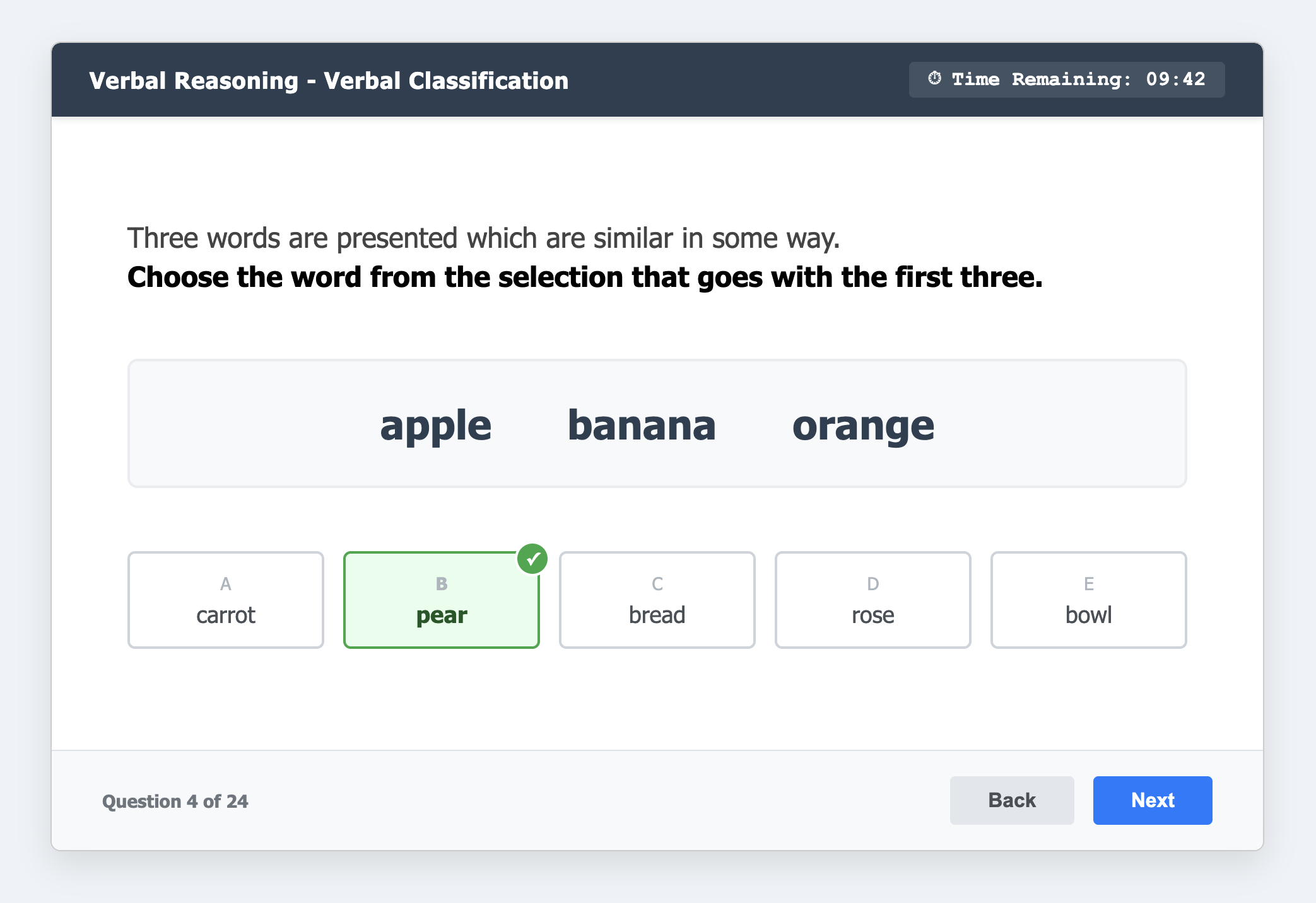
Strategy: It's crucial to practice not just understanding word meanings, but also instantly identifying categories (e.g., fruits, tools, emotions).
- Verbal Analogies: Students must complete the analogy "C : ?" so that it has the same relationship as "A : B".
Example:
finger : hand::toe: ? (Answer:foot)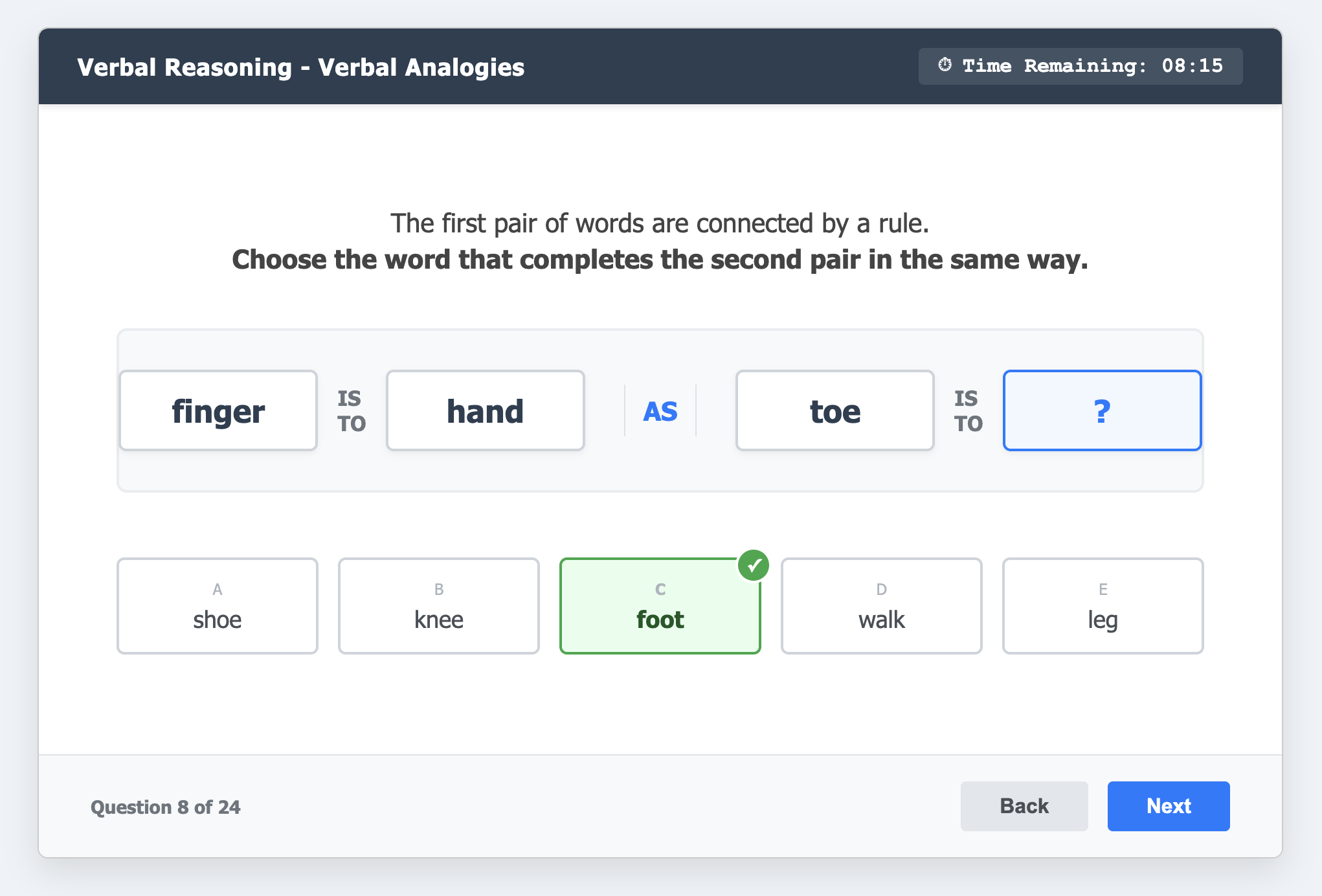
Explanation: Identify the relationship "a finger is part of a hand" and apply the same logic: "a toe is part of a foot."
② Quantitative Reasoning
This section assesses the ability to identify patterns in numbers. Advanced calculation skills are not required, but a strong number sense is essential.
- Number Analogies:
Identify the rule governing pairs of numbers, such as in
[4 → 6],[8 → 10],[9 → ?].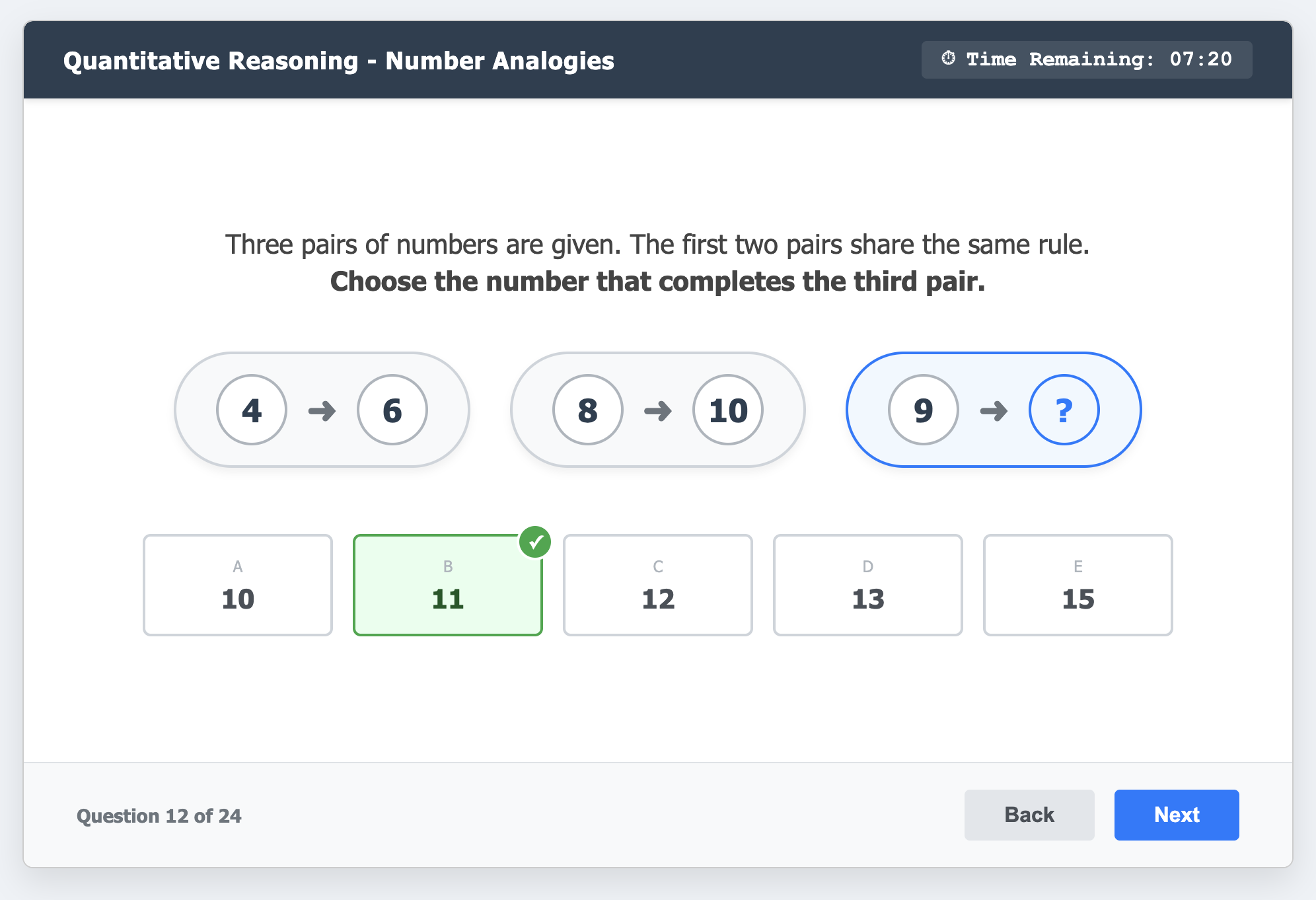
Answer:
11(The rule is +2) - Number Series:
Find the next number in a sequence, such as
2, 4, 8, 16, ?.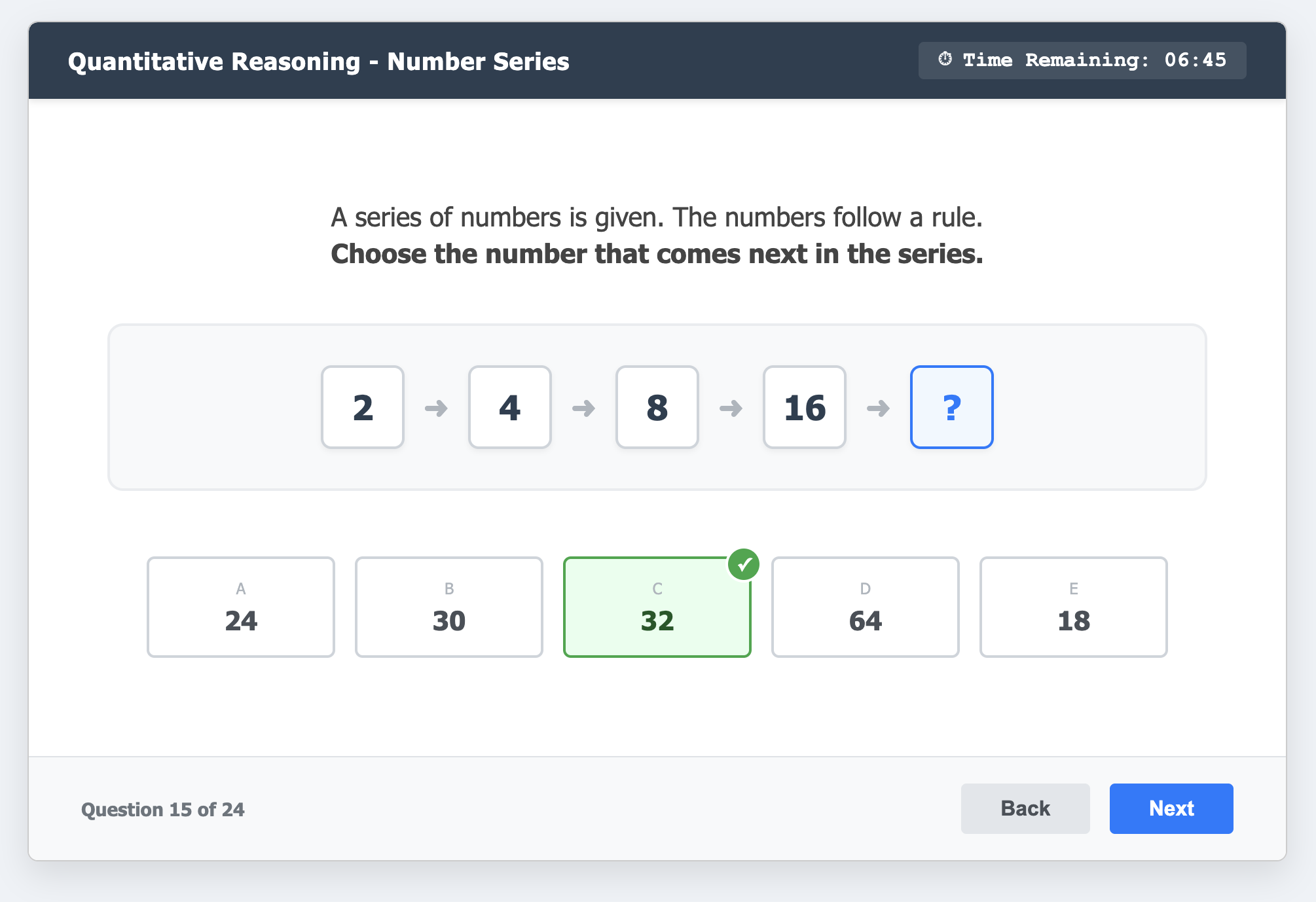
Answer:
32(The rule is x2)
③ Non-Verbal Reasoning
This section involves logic puzzles using shapes and patterns. As it is not language-dependent, students from non-English speaking backgrounds often perform well here.
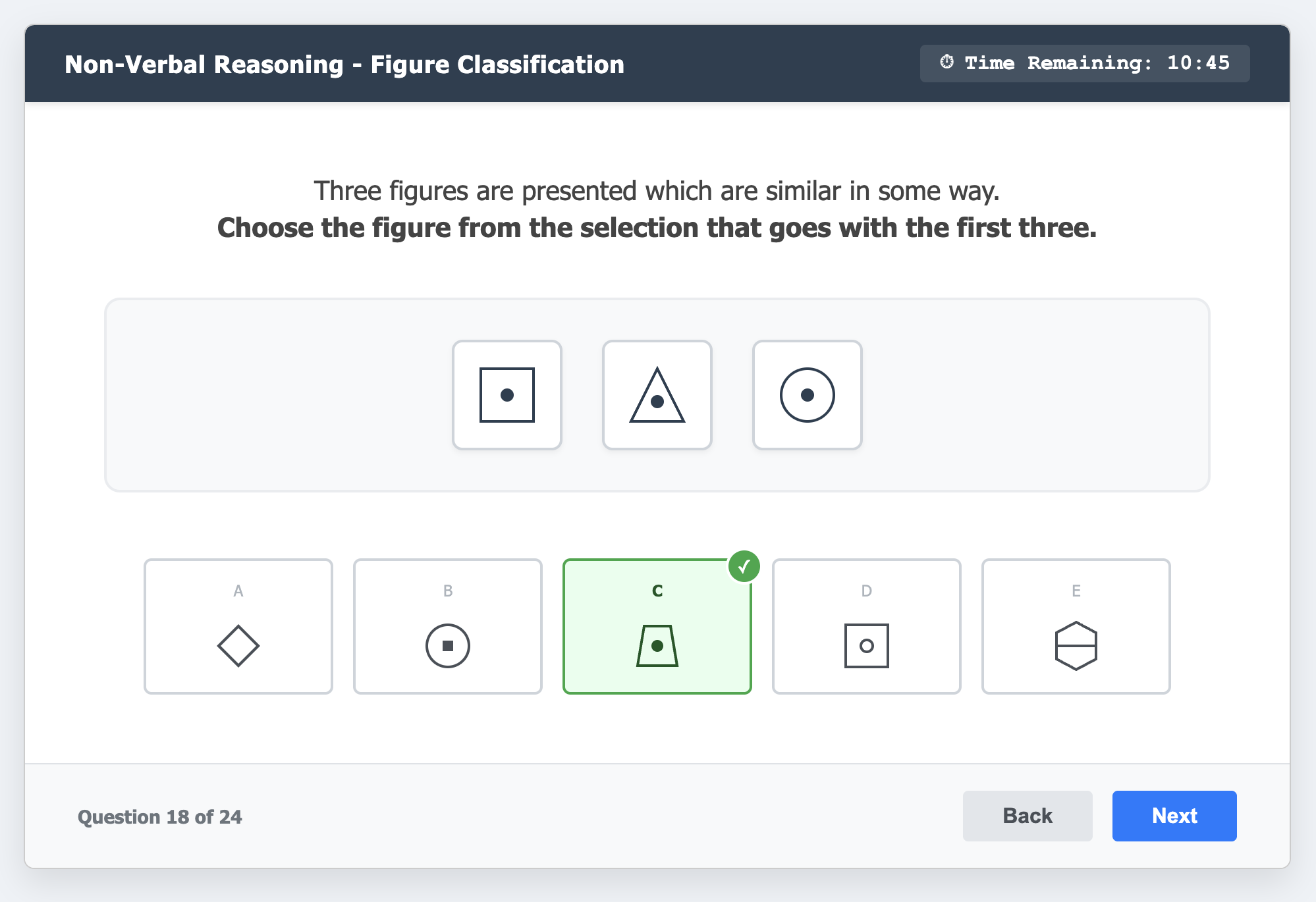
- Figure Classification: Identify a common feature in three figures (e.g., "all have a black circle," "all have three lines") and select another figure with the same feature.
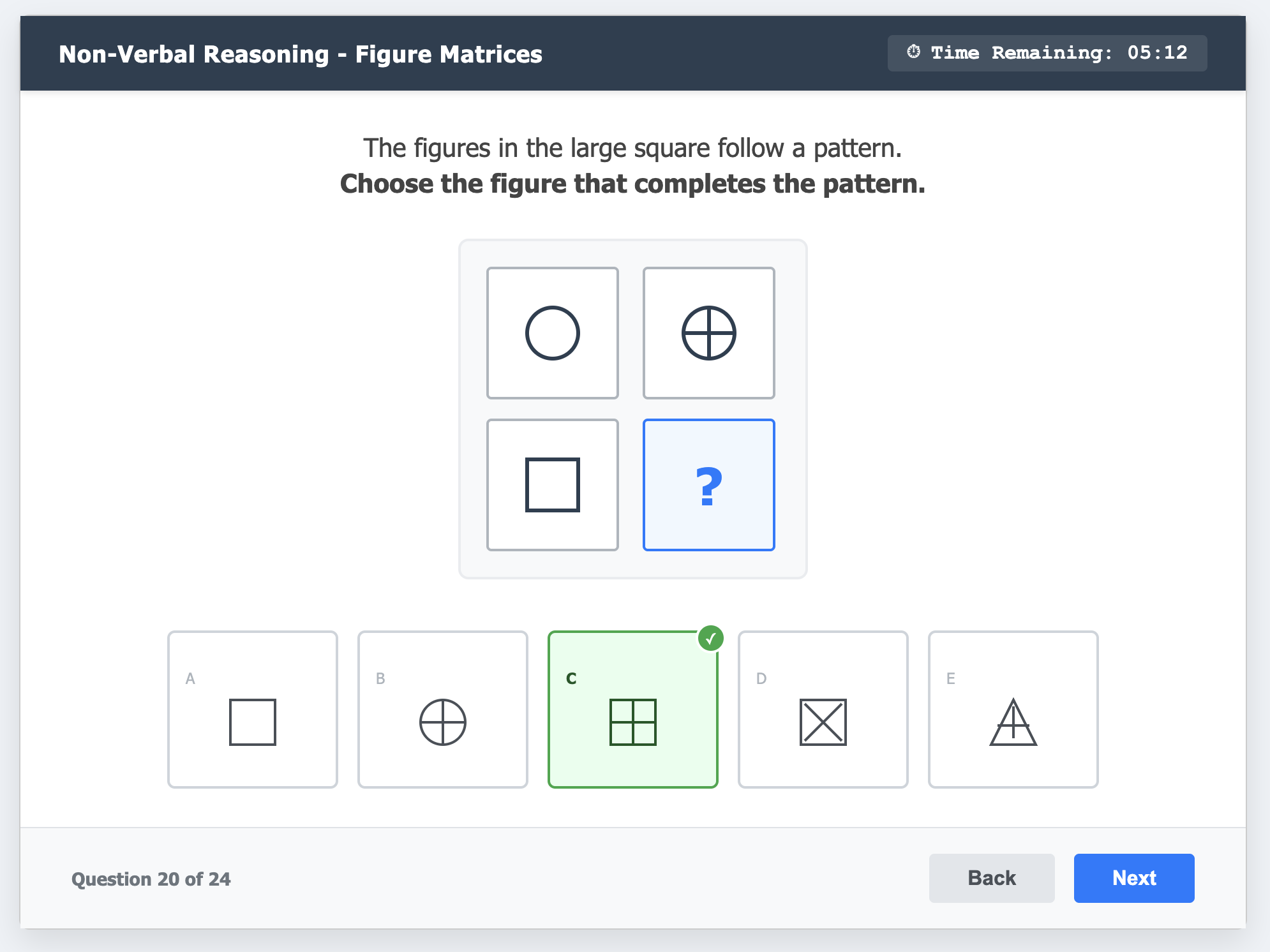
- Figure Matrices: Figures are arranged in a 2x2 or 3x3 grid, and students must deduce the figure that completes the empty square.
④ Spatial Ability
This assesses the ability to mentally rotate and assemble objects.
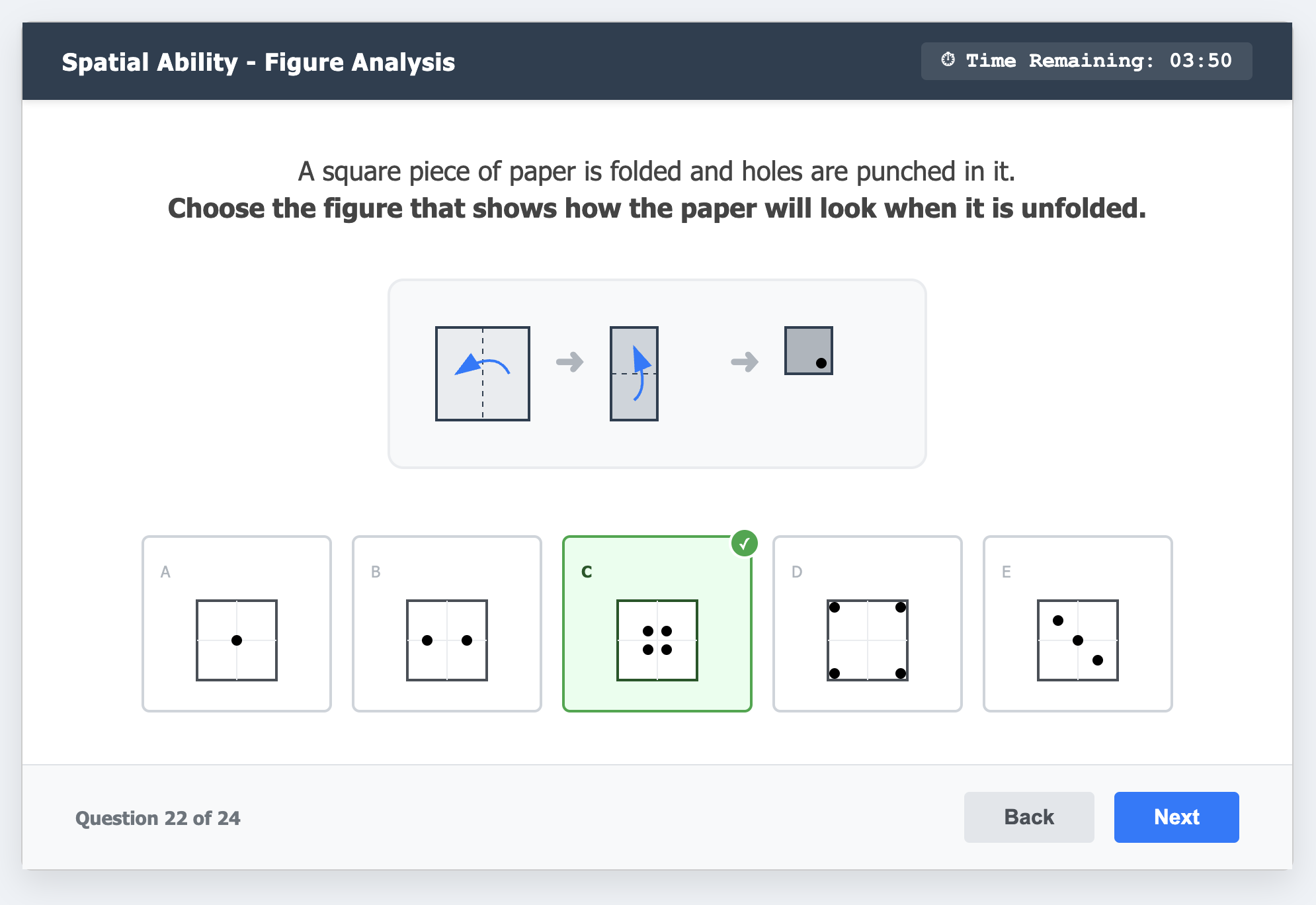
- Figure Analysis (Paper Folding): A piece of paper is folded and a hole is punched through it. Students must determine the location of the holes when the paper is unfolded.
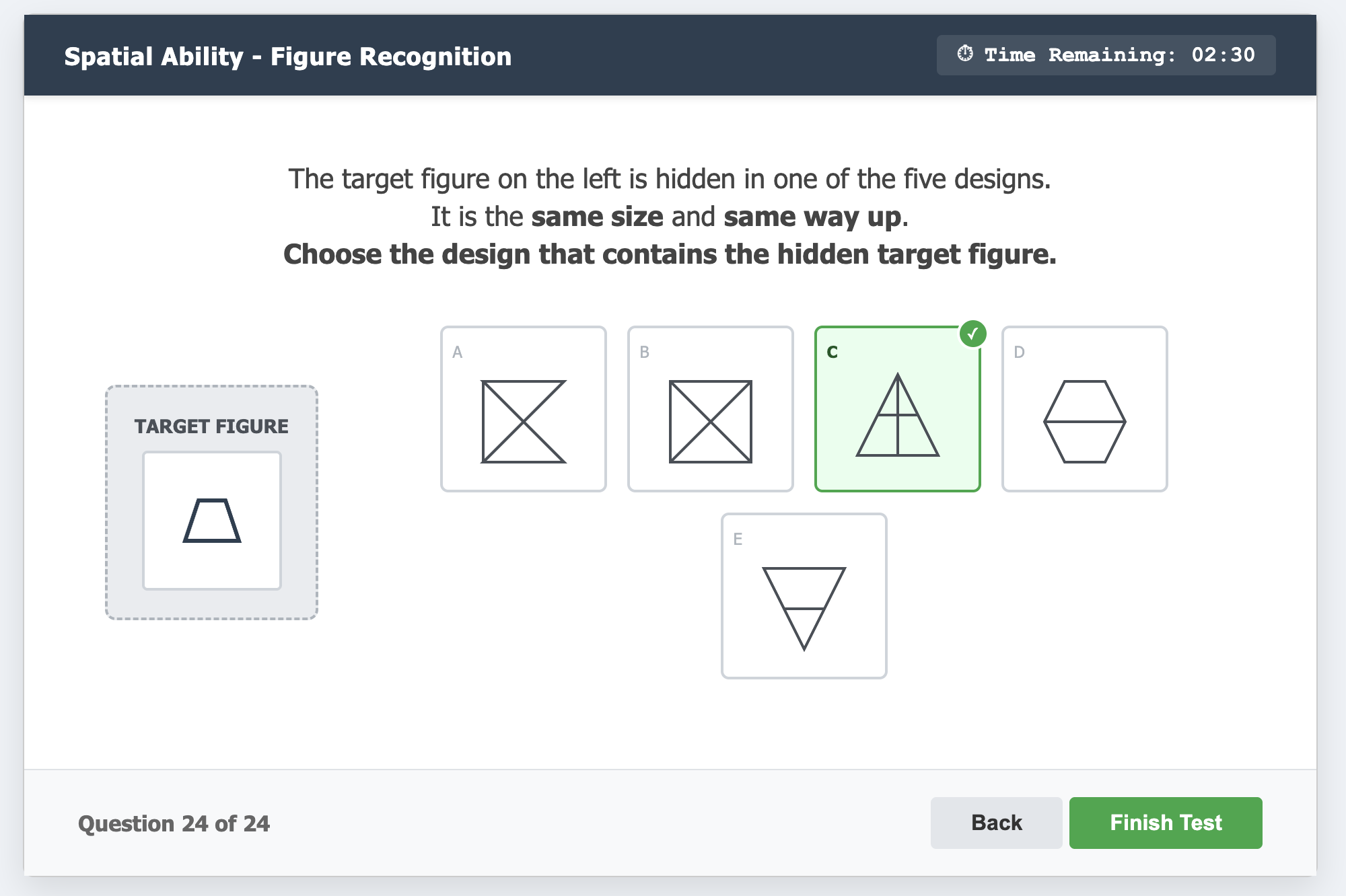
- Figure Recognition (Hidden Shapes): Students must find a "target shape" hidden within a more complex pattern.
3. What is the SAS (Standard Age Score) and What's a Passing Score?
CAT4 results are not given as a percentage of correct answers, but as a Standard Age Score (SAS), which is a standardized score similar to a percentile ranking.
- SAS 100: Average for the student's age group
- SAS 112 and above: Above Average
- SAS 127 and above: Very High
Target Scores for Top-Tier International Schools
When aiming for highly selective (Top Tier) schools like Harrow or Rugby, an average score of 100 may not be sufficient. Generally, an SAS of 115-120 or higher is considered a competitive score for admission. If a student's Verbal score is weaker, a key strategy is to achieve high scores in the other three sections (Non-Verbal, Quantitative, and Spatial) to raise the overall Mean SAS.
4. Is "No Preparation Needed" Really True? How to Prepare at Home
Schools often announce that "since the CAT4 measures potential, no practice is necessary (or possible)." However, this is often just a formal statement. In reality, being unfamiliar with the unique question formats (like paper folding or analogies) can cause students to waste time understanding the rules, leading to a lower score.
Three Effective Preparation Steps
- Familiarize with Question Formats: Use commercially available practice books (like Bond 11+) or online mock test platforms (like TestPrep-Online or Atom Learning) to work through each question type at least once. Simply being able to recognize, "Oh, this is a paper-punching question," can provide a significant mental advantage.
Bond 11+
Conclusion: Familiarity Can Significantly Impact Your CAT4 Score
While the CAT4 is a type of cognitive test, the results are not determined solely by "innate talent." With familiarity with the question formats and a solid foundation in English vocabulary, it is entirely possible to increase a score by 10 to 15 points.
To avoid the frustrating experience of thinking, "My child is bright, but they failed because they didn't understand the test format," ensure they go into the exam with at least some basic preparation.
For CAT4 Prep and British International School Admissions, Consider "ELT"
At ELT, we offer lessons designed to cultivate the logical thinking and vocabulary skills assessed by the CAT4. Our native-speaking instructors provide one-on-one support, especially for students aiming for schools like Harrow and Rugby, focusing on strengthening Verbal Reasoning and preparing for English-language interviews.
