


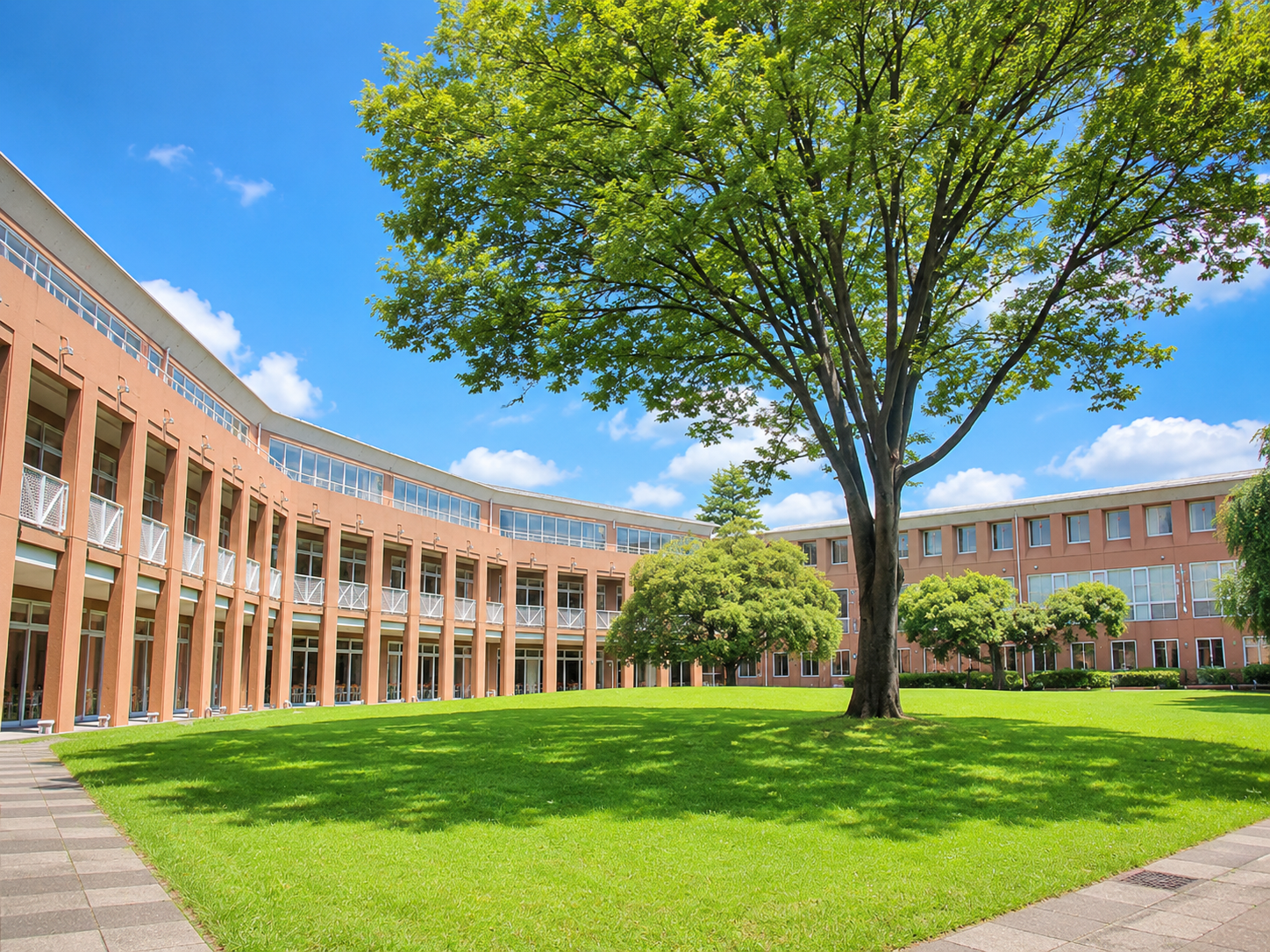
Mita International Science Academy (formerly Mita International Academy, Mita International Science Academy) is a junior-senior high school (recognized as a regular Japanese school) located in Yōga, Setagaya Ward, Tokyo. Originating from the Toita Sewing School founded by Toita Sekiko in 1902, the school underwent coeducation in 2015 as "Mita International Academy" and changed its name to "Mita International Science Academy" in 2025. As an Apple Distinguished School with all students equipped with iPads, it is an ICT-forward institution. In autumn 2025, the new innovation hub "Zero to One" building was completed.
The middle school features a three-track system: IC (International Class), ISC (International Science Class), and MSTC (Medical Science Technology Course). At the high school level, from the 2026 academic year, students in the IC track can choose between the DDP program (Western Australian Certificate of Education – WACE) and the newly available AP program (Advanced Placement for university preparation in the United States).
Recent university admission results show 92 students admitted to Waseda, Keio, Sophia, and ICU; 144 to GMARCH universities; and 13 to medical schools. Students rank in the top 0.5% on ATAR rankings, and those who achieve the highest score in a single subject on the ATAR exam are invited to Australia for recognition. Middle school entrance exam difficulty ranges from 61 to 72 in standard deviation depending on the examination round, with the fourth ISC entrance exam reaching a highly competitive 8.5x application-to-acceptance ratio. Total tuition for the six-year middle and high school program is approximately ¥7.04–7.57 million, representing exceptional value—approximately one-third the cost of pure international schools (¥24 million over six years).
[IMPORTANT] From the 2026 academic year, high school admissions (both general entrance exams and returning student exams) have been discontinued, making middle school entrance the sole pathway to enrollment.
"Which track—IC or ISC—is the better fit for my child?"
"How should we choose between DDP and AP?"
"Which entrance exams does the EIKEN Pre-1 certification exempt me from?"
"How does this compare to a pure international school?"
In this article, ELT, which has supported many successful admissions to Mita International, provides a comprehensive breakdown of the latest three-track system, the DDP vs. AP selection framework, EIKEN Pre-1 advantages, and admission strategy.
1. Mita International Science Academy — Essential Information in Five Minutes
Mita International Science Academy has established a unique position as a regular Japanese school that maximizes English-language immersion without being a pure international school, functioning as a junior-senior high school in Yōga, Setagaya Ward, Tokyo.
School Basic Information
Item | Details |
|---|---|
Official Name | Mita International Science Academy Junior and Senior High School (formerly Mita International Academy) |
Founded | 1902 (originating from Toita Sewing School, established by Toita Sekiko) |
Coeducation | 2015 (coinciding with the name change to Mita International Academy) |
Latest Name Change | 2025 (Mita International Academy → Mita International Science Academy) |
Location | Yōga, Setagaya Ward, Tokyo (5-minute walk from Yōga Station on the Tōkyū Denentoshi Line) |
Coeducational Status | Coeducational |
Curriculum | Regular Japanese school education + DDP (Western Australia WACE) + AP (introduced 2026) |
Track System | IC / ISC / MSTC – three tracks |
ICT Recognition | Apple Distinguished School certification (2018) |
Curriculum Special Designation | Middle school IC and high school IC Advanced officially implement English immersion education |
Tuition (Six-Year Middle and High School Total) | Approximately ¥7.04–7.57 million |
The Pinnacle of "Almost International" Schools
Mita International Science Academy is one of Tokyo's most refined options for families seeking to reduce the cost of pure international schooling while shifting from "learning English" to "learning through English".
- Pure international schools: ASIJ, Sacred Heart International School, Seisen International School, etc. (annual tuition ¥3–4 million; six-year total ¥24–30 million)
- Near-international (regular Japanese school international tracks): Mita International Science Academy, Hiroo Gakuen, Kaichi Nihonbashi, etc. (annual tuition ¥1–1.5 million; six-year total ¥7–8 million)
"Achieve an international school English environment at one-third the cost of a pure international school."
This is the core concept of Mita International Science Academy.
Official Status as a "Ministry of Education Curriculum Special Designation School"
Mita International Science Academy holds official designation as a Ministry of Education Curriculum Special Designation School, authorized to implement English immersion education in middle school IC and high school IC Advanced, where core subjects (English, mathematics, science, and social studies) are taught entirely in English.
This is not simply "school-independent English instruction" but rather English immersion education officially recognized by the government. Among regular Japanese schools, only a limited number are authorized to implement this officially.
Founding Philosophy: "Zhī Hào Lè" (知好楽)
"Zhī Hào Lè" derives from the Analects: "To know is not as good as to like it; to like it is not as good as to find joy in it." This foundational principle of Mita International reflects the gradual deepening of learning: "acquiring knowledge → developing interest → finding joy in learning."
This embodies learning centered not on "studying for exams" but on "posing one's own questions, conducting inquiry, and communicating findings"—a hallmark of Mita International's educational philosophy.
2. [Latest Updates] 2025 Name Change and Critical 2026 Shifts
Families considering Mita International Science Academy must first understand three major updates:
Change 1: 2025 Name Change (Mita International Academy → Mita International Science Academy)
In July 2025, the school changed its name from "Mita International Academy" to "Mita International Science Academy." This reflects a strategic shift to position science education as the core of the school's brand.
- Former name: Mita International Academy Junior and Senior High School (2015–2025)
- Current name: Mita International Science Academy Junior and Senior High School (2025–)
Change 2: 2026 AP Introduction (IC High School Track Choice Between DDP and AP)
Announced in 2024 and fully implemented from the 2026 academic year is the introduction of the AP (Advanced Placement) program to the high school IC track.
This creates two pathway options for high school IC students:
Option | Credential Earned | Primary University Destinations |
|---|---|---|
DDP Group | Western Australia WACE + Japanese high school diploma | Australia, United Kingdom, Japan (returning student admissions), United States |
AP Group (introduced 2026) | AP (U.S. university preparation) + Japanese high school diploma | Optimized for U.S. university admission |
During third-year middle school, students select between DDP and AP based on English proficiency and educational goals. Admission to the AP group requires meeting "certain benchmarks" and is subject to selection criteria (specific standards set by the school).
Change 3: 2026 High School Admissions Discontinued
From the 2026 academic year, high school admissions (both general entrance exams and returning student exams) have been suspended.
- New enrollment pathway is exclusively through middle school entrance
- Transfer and re-enrollment continue (only when vacancies arise)
- Families seeking high school enrollment should consider alternative schools (Hiroo Gakuen, Kaichi Nihonbashi, Kaetsu Ariake, etc.)
This policy shift aims to strengthen integrated middle-high school education and ensure educational quality. Middle school entrance exam competition is likely to intensify further.
What These Three Changes Signify
These major shifts signal Mita International Science Academy's complete transition to a model that "develops globally competitive students over six years from middle school through high school".
- Name change (Science): Brand reinforcement of science education
- AP introduction: Enhanced U.S. university admission support
- High school admissions discontinuation: Full integration of middle-high school education
These changes mean middle school entrance has become even more critical, and families who miss this pathway face significant difficulty in later re-entry.
3. Complete Comparison of the Three-Track System — IC vs. ISC vs. MSTC
Mita International Science Academy's middle school operates under a three-track system: IC (International Class), ISC (International Science Class), and MSTC (Medical Science Technology Course). Understanding the design philosophy and student fit for each track is the most critical factor in school selection.
Three-Track Comparison Chart
Perspective | IC | ISC | MSTC |
|---|---|---|---|
Core of the Program | "International environment" itself becomes the learning foundation. Emphasizes collaborative English-speaking culture | "Science" is the axis, cultivating scientific thinking and perspectives. English is differentiated by proficiency level | "Medical and advanced science" – specialized science education with a medical focus |
Language of Core Subjects | Academy: All four core subjects (English, mathematics, science, social studies) taught entirely in English from entry. Immersion students progress to full English by third-year middle school | English only is ability-differentiated. Full-English instruction in core subjects is limited | Standard Japanese instruction + science emphasis |
Homeroom Teacher | International Teacher (IT) as homeroom teacher; Japanese staff member as co-homeroom teacher | IT serves as co-homeroom teacher; Japanese staff member as homeroom teacher | Japanese staff member as homeroom teacher |
Homeroom Language | English-centered | Japanese and English used interchangeably | Japanese |
English Instruction | Two groups: Academy (international background students) / Immersion (general domestic students) | Three ability levels: Standard / Intermediate / Advanced | Standard English instruction |
Standard Track Target | – | No prior English study required | – |
Intermediate Level Target | – | Approximately EIKEN Level 3 to Level 2 | – |
Advanced Track Target | – | Returning students and native-level speakers | – |
Zero English Background Entry | Possible (starting in Immersion) | Possible (starting in Standard) | Possible |
Ideal for Families | Families wanting to center their child's school experience in an English-speaking environment | Families valuing both rigorous Japanese education and depth in science and inquiry learning | Families with aspirations toward medicine or advanced science |
High School Pathway | DDP Group / AP Group (student choice) | ISC Continuation | MSTC Continuation |
The Essence of IC (International Class)
The IC program's defining characteristic is that "the international environment itself, where students learn major subjects in English," forms the core of the curriculum. This is because Mita International Science Academy holds the status of a school authorized by Japan's Ministry of Education to implement curriculum innovations, enabling it to officially deliver English immersion education in major subjects at the junior high IC level.
The Difference Between IC Academy and IC Immersion
The IC program is internally divided into two groups.
Group | Target Students | English Level at Admission | Language of Study in Major Subjects |
|---|---|---|---|
IC Academy | Students who entered as returnees or through English-based entrance exams | Native or near-native level | From admission, all English for English, mathematics, science, and social studies |
IC Immersion | General students with no prior English study | Can start from zero | Progressively transition to all English by Grade 9 |
"Entering with zero English proficiency and reaching a level where students can learn major subjects entirely in English by Grade 9"—this is the design philosophy of IC Immersion. This is a unique roadmap that would be difficult to achieve in a pure international school.
IC homeroom teachers are International Teachers, with Japanese faculty members serving as assistant homeroom teachers. Homeroom instruction is conducted primarily in English from the very first day. Through the Buddy System, students from both Academy and Immersion groups develop a culture of daily collaboration.
The Essence of ISC (International Science Class)
ISC's design philosophy is "a science-oriented curriculum based on Japan's single-track system + proficiency-level-differentiated English instruction." Whereas IC is built on "the English environment itself," ISC is designed to gradually strengthen English while maintaining the stability of Japanese-language thinking.
ISC's Three-Level English System
Level | Target Students | Class Format |
|---|---|---|
Standard | No prior English study | Japanese-language instruction + team teaching led by International Teachers |
Intermediate | Approximately EIKEN Grade 2 to Pre-2 level | All English English instruction |
Advanced | Returnees and native-level speakers | All English English instruction (advanced content) |
ISC homerooms are organized regardless of English proficiency level, so Intermediate and Standard students share the same class. This creates a structure where "daily English contact naturally occurs in a diverse classroom."
Beginning in Grade 8, students enter the Foundation Seminar, which strongly emphasizes science and inquiry-based learning.
Characteristics of MSTC (Medical Science and Technology Course)
Established in 2019, MSTC is a specialized course designed for students pursuing medicine and advanced science.
- Advanced science education implemented from junior high
- Curriculum strongly oriented toward medical school admission
- Partnership programs with universities and research institutions
- Entrance examination difficulty at the highest level (MSTC math and science entrance exam: 65-72 in stanine)
MSTC is "science-oriented + medical school admission"—an ideal option for families with clear goals.
The Reality of "Zero English Proficiency" Admission
Mita International Science Academy explicitly states in its official FAQ that "all classes accept students with zero English learning experience at admission." This is the school's most distinctive feature compared to pure international schools (many of which impose strict English requirements).
- IC Immersion: Accepts students with no prior English study; aims for all-English major subjects by Grade 9
- ISC Standard: Accepts students with no prior English study; progressively strengthens English through three levels
- MSTC: Accepts students with no prior English study
However, "zero English proficiency accepted" does not mean "zero learning burden." IC in particular has strong "environmental pressure" in English, and homework and assignments increase significantly after admission. Family support for English and student motivation are essential.
4. 【Critical】Senior High Pathways—DDP Group vs. AP Group
The most significant differentiation point of Mita International Science Academy is the curriculum choice in senior high. Beginning in the 2026 academic year, students in senior high IC can choose between DDP Group (Western Australia WACE) and AP Group (U.S. university preparation)—two distinct pathways.
DDP Group vs. AP Group Comparison Table
Item | DDP Group | AP Group (launching 2026) |
|---|---|---|
Qualifications Earned | WACE (Western Australian Certificate of Education) + Japan high school diploma | AP (Advanced Placement) + Japan high school diploma |
Assessment Metric | ATAR (percentile rank from 0.00-99.95) | AP Score (5-point scale: 1-5) |
Available Subjects (Publicly Disclosed) | EAL/D, Math Applications, Math Methods, Chemistry, Media Production and Analysis, etc. | Details to be announced by the school (planned 2026 launch) |
Primary University Destinations | Australia, United Kingdom, United States, and Japan | Top U.S. universities |
Study Format | Integrated study of 5-6 subjects + external examination | Independent enrollment per subject; students can take multiple subjects in areas of strength |
University Entrance Recognition | Mainstream qualification in Australia; widely recognized in UK and U.S. | Subject to credit recognition and selective evaluation at U.S. universities |
Selection Process | Advancement from junior high IC to DDP Group (standard pathway) | Selection restricted to students exceeding specified criteria (limited availability) |
Launch Year | 2021 | 2026 |
Why Choose the DDP Group
DDP is a rare program globally, enabling students to earn an Australian high school credential without leaving Japan. Mita International maintains official partnership with the Western Australian Department of Education, and certified teachers deliver instruction aligned with the official curriculum.
The DDP pathway is suited to families who:
- Are considering Australian universities
- Wish to keep U.K. universities (accessible via ATAR-based applications) as an option
- Are considering using DDP for Japan domestic university returnee admissions and comprehensive selection exams
- Value integrated learning across 5-6 subjects equally
Why Choose the AP Group
AP, launching in 2026, is a new pathway designed for students seriously pursuing U.S. university admission.
The AP pathway is suited to families who:
- Are genuinely committed to U.S. university admission
- Wish to specialize deeply in areas of strength (through independent subject-by-subject enrollment)
- Wish to leverage U.S. university credit recognition
However, since "students must exceed specified criteria, and availability is restricted" (per official documentation), advancement to the AP Group is expected to be more selective than entry to the DDP Group.
Senior High Pathways from IC Immersion
According to official information:
- IC Academy: In Grade 11, students can choose from both DDP and AP pathways
- IC Immersion: Progression to the DDP Group allows students to build solid proficiency steadily. AP Group progression requires students to "exceed specified criteria," with restrictions applied
In other words, students who enter IC Immersion with zero English proficiency can still earn a world-class high school credential through the DDP Group—this is IC Immersion's core design principle.
For more detailed information on the AP system, please see the following article.
The Complete Guide to AP (Advanced Placement) [2026 Edition] | Subject List, Exam Dates, Scores, and College Credit
5. DDP and WACE·ATAR—Your Passport to International University Admission
To understand DDP's true nature, you must grasp the official rules governing WACE (Western Australian Certificate of Education) and ATAR (Australian Tertiary Admission Rank) with precision.
What is WACE—The Western Australian High School Diploma
WACE (Western Australian Certificate of Education) is the Year 12 (Grade 12) completion qualification from Western Australia. To earn WACE, students must satisfy the requirements set by SCSA (School Curriculum and Standards Authority).
Official Requirements for WACE (2026 Version)
Requirement | Details |
|---|---|
Credit Units | Minimum of 20 units completed |
Year-Level Requirement | Must include units completed in Year 12 |
English Domain | Must satisfy English requirement |
List A/B | Minimum units from List A (primarily Arts/Languages/Social Sciences) and List B (primarily Math/Sciences/Technologies) |
Grade Standard | Specified number of subjects must achieve C grade or above |
Literacy/Numeracy | OLNA or Year 9 NAPLAN specified achievement level |
ATAR Subject External Exams | External examination is mandatory if students enroll in ATAR subjects in Year 12 |
Source: SCSA Official WACE Requirements
If external examination is not taken, those units do not count toward WACE requirements—an important public rule. This means "even in the DDP program, external examinations are mandatory if aiming for an ATAR score."
What is ATAR—Your University Admission Rank
ATAR (Australian Tertiary Admission Rank) is calculated by TISC (Tertiary Institutions Service Centre) and expressed as a percentile rank (0.00-99.95) indicating your relative position within your age cohort.
Official Rules for ATAR Calculation
Requirement | Details |
|---|---|
Number of Subjects Required | Minimum of 4 scaled scores |
Calculation Method | TEA (Tertiary Entrance Aggregate) = calculated from the sum of the best four scaled scores |
Range | 0.00 (lowest) to 99.95 (highest) |
Source: TISC Official ATAR Guide
ATAR is not an absolute score but a relative percentile rank. For example, "ATAR 90" means "top 10% of your age cohort," and "ATAR 95" means "top 5%."
Mita International Science Academy's WACE/ATAR Results
Based on publicly available information:
- ATAR ranking in the top 0.5% globally — documented achievement
- Students earning the highest score in individual ATAR subjects, resulting in invitation and recognition from Australia
- Documented success in domestic Japanese university returnee admissions using WACE
This demonstrates concrete evidence that the school is producing students who rank in the top 0.5% even when competing against their international age cohort.
Mita International Science Academy's WACE ATAR Subjects (Publicly Disclosed)
The school's official curriculum PDF lists the following WACE ATAR subjects available.
Subject | Content |
|---|---|
EAL/D (English as an Additional Language/Dialect) | English for Second Language Learners |
Mathematics Applications | Applied Mathematics |
Mathematics Methods | Advanced Mathematics |
Chemistry | Chemistry |
Media Production and Analysis | Media Production and Analysis |
Source: Mita Kokusai Science Academy Official High School IC Curriculum PDF
These subjects are studied at Mita Kokusai, and students take external examinations in Year 12, which leads to WACE qualification and ATAR calculation.
6. University Admission — A Regional Comparison of Practical Reality
How DDP/WACE/ATAR can actually be used in university admissions varies significantly by country, university, faculty, and academic year. Rather than vague expectations about "accessing overseas universities," it is essential to rely on accurate regional comparisons based on official sources.
Regional University Admission Pathway Comparison
Region | WACE/ATAR Status | Foundation Course |
|---|---|---|
Australia | Mainstream qualification (directly used in undergraduate applications) | Not required |
United Kingdom | Directly recognized by major universities (Cardiff, Warwick, Surrey, etc.) | Offered only if minimum standards are not met |
United States | Incorporated as documentation in Freshman admission | Foundation program system itself is not common |
Japan | Varies by university (Nagoya University's G30 Program, for example, requires both ATAR and WACE) | Not required (used alongside Japanese high school graduation certificate) |
Australia — WACE/ATAR as the Mainstream Path
In Australia, WACE and ATAR are essentially the mainstream high school completion qualifications.
According to TISC's 2026 University Admission Guide, school leavers in Western Australia who wish to proceed to university typically require:
- WACE (senior secondary certificate)
- English requirement
- A competitive ATAR/Selection Rank
- Prerequisite subjects specified by each university
The University of Western Australia (UWA) officially defines ATAR as "a Year 12 achievement ranking used to determine eligibility for undergraduate entry." The university also publicly discloses its practice of awarding adjustment points according to WACE ATAR subjects.
University admission in Australia is a qualification that allows direct undergraduate application without requiring a Foundation Course.
United Kingdom — Direct Recognition by Major Universities
In the United Kingdom, where WACE and ATAR are directly recognized as entry requirements, students can apply for undergraduate programs without a Foundation Course.
Official confirmation from major universities:
University | ATAR Requirement / Conversion |
|---|---|
Cardiff University | ATAR 80+ considered for direct entry into Year 1 of bachelor's degree |
University of Warwick | A-level conversion: AAA = WACE+ATAR 95, AAA = WACE+ATAR 97* |
University of Surrey | Publishes ATAR conversion table; applicants below the threshold are offered International Foundation Year |
In other words, if minimum requirements are met, direct entry into UK universities is possible; only when standards are not met does International Foundation Year become an alternative pathway.
United States — Foundation Programs Are Not Standard
In the United States, the Foundation Year system common in the UK does not exist as a standard practice. Therefore, the concept of "Foundation exemption" does not apply.
Confirmed operational practices:
- University of Michigan: Requires WACE and ATAR submission from Australian applicants
- Many US universities: Incorporate WACE and ATAR as documentation in Freshman admission (alongside SAT/ACT scores and transcripts)
In other words, in the United States, WACE/ATAR is accurately understood as "high school completion qualification plus evidence of academic achievement."
The AP program launching in 2026 will represent a pathway specifically optimized for US university admission, providing a stronger option than DDP for students strongly oriented toward attending US universities.
Japan — Varies by University
Within Japan, the treatment of WACE/ATAR varies significantly by university.
Confirmed operational practices:
- Nagoya University's G30 Program: Formally requires ATAR and WACE as country-specific qualifications
- NIC-Japan: Japanese higher education entry qualifications are determined based on School Education Act and individual university screening
However, Mita Kokusai Science Academy DDP students simultaneously obtain a Japanese high school graduation certificate. Therefore, within Japan:
- General entrance examinations and international student entrance examinations for Japanese universities: Apply using Japanese high school graduation certificate
- Comprehensive selection (formerly AO entrance exams): Leverage WACE/ATAR as a strength
- International admissions and English-medium degree programs: Use WACE/ATAR directly
The practical advantage is the flexibility to strategically employ these three different routes.
Precise Understanding of "Foundation Not Required"
The official Mita Kokusai brochure states that "WACE certificate and ATAR often eliminate the need for Foundation Courses at overseas universities."
However, the critical point is that "'often' does not mean 'always'." The actual application depends on:
- The university
- The faculty or program
- The academic year
- The individual ATAR score
Therefore, at the time of application, it is essential to make a final confirmation using the latest requirements from SCSA / TISC / the target university.
7. University Admission Results — 92 Acceptances to Top Japanese Universities, 13 Medical School Admissions, Top 0.5% ATAR
Mita Kokusai Science Academy's university admission results have improved year after year since coeducation was introduced in 2015.
Recent Major University Admission Results
University / Program | Number of Acceptances |
|---|---|
Waseda, Keio, Sophia, Tokyo Science, and ICU | 92 |
GMARCH Universities (Meiji, Aoyama Gakuin, Rikkyo, Chuo, Hosei, Gakushuin) | 144 |
Medical School | 13 |
National and Public Universities | Significant number |
Source: Official school admission outcomes page and education media (LocalLog, etc.)
Overseas University Admission Results (DDP/WACE Utilization)
Admission results to overseas universities through DDP/WACE/ATAR:
- Australia: Within top 0.5% of ATAR, achieving highest subject score with invitations and recognition from Australian institutions
- Secured pathways to UK universities (Cardiff, Warwick, Surrey, etc.)
- Admission to US universities (further acceleration expected after AP program launch in 2026)
- Cases of DDP/ATAR utilization in Japanese university international student entrance examinations and comprehensive selection
Structural Factors Behind Admission Result Growth
Factors supporting Mita Kokusai Science Academy's improving admission outcomes:
- Academic Excellence: Entrance exam difficulty of 61–72 indicates selective admission
- DDP/AP Programs: Clear pathways to overseas university admission
- ATAR Utilization: Direct entry qualifications for UK and Australian universities
- Science Strengthening: MSTC establishment, Zero to One new campus, Apple Distinguished School recognition
- Inquiry-based and Presentation Skills: Two-way interactive lessons and cross-curricular instruction enhancing critical thinking
Ten Years of Coeducation and Evolution of Admission Outcomes
Since coeducation began in 2015, Mita Kokusai has achieved 13 medical school admissions and 92 acceptances to top universities—results delivered by the first cohort of graduates since coeducation.
Compared to the precoeducation era (Toita Junior and Senior High School for girls), admission outcomes have improved dramatically. This demonstrates the success of coeducation combined with educational reform (DDP, IC/ISC/MSTC, and ICT advancement).
Over the next 5–10 years, as AP program graduates enter the system, thicker outcomes for admission to top-tier US universities are anticipated.
8. [Critical] Mita Kokusai Science Academy vs. Competitive Schools
Families considering Mita Kokusai almost always compare it against other "quasi-international" schools (international courses at accredited Japanese schools). This section presents a comparison with the four most directly comparable institutions.
Four-School Comparison Table
Factor | Mita Kokusai Science Academy | Hiroo Gakuen | Hiroo Gakuen Komagome | Kaichi Nihonbashi |
|---|---|---|---|---|
Location | Setagaya Ward, Yōga | Minato Ward, Minami Azabu | Bunkyo Ward, Honkomagome | Chuo Ward, Nihonbashi |
Founded / Coeducation | 1902 / 2015 | 1918 / 2007 | Coeducational from 2021 | 1924 / 2015 |
International Programs | IC / ISC / MSTC | International (AG/SG) / Medical/Science / Regular / Medical | International (AG/SG) / Regular | GLC / DLC / SEC |
DDP Offered | Yes (Western Australia WACE) | No | Yes (Western Australia WACE) | No |
AP Program Offered | Yes (launching 2026) | No | No | No |
IB Program Offered | No | No | No | Yes (DLC/GLC) |
English Proficiency Incentives | ISC: English Test Grade 1 (EIKEN Pre-1) exempts English requirement | Available | Available | Yes |
Deviation Value (80% benchmark) | 61-72 | 65-72 | 64-70 | 58-67 |
6-Year Tuition (Estimate) | Approximately 7.04–7.57 million yen | Approximately 7.50–8.20 million yen | Approximately 7.20–7.80 million yen | Approximately 6.50–7.20 million yen |
University Placement Results | Early/Waseda/Keio/University of Tokyo/ICU: 92 students; Medical school: 13 students | Early/Waseda/Keio 100+; Medical school | Early/Waseda/Keio | Early/Waseda/Keio |
High School Admissions | Suspended (from 2026) | Continuing | Continuing | Continuing |
How to Choose Among the Four Schools
Why Mita International Science Academy is selected:
- Two major programs: DDP (Western Australia WACE) + AP (to be introduced in 2026)
- English immersion education as a designated educational innovation school (officially recognized)
- Three-class system: IC, ISC, and MSTC accommodating diverse pathways
- Quiet location in Yoga, Setagaya; Zero to One new campus
- Apple Distinguished School accreditation; ICT-advanced institution
Why Hiroo Gakuen is selected:
- Urban location in Minami-Azabu, Minato Ward
- History and track record of the International Course (AG/SG)
- Strong medical and science courses
- Reliable university placement results of 100+ to Early/Waseda/Keio
Why Hiroo Gakuen Koishikawa is selected:
- DDP implementation (Western Australia WACE) — equivalent to Mita International
- Excellent location in Honkomagome, Bunkyo Ward
- Fresh environment following recent coeducation
- Inheritance of the Hiroo Gakuen brand
Why Kaichi Nihonbashi is selected:
- IB implementation (DLC/GLC) — an option not available at Mita International
- Location in Nihonbashi, Chuo Ward
- Comparatively affordable tuition (approximately 6.50–7.20 million yen)
- Emphasis on inquiry-based learning
The Typical Dilemma: "Mita International vs. Hiroo Gakuen Koishikawa"
Among DDP-implementing schools, the two most directly compared are Mita International Science Academy and Hiroo Gakuen Koishikawa. Selection criteria for both schools:
Perspective | Mita International Science Academy | Hiroo Gakuen Koishikawa |
|---|---|---|
DDP | ✓ | ✓ |
AP | ✓ (2026) | – |
Location | Yoga, Setagaya Ward | Honkomagome, Bunkyo Ward |
Coeducation | 2015 (10 years of track record) | 2021 (newly established school) |
MSTC (Healthcare) | ✓ | – |
ICT Accreditation | Apple Distinguished School | – |
6-Year Tuition | Approximately 7.04–7.57 million yen | Approximately 7.20–7.80 million yen |
If you seek "DDP + AP + MSTC + 10 years of coeducation track record," Mita International Science Academy is the choice. If you prefer "Hiroo Gakuen brand + urban location + freshness," Hiroo Gakuen Koishikawa is the choice. This differentiation reflects each school's distinct strengths.
9. Complete Explanation of Tuition for 2026 (Revised)
Mita International Science Academy's tuition represents approximately 30% of that of a pure international school, an exceptionally rare cost-performance advantage.
Official Tuition (2025–2026 Academic Year)
Junior High School
Item | Amount |
|---|---|
Admission Fee | 350,000 yen |
Tuition (annual) | 552,000 yen |
Facility Fee (annual) | 150,000 yen |
Maintenance and Utility Fee (annual) | 228,000 yen |
Total Annual Tuition | 930,000 yen |
PTA and Student Council (annual) | 46,900 yen |
Senior High School (Revised from 2026 Academic Year)
Item | Amount |
|---|---|
Admission Fee | 300,000 yen |
Tuition (annual) | 516,000 yen |
Facility Fee (annual) | 50,000 yen |
Maintenance and utilities (annual) | 168,000 yen |
Total tuition (annual) | 734,000 yen |
PTA and student council (annual) | 46,900 yen |
Source: Mita International Science Academy official tuition page
Reference guidelines (official information)
Junior high school
Item | Grade 7 | Grade 8 | Grade 9 |
|---|---|---|---|
Educational enrichment fee | Approximately 250,000 yen (including iPad-related expenses) | Approximately 120,000 yen | Approximately 120,000 yen |
Residential training fees | Approximately 60,000 yen | Approximately 60,000 yen | Approximately 110,000 yen |
School supplies (uniform 120,000 yen, bag and sports equipment 50,000 yen) | 170,000 yen | – | – |
Senior high school
Item | Grade 10 | Grade 11 | Grade 12 |
|---|---|---|---|
Educational enrichment fee | Approximately 150,000 yen | Approximately 100,000 yen | Approximately 100,000 yen |
Alumni association fee | – | – | 18,000 yen (one-time) |
School supplies (uniform 110,000 yen, bag and sports equipment 50,000 yen) | 160,000 yen | – | – |
DDP additional fees
The DDP program fee is listed as "separate" on the official tuition page, but the specific amount is not disclosed. According to the press release from the DDP introduction in 2020, the cost is stated as "approximately 230,000 yen for three years of high school," so this article uses 230,000 yen as an estimated figure.
Six-year total cost simulation
Scenario | Junior high total (3 years) | Senior high total (3 years) | High school entrance fee | DDP additional | Six-year total estimate |
|---|---|---|---|---|---|
Without DDP, no high school entrance fee | 4,170,700 yen | 2,870,700 yen | 0 yen | 0 yen | 7,041,400 yen |
Without DDP, with high school entrance fee | 4,170,700 yen | 2,870,700 yen | 300,000 yen | 0 yen | 7,341,400 yen |
With DDP, no high school entrance fee | 4,170,700 yen | 2,870,700 yen | 0 yen | 230,000 yen | 7,271,400 yen |
With DDP and high school entrance fee | 4,170,700 yen | 2,870,700 yen | 300,000 yen | 230,000 yen | 7,571,400 yen |
The six-year junior and senior high school total costs range from approximately 7.04 million to 7.57 million yen.
Comparison with international schools
School | Six-year total (estimate) | Ratio to Mita International |
|---|---|---|
ASIJ (American curriculum) | Approximately 25–30 million yen | Approximately 4 times |
Sacred Heart ISSH | Approximately 24–26 million yen | Approximately 3.4 times |
BST | Approximately 19–21 million yen | Approximately 2.7 times |
Seisen SIS | Approximately 15–17 million yen | Approximately 2.2 times |
Mita Kokusai Science Academy | Approximately ¥7.04–7.57 million | Standard |
Hiroo Gakuen | Approximately ¥7.50–8.20 million | Approximately 1.07× |
Kaichi Nihonbashi | Approximately ¥6.50–7.20 million | Approximately 0.93× |
At approximately 30% of the cost of pure international schools, you can earn both the DDP (Western Australia graduation qualification) + AP (launching in 2026)——this is Mita Kokusai Science Academy's greatest value proposition.
Variable Costs: A Critical Consideration
The above simulation excludes variable costs. In practice, you will also need to budget for:
- Overseas study trips (DDP-related field programs, etc.)
- Study abroad expenses (depending on destination and duration)
- Device fees (iPad upgrades, additional ICT equipment)
- Currency-dependent costs (DDP external examinations, etc.)
Taking these into account, a realistic estimate of the actual family burden is in the range of ¥8 million.
10. [Critical] Middle School Entrance Exam:偏差値, Competitiveness, and Test Format
Mita Kokusai Science Academy's middle school entrance examination is among the most competitive in the Tokyo metropolitan area.
Standardized Assessment Scores by Test Session (80th Percentile)
Test Session | Class | Score |
|---|---|---|
Session 1 | IC / ISC | 61 |
Session 2 | IC / ISC | 64 |
Session 3 | IC / ISC | 67 |
Session 4 | IC / ISC | 70–72 |
MST Entrance Exam | MSTC | 65–72 |
Source: Ranking data from Yotsuya Otsuka, Tokyo Metropolitan Testing Center, and other assessment bodies
Actual Acceptance Ratios by Test Session
Test Session | Actual Ratio |
|---|---|
Session 1 | Approximately 3:1 |
Session 2 | Approximately 4:1 |
Session 3 | Approximately 5–6:1 |
Session 4 ISC | Approximately 8.5:1 |
MST Entrance Exam | Approximately 3.9:1 |
Returnee (Kikokushi) Entrance Exam | Relatively lower |
Entrance Exam Format Options (February 2026 Admissions)
IC (International Class)
Format | Test Subjects |
|---|---|
Four-Subject Format | Japanese, Mathematics, Science, Social Studies |
English Format | English 60 minutes (including listening) + interview |
ISC (International Science Class)
Format | Test Subjects |
|---|---|
Four-Subject Format | Japanese, Mathematics, Science, Social Studies |
English Format | English 60 minutes (including listening) + Japanese and Mathematics 50 minutes + interview |
ISC English Preference Format | English exempted + Japanese and Mathematics 50 minutes + interview (for holders of Eiken Grade Pre-1 or higher, etc.) |
MSTC
Format | Test Subjects |
|---|---|
MST Entrance Exam | Mathematics and Science focused |
Four-Subject Format | Japanese, Mathematics, Science, Social Studies |
Source: Mita Kokusai Science Academy official 2026 recruitment prospectus
English Exam Format
Question composition for the English format (shared by IC and ISC):
Section | Content |
|---|---|
Reasoning | Mathematics presented in English |
Listening Comprehension | Listening |
Reading Comprehension | Reading comprehension |
Essay Writing | Free-form essay writing |
All sections except listening are written responses, and writing proficiency is heavily weighted.
Educational media analysis concludes that "English proficiency equivalent to EIKEN Grade Pre-1 to Grade 1 is required."
Interview Structure
Item | Details |
|---|---|
Format | Candidate only |
Duration | Approximately 10 minutes |
Language | Both English and Japanese |
Preference Measure Holders | Interview is conducted |
Specific questions and evaluation criteria are not publicly disclosed. In practical terms, it is recommended that candidates prepare to speak about their self-introduction, motivation for applying, reason for choosing IC/ISC, and desired future learning in both English and Japanese, using 1–2 minutes for each language.
11. [Critical] EIKEN Grade Pre-1 Preference and the Reality of "English Exemption"
Mita Kokusai Science Academy's entrance exam offers significant advantages to holders of EIKEN Grade Pre-1 or higher. However, the application of this advantage differs by target class, and precise understanding is essential.
Official English External Exam Preference Information for 2026 Admissions
Item | Details |
|---|---|
Eligible Classes | ISC applicants only |
Exemption Details | English written exam (including listening, 60 minutes) is waived |
Classification | True "exemption," not "deemed score" |
Eligible Scores | EIKEN Grade Pre-1 or higher (CBT/S-CBT accepted), TOEFL iBT 72+, IELTS Academic 5.5+ |
Certificate Requirements | Score from November 2023 onward, uploaded within specified deadline |
Interview | Interview is conducted even for exemption holders (English + Japanese, candidate only, approximately 10 minutes) |
Source: Mita Kokusai Science Academy official ISC English Written Exam Preference Procedure PDF (2026)
Common Misconception: "EIKEN Grade Pre-1 Exempts You from English in Both IC and ISC"
A frequent misunderstanding in ELT consultations:
✗ "If you have EIKEN Grade Pre-1, English is waived in both IC and ISC"
✓ "English written exam exemption applies to ISC only"
The official preference measure is limited to ISC; there is currently no explicit English written exam waiver for IC.
The Role of EIKEN Grade Pre-1 for IC Applicants
For families targeting IC, EIKEN Grade Pre-1 is best understood not as an "exemption" but as "a foundation that increases your likelihood of success."
- You will more easily earn high marks on the English exam (Reading/Listening/Writing/Reasoning)
- You are more likely to be placed directly in IC Academy
- You will transition smoothly into all-English lessons after admission
Strategic Value of EIKEN Grade Pre-1 for ISC Applicants
For families targeting ISC, EIKEN Grade Pre-1 is an overwhelming strategic advantage.
- The English written exam (60 minutes) is completely waived (not a deemed score)
- On exam day, you face only Japanese and Mathematics (50 minutes) + interview
- You eliminate the risk of losing points on the English section
- You gain time and mental resources to focus on Japanese and Mathematics
EIKEN Grade 2 Is Not an Official Preference Measure
EIKEN Grade 2 does not appear in the official 2026 preference measures list. The assumption that "EIKEN Grade 2 earns you bonus points" is not supported by official documentation.
That said, official FAQs indicate that the target level for ISC/MSTC English classes is "EIKEN Grade Pre-2 to Grade 2 equivalency". This describes the expected level for post-admission English coursework and is separate from entrance exam advantages.
Roadmap for Attaining EIKEN Grade Pre-1
Practical guidance based on ELT's instructional experience:
Grade Level | Recommended Target |
|---|---|
Grade 4 | Attain EIKEN Grade 3 |
Grade 5 | Attain EIKEN Grade 2 |
Summer Grade 5 – Spring Grade 6 | Target EIKEN Grade Pre-1 |
Summer Grade 6 | Complete foundation in Japanese and Mathematics; begin interview preparation |
Autumn Grade 6 | Final exam preparation; conduct mock interviews |
Making EIKEN Grade Pre-1 attainment by autumn of Grade 6 your top priority significantly reduces the burden on test day.
Breaking Through the Eiken Grade Pre-1 Barrier! English Skills and Study Methods for Admission to Top Japanese Universities
12. Age-Based Entrance Exam Preparation Roadmap
This practical preparation roadmap is derived from reverse-engineering the preparation timeline of successful candidates ELT has supported.
For IC Applicants
Period | Actions |
|---|---|
Grades 3–4 | Begin foundational English language study; establish regular conversational English and reading habits |
Grade 5, Spring | Achieve EIKEN Grade 2, foundational English composition training |
Grade 5, Summer–Winter | Target EIKEN Grade Pre-1, begin English entrance exam preparation |
Grade 6, Spring | Reading/Listening/Writing/Reasoning preparation, foundational completion in four subjects |
Grade 6, Summer | Past paper practice, interview preparation begins (English + Japanese) |
Grade 6, Autumn | Application document preparation, final adjustments |
Grade 6, January–February | Final exam preparation, mock interviews, family motivation consistency confirmation |
For ISC Applicants
Period | Key Actions |
|---|---|
Grade 4 | English fundamentals, begin preparation in four subjects |
Grade 5, Spring–Summer | Achieve EIKEN Grade 2, gain science and inquiry learning experience |
Grade 5, Autumn–Winter | EIKEN Grade Pre-1 achievement is the top priority |
Grade 6, Spring | With EIKEN Grade Pre-1 achieved, concentrate on Japanese and Mathematics |
Grade 6, Summer | Past paper practice, interview preparation |
Grade 6, Autumn–Winter | Application preparation, final adjustments |
Grade 6, January–February | Final exam preparation, mock interviews |
For MSTC Applicants
Period | Key Actions |
|---|---|
Grades 4–5 | Strengthen fundamentals in Mathematics and Science, cultivate interest in science |
Grade 5, Autumn–Winter | Begin MST entrance exam preparation (Mathematics and Science focused) |
Grade 6, Spring–Summer | Advanced problems in Mathematics and Science, past paper practice |
Grade 6, Autumn | Balance across four subjects, interview preparation |
Grade 6, January–February | Final exam preparation |
For Returnee Entrance Exams
Period | Key Actions |
|---|---|
While abroad | Maintain and improve English, continue studies at local school |
6–12 months before return | Research Mita International entrance exams, obtain past papers |
After returning home | Adapt to school in Japan, interview preparation (English + Japanese) |
Application period | Complete application documents, request recommendation letters |
Determining "Is It Possible to Prepare in Time?"
Answers to ELT's most frequently asked questions:
- 18+ months of preparation: Typically within competitive range for acceptance
- 12–18 months of preparation: Fully achievable with intensive preparation
- 6–12 months of preparation: Possible only if English proficiency (EIKEN Grade 2 or higher) is already established
- Less than 6 months: Not recommended for most families; deferral to the following year is advised, except for native English speakers or families with English-speaking backgrounds
13. Five Common Characteristics of Families Who Succeed in Mita International Entrance: ELT's Analysis
From the many Mita International success stories ELT has supported, we identify five shared characteristics.
Characteristic 1: EIKEN Grade Pre-1 Acquired Strategically
Successful families prioritize achieving EIKEN Grade Pre-1 by autumn of Grade 6.
- ISC applicants: Maximize the benefit of English exam exemption
- IC applicants: Score highly on the English entrance exam, aiming for placement in IC Academy
The shared time strategy is "complete EIKEN Grade Pre-1 by Grade 6," not "pursue it from middle school."
Characteristic 2: Maintain Balance Across Four Subjects
Rather than specializing solely in English, successful families maintain foundational competence in Japanese, Mathematics, Science, and Social Studies.
- ISC English advantage track: Japanese and Mathematics exams remain, making foundational strength in both essential
- Secure a backup strategy by preparing for the four-subject format
- Logical thinking in Mathematics and reading comprehension in Japanese are common strengths
Characteristic 3: Experience with "Inquiry" and "Presentation"
Mita International emphasizes "reciprocal learning," "cross-disciplinary instruction," and "presentations". Successful families possess:
- Inquiry learning experience through independent research projects, social studies field trip reports, etc.
- Presentation experience at school or in tutoring
- The ability to express personal opinions logically
These skills are valued in interviews.
Characteristic 4: Genuine Resonance with "Chikokuraku" Philosophy
Successful families can articulate Mita International's educational philosophy—"Chikokuraku" (知好楽)—not superficially but through family experience.
- They practice learning that begins with curiosity, not mere memorization
- Family culture that nurtures children's interests
- An attitude of enjoying learning
Characteristic 5: Families Share a Clear Vision of Their Educational Journey
Successful families can articulate clearly—as a family—why Mita International is right for them.
- Families considering global universities through the DDP pathway
- Families seriously considering U.S. university admission through AP
- Families oriented toward medicine and advanced science through MSTC
- Appreciation for Mita International's unique position as "nearly an international school"
14. Families Well-Suited to Mita International—and Those Who Are Not
To be candid, Mita International is not the right fit for every family. Tuition, entrance exam difficulty, and alignment with educational philosophy require careful consideration.
Well-Suited Families
- Families seeking "nearly an international school" — English environment at one-third the cost of a pure international school
- Families drawn to DDP (Western Australian WACE) — a pathway to global university admission
- Families considering U.S. university admission through AP (launching 2026)
- Families whose educational vision aligns with IC, ISC, or MSTC
- Families able to pursue EIKEN Grade Pre-1 systematically
- Families who resonate with "Chikokuraku," "reciprocal learning," and "inquiry learning"
- Families attracted to ICT-forward schools (Apple Distinguished Schools)
- Families wanting an English-centered school experience but unable to afford pure international school tuition
Not Well-Suited Families
- Families seeking traditional exam-focused schools — Mita International prioritizes "inquiry and presentation"
- Families prioritizing central Tokyo location — Yoga is somewhat removed from the central business district
- Families preferring single-sex education — Mita International is coeducational
- Families seeking schools with minimal homework and assignments — particularly IC has substantial coursework
- Families aiming to minimize tuition further — public middle-high schools are more affordable
- Families unable to commit to systematic English study toward EIKEN Grade Pre-1
- Families considering entry at the high school level — high school admissions cease as of 2026
Decision Framework: "Mita International vs. Pure International Schools (ASIJ, Seishin, etc.)"
If you are considering both pure international schools and Mita International:
Perspective | Pure International Schools (ASIJ, Seishin, etc.) | Mita International Science Academy |
|---|---|---|
Six-year tuition | Approximately 24–30 million yen | Approximately 7.04–7.57 million yen |
English environment | 100% English (all aspects of school life) | IC: English-intensive; ISC: mixed |
Japanese high school diploma | Available (if school holds accreditation) | Yes |
Pathways to foreign universities | U.S., U.K., Australia, others | Available via DDP/AP |
Japanese university admission | Returnee entrance exams | General admissions, returnee exams, comprehensive selection |
For families with a tuition cap around 8 million yen but seeking the fullest possible English environment of a pure international school, Mita International Science Academy is among the finest options.
16. ELT's Mita International Entrance Exam Preparation: Comprehensive Support to Admission
ELT has supported admission to Mita International Science Academy across all three classes (IC, ISC, MSTC) and all entrance formats (four-subject, English-focused, returnee). We provide coherent support grounded in understanding Mita International's English requirements, EIKEN Grade Pre-1 acquisition, interview preparation, and DDP/AP pathways.
ELT's Mita International Entrance Preparation: Distinguishing Features
- EIKEN Grade Pre-1 acquisition support: One-to-one coaching targeting autumn of Grade 6; taught by native instructors holding CELTA/DELTA
- English entrance exam preparation: Comprehensive coverage of Reading, Listening, Writing, and Reasoning (English mathematics)
- Essay writing preparation: Structured instruction in free English composition
- English interview coaching: Training to articulate "Why IC/ISC?" and your learning plans in both English and Japanese
- Japanese interview coaching: Articulating motivation and family educational philosophy
- Four-subject preparation: Balanced strengthening of Japanese, Mathematics, Science, and Social Studies
- IC/ISC/MSTC selection counseling: Professional assessment of your child's aptitude and goals to identify the optimal class
- DDP/AP pathway counseling: Strategic planning for high school track selection (Grade 9) toward university goals
- IELTS/TOEFL preparation: Support if using alternative test scores to pursue ISC English advantages
- Returnee entrance exam support: Systematic preparation while abroad, document preparation, and interview coaching
Why Families Choose ELT
- I want to achieve EIKEN Grade Pre-1 by autumn of Grade 6
- I am unsure which of IC, ISC, or MSTC is best for my child
- I need guidance on which path—DDP or AP—to pursue
- I want to understand how to strategically use ISC English advantage
- I don't know how to prepare for the English entrance exam (Reading/Listening/Writing/Reasoning)
- I want professional help with interview preparation (English + Japanese)
- My family is returning from abroad and is new to Japanese middle school entrance exams
- My child was not admitted previously; I want a strategic plan for next year's attempt
Free Consultation
"I want to know if my child's current English level can achieve EIKEN Grade Pre-1," "Please diagnose which of IC, ISC, or MSTC is best," "I need to decide between the English entrance exam and the four-subject exam"—for questions like these, our highly experienced admissions consultants provide individualized guidance.


![The Complete Guide to AP (Advanced Placement) [2026 Edition] | Subject List, Exam Dates, Scores, and College Credit](/_next/image?url=https%3A%2F%2Fstorage.googleapis.com%2Felt-microcms-ai-automator-og-images%2Fcolumns%2Fadvanced-placement-guide%2Fen.png%3Fv%3D1775750138179&w=3840&q=75)