


The British School in Tokyo (BST) is Japan's largest British-style international school, founded in 1989 by the then British Prime Minister, Margaret Thatcher. Catering to students aged 3 to 18, it offers the English National Curriculum (IGCSE / A-Level) and will also introduce the IB Diploma Programme (IBDP) from August 2025. The school has a student body of approximately 1,100-1,300 students from over 65 countries.
In September 2023, BST opened its new Primary Campus in Azabudai Hills, where Primary students (Nursery to Year 6) learn in a building designed by world-renowned architect Thomas Heatherwick. Secondary students (Year 7-13) study at the Showa Women's University campus in Setagaya.
With 59% of students achieving A*/A grades in the 2025 A-Level results and a 99% pass rate, the school boasts world-class academic achievements. The Class of 2026 received university offers from over 90 institutions, including Cambridge, Oxford, Princeton, Yale, Brown, Imperial, UCL, King's, and LSE. Named in the 2025 Spear's Schools Index as one of the "Top 100 Private Schools in the World," it stands as one of the premier international schools in Japan.
"We're considering a British international school in central Tokyo, but how difficult is admission?"
"Is admission open to families of all nationalities?"
"Should we choose the IBDP or A-Levels?"
In this article, ELT, with a proven track record of helping students gain admission to BST, provides a comprehensive overview of the school and outlines effective application strategies based on official data and our unique coaching expertise.
1. What is The British School in Tokyo (BST)? — Key Facts in 5 Minutes
The British School in Tokyo is Japan's sole and largest British-style international school, founded in 1989 by Prime Minister Margaret Thatcher with just 63 students. For over 35 years, it has been at the forefront of international education in Japan, upholding the high standards of education found in the UK.
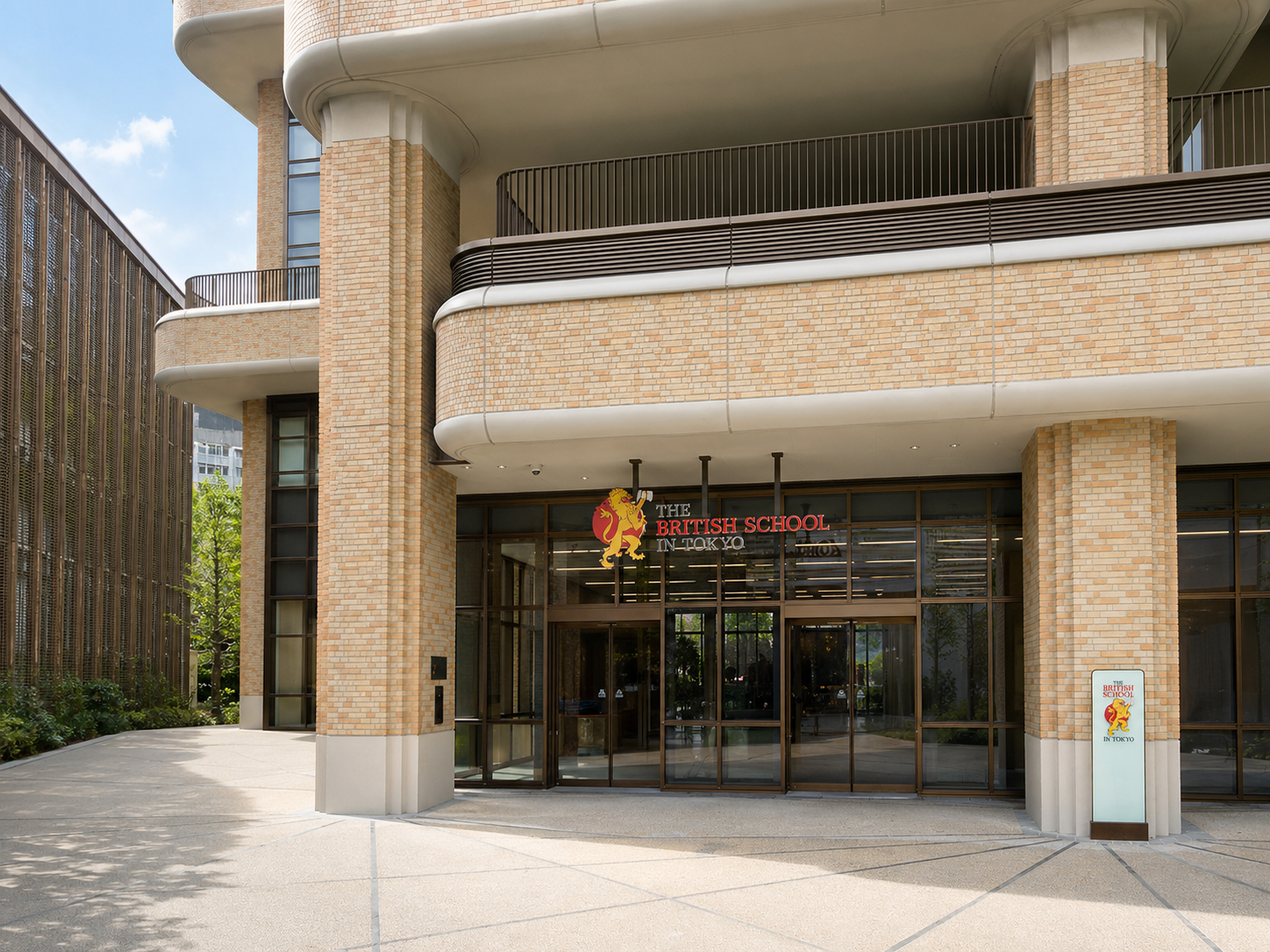
School Profile
Item | Details |
|---|---|
Official Name | The British School in Tokyo (BST) |
Founded | 1989 |
Founder | Margaret Thatcher (then British Prime Minister) |
Age Range | Nursery (Age 3) to Year 13 (Age 18) |
Co-educational/Single-sex | Co-educational |
Number of Students | Approx. 1,100-1,300 |
Nationalities | Over 65 |
Curriculum | English National Curriculum (IGCSE/A-Level) + IBDP (from Aug 2025) |
Language | English (all instruction in English) |
Accreditations | Member of COBIS, FOBISIA, BSA / ABSA |
Class Size | Approx. 22 students (with a Teaching Assistant) |
Campuses | Two locations: Azabudai Hills (Primary) + Showa Women's University (Secondary) |
Positioned as "Japan's Largest British-Style International School"
BST is the only school in Japan to offer the complete English National Curriculum. While other schools incorporate elements of the British system, BST is the central institution in Tokyo offering the authentic "UK-based curriculum" centered on IGCSE and A-Levels.
The majority of its teachers are UK-qualified, and all classes are conducted in English. British culture, values, and academic rigour are integrated into daily school life.
Named in the 2025 Spear's Schools Index of the "Top 100 Private Schools in the World"
In the Schools Index 2025, published by the prestigious UK educational authority Spear's Magazine, BST was named one of the "Top 100 Private Schools in the World" (Source: Tokyo Metropolitan Government International School Portal). This is one of the highest accolades for an international school in Japan, signifying that it has earned a reputation on par with renowned boarding and private schools worldwide.
Approximately 95% of Graduates Progress to Higher Education
A key indicator of BST's educational success is the fact that approximately 95% of its graduates proceed directly to universities and other higher education institutions after graduation. The remaining 5% typically opt for gap years or specialized pathways, meaning virtually all graduates pursue advanced education.
2. The Two-Campus System — Azabudai Hills and Showa Women's University
One of BST's most distinctive features is its two-campus system, which completely separates students by age group. With the opening of the Azabudai Hills campus in September 2023, the Primary and Secondary schools are now clearly divided.
Azabudai Hills Campus (Primary: Nursery to Year 6)
Located in the "Azabudai Hills" urban redevelopment project in Minato Ward, BST's Primary Campus is a state-of-the-art facility designed by the world-renowned British designer Thomas Heatherwick (Heatherwick Studio). It was completed in August 2023 and opened in September.
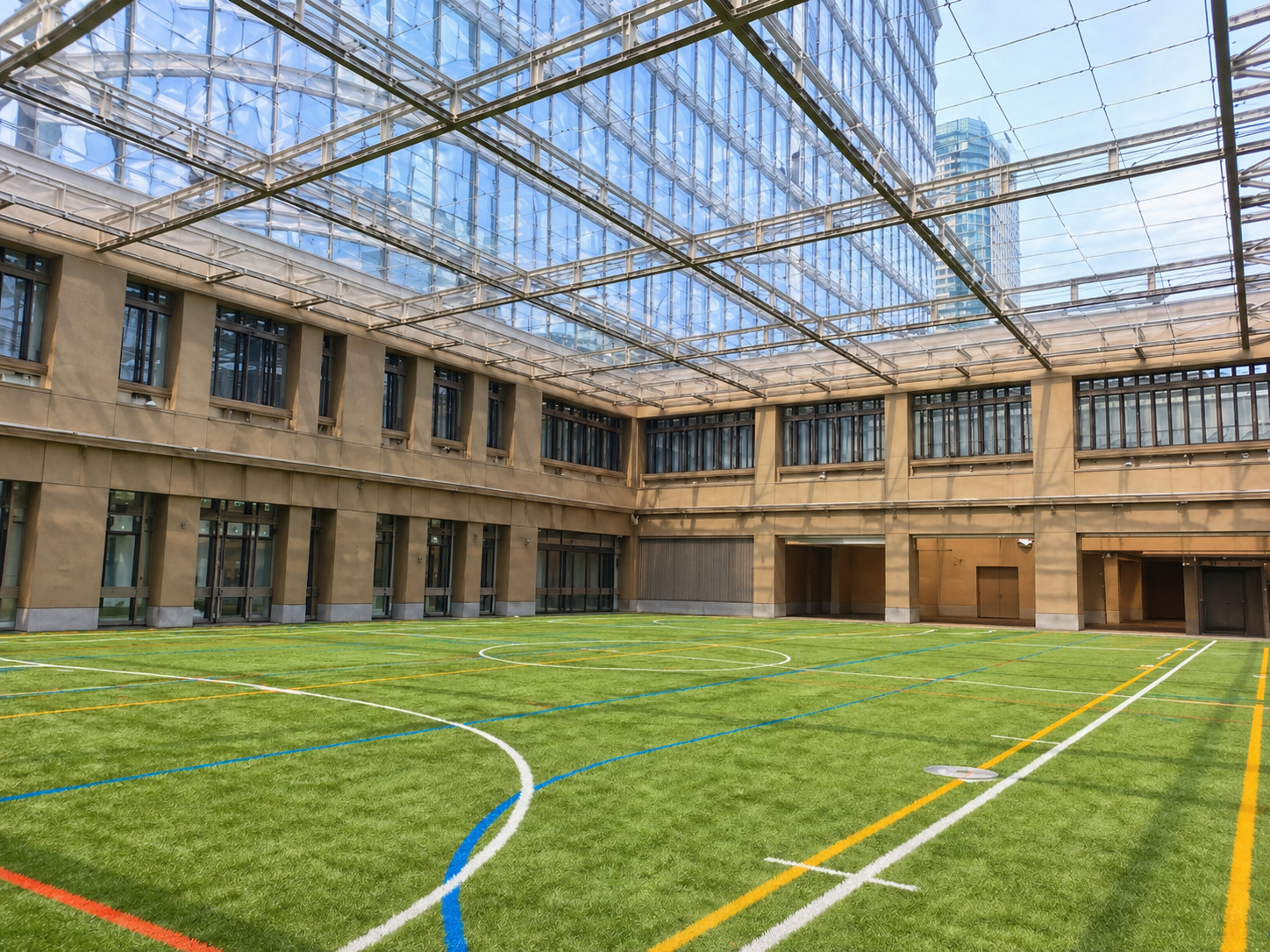
Key Facilities at the Azabudai Hills Campus:
Facility | Details |
|---|---|
Size | 7 floors above ground, 1 basement level; over 24,000 m² of floor space |
Pool | Indoor heated swimming pool |
Libraries | Two libraries |
Art Facilities | Art studios |
STEM Facilities | Digital Technology Studio (STEM/STEAM) |
Sports Facilities | Indoor gymnasium |
Outdoor Areas | Rooftop garden, Sky Pitch (a sports field with views of Tokyo Tower), and lower-level play areas |
Access | Direct underground access from Toranomon Hills Station (Hibiya Line) and Roppongi-itchome Station (Namboku Line) |
Despite its central Minato Ward location, the urban campus is surrounded by two hectares of green space and features cutting-edge security and ICT facilities. The Sky Pitch offers views of Tokyo Tower, creating a rare learning environment that allows students to experience "nature in the heart of the city."
Showa Women's University Campus (Secondary: Year 7 to Year 13)
Located within the Showa Women's University campus in Taishido, Setagaya, the Secondary Campus has been BST's home since its founding in 1989. Approximately 600 secondary students study here.
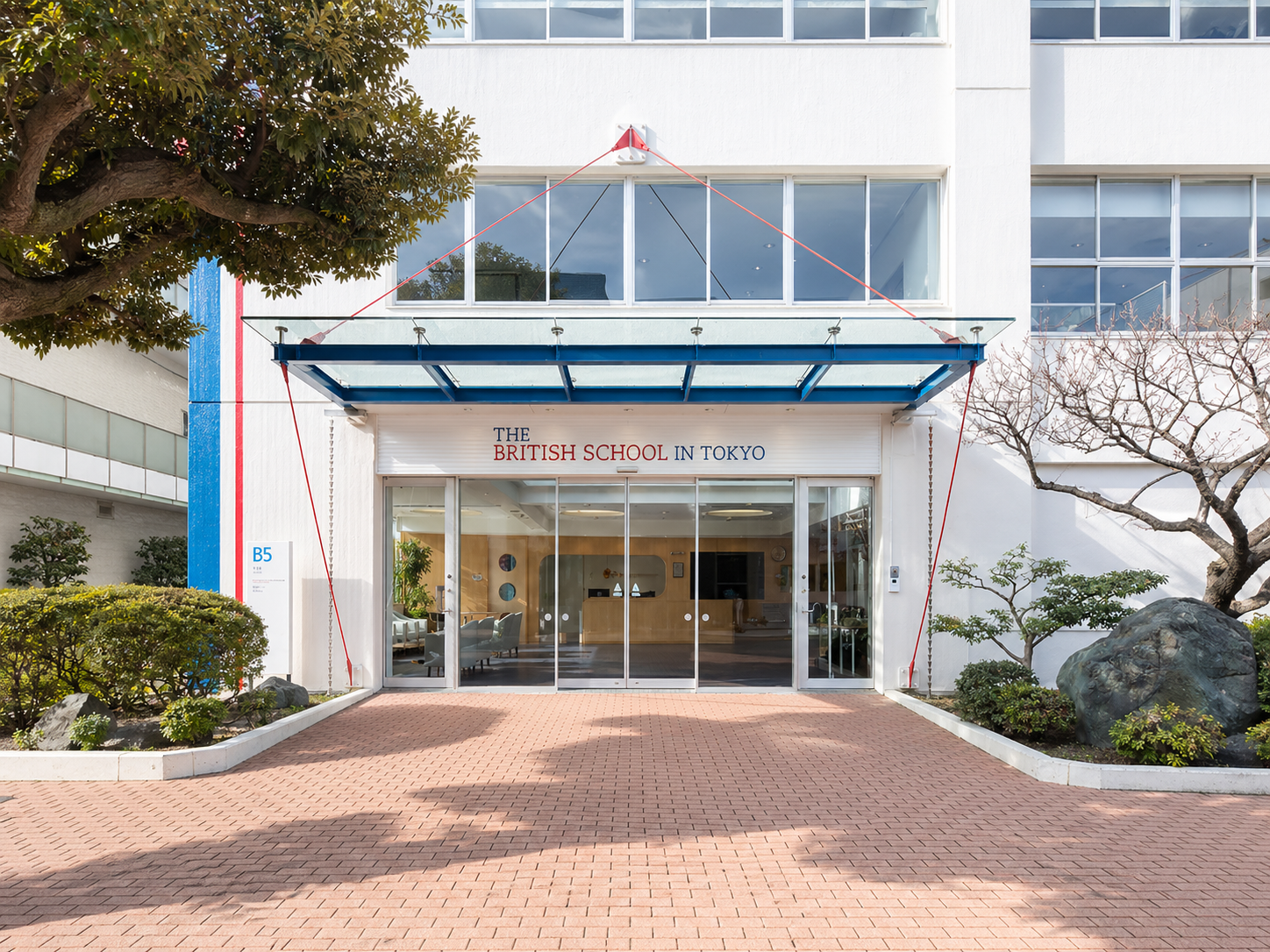
Key Facilities at the Showa Women's University Campus:
Facility | Details |
|---|---|
Sports Grounds | Three sports grounds of various sizes |
Halls | Two auditoriums |
Gymnasiums | Two gymnasium buildings |
Pool | Swimming pool |
Other | Japanese garden with a koi pond, student lounge, cafeteria |
Access | Walking distance from Sangen-jaya Station (Tokyu Den-en-toshi Line) |
The sports facilities, in particular, are far more extensive than what is possible at the indoor, high-rise Azabudai campus, allowing for on-site inter-school matches in football, rugby, and athletics. The environment also supports large-scale arts and drama productions.
Support for Siblings on Different Campuses
For families with siblings attending different campuses, BST operates a free inter-campus shuttle bus.
- Runs between Showa (Setagaya) and Azabudai Hills (Minato) in the morning and evening
- Includes a convenient stop near Shibuya Station
- Approx. 20 mins between Shibuya and Showa; approx. 15 mins between Shibuya and Azabudai.
This allows for seamless coordination, such as dropping off an older sibling for the Showa bus in Shibuya before taking a younger sibling to the Azabudai campus.
"One School, Two Campuses" Philosophy
Both campuses are operated as an integrated "One School, Two Campuses," ensuring that educational resources, library collections, and ICT facilities are of the same high standard at both locations. The scheduling of school events (like sports days and performances) is also coordinated.
3. BST's Curriculum — IGCSE / A-Level / IBDP / BTEC / ASDAN
While centered on the English National Curriculum, BST employs a flexible design that combines multiple programmes to cater to students' diverse university and career pathways.
The English National Curriculum Framework (KS1 to KS5)
Key Stage | Year Group | Age | Content |
|---|---|---|---|
Foundation | Nursery & Reception | 3-5 | Foundational learning through play |
Key Stage 1 | Years 1-2 | 5-7 | Fundamentals of literacy and numeracy |
Key Stage 2 | Years 3-6 | 7-11 | Systematic study of core subjects |
Key Stage 3 | Years 7-9 | 11-14 | Lower secondary, broad general education |
Key Stage 4 | Years 10-11 | 14-16 | IGCSE Programme |
Key Stage 5 | Years 12-13 | 16-18 | A-Level / IBDP / BTEC |
Year 10-11: IGCSE (International General Certificate of Secondary Education)
The IGCSE is the international version of the UK's standard "General Certificate of Secondary Education" and is adopted by British-style schools worldwide. At BST, all students take Mathematics, English Language, English Literature, a modern foreign language (Japanese, Spanish, or French), Physical Education, and two or three IGCSE-level science subjects, in addition to three elective subjects.
2025 IGCSE Results: An exceptionally high 96% of grades were 9-4 (equivalent to the former A*-C), a figure that confirms a strong consolidation of foundational academic skills.
The Complete Guide to IGCSE/GCSE and Strategy for A-Level & IBDP | Avoiding the 'Subject Selection Trap' and Finding the Shortest Path to Top Universities
Year 12-13: A-Levels (The Traditional British Pathway)
The A-Level (Advanced Level) is the most traditional qualification for university entrance in the UK. Unlike the broad scope of the IB, its key feature is allowing students to specialize and study 3-4 of their strongest subjects in great depth.
2025 A-Level Results:
Grade | Percentage Achieved |
|---|---|
A*/A (Top two grades) | 59% |
A*-B (Top three grades) | 75% |
A*-C (Top four grades) | 90% |
A*-E (Pass rate) | 99% |
In 2024, several BST students received awards for achieving the top marks in Japan, and even in the world, for their subjects (Source: BST Official Academic Results).
The Complete Guide to A-Levels: Subject Selection, Grading, and Entry Requirements for Top UK Universities [2026 Edition]
Year 12-13: IBDP (Newly Introduced from August 2025)
From August 2025, BST has introduced the IB Diploma Programme (IBDP). This expands the options available in the Sixth Form to the following three pathways.
Programme | Best Suited For |
|---|---|
A-Level | UK universities (including Oxbridge); students wishing to specialize deeply in specific subjects. |
IBDP | US and European universities; students seeking a qualification with broad global recognition. |
BTEC | Students aiming for vocational or practical careers (e.g., business, arts, sports). |
The graduating class of 2026 will be the last cohort at BST to exclusively take A-Levels; subsequent year groups will choose between A-Levels, the IBDP, and BTEC.
An international school offering a choice between the "depth of the British system" and the "breadth of the IB" is a rare find in Tokyo, further boosting BST's popularity.
IBDP (IB Diploma) Complete Mastery Guide: Subject Selection, TOK/EE, and Score Strategy Explained【2026 Edition】
ASDAN Programme — Personal & Social Education
BST also implements the ASDAN (Award Scheme Development and Accreditation Network) programme across all year groups (Source: Tokyo Metropolitan Government International School Portal). This is a UK Department for Education-approved programme designed to systematically develop personal and social skills. It allows students to record extracurricular activities, volunteering, and leadership experiences in an accredited format, which can be used in their university application portfolios.
Personalised Learning
From Primary through to Sixth Form, BST consistently implements Personalised Learning. The curriculum is designed to build learning programmes based on each student's interests, strengths, and future goals, creating an "individual academic portfolio" rather than a one-size-fits-all approach.
4. Latest Academic Results for 2025
BST's academic results are world-class, on par with those of leading independent schools in the UK.
2025 A-Level Detailed Results
Metric | BST 2025 | UK National Average |
|---|---|---|
A*/A Rate | 59% | Approx. 27% |
A*–B Rate | 75% | Approx. 58% |
A*–C Rate | 90% | Approx. 76% |
Pass Rate (A*–E) | 99% | Approx. 97% |
BST's 59% A*/A rate is more than double the UK national average. This is comparable to the standards of prestigious UK independent schools (such as Eton, Harrow, and Westminster) and represents a world-class academic achievement.
Past Awards and Recognition
In 2024, several BST students were recognized for achieving the top marks in Japan, and even in the world, for various IGCSE and A-Level subjects. This demonstrates that the school not only maintains high standards overall but also has the educational capacity to produce students who reach the pinnacle of their subjects globally.
Consistent IGCSE Performance
At the IGCSE level, a 96% rate of grades 9-4 (formerly A*-C) in 2025 confirms a strong foundation of academic skills. A key characteristic of BST is its depth of talent, where success is not limited to top performers but is widespread across the student body.
5. University Destinations — Over 90 Offers for the Class of 2026
BST's university placement record boasts a depth and diversity that is among the best of any international school in Tokyo. The Class of 2026 received offers from over 90 universities worldwide.
US Ivy League & Top Universities
University | Category |
|---|---|
Princeton University | Ivy League |
Yale University | Ivy League |
Brown University | Ivy League |
University of Chicago | Top US Private University |
New York University (NYU) | Top US Private University |
NYU Stern School of Business | Top US Business School |
Bowdoin College | Top US Liberal Arts College |
Pratt Institute | Top US Art College |
The New School | Top US Art & Design School |
School of Visual Arts | Top US Visual Arts School |
UC Davis, UC Irvine | University of California System |
University of Massachusetts Amherst | Top US Public University |
University of Minnesota Twin Cities | US Public University |
Rutgers University, Syracuse University | US National Universities |
UK Oxbridge, G5 & Russell Group Universities
Category | University |
|---|---|
Oxbridge | University of Cambridge, University of Oxford |
G5 (UK's Top 5, including Oxbridge) | Imperial College London, King's College London, LSE, UCL |
Russell Group | Edinburgh, Manchester, Sheffield, Birmingham, Bristol, Warwick, Durham, Glasgow, Leeds, Liverpool, Newcastle, Nottingham, Exeter, York, St Andrews |
Specialist & Arts | Royal Holloway, SOAS, Loughborough, Aberdeen, Bath, and many more |
Students received offers from over 40 leading UK universities alone.
Canada
University | Comment |
|---|---|
University of Toronto | Top comprehensive university in Canada |
University of British Columbia (UBC) | Top university on Canada's west coast |
Concordia University | Comprehensive university in Canada |
University of Victoria | West coast Canadian university |
Europe, Asia & Oceania
Region | University |
|---|---|
Ireland | Trinity College Dublin |
Netherlands | Erasmus University Rotterdam, Leiden, Utrecht, Groningen |
Czech Republic | Anglo-American University |
Belgium | Artevelde University of Applied Sciences |
Malta | University of Malta |
Hong Kong | The University of Hong Kong, HKUST |
Japan | Keio University, Rikkyo University, Sophia University, Waseda University |
Australia | University of Melbourne |
What These Results Mean
Receiving offers from over 90 universities in a single year for the Class of 2026 is powerful evidence of BST's ability to cultivate graduates who are successful across a wide range of global destinations, rather than being limited to a specific pathway.
Three points are particularly noteworthy:
1. Offers from Three Ivy League Universities Offers from Princeton, Yale, and Brown are a key indicator for families targeting top US universities. This achievement from a British-style school, not an American one, highlights the academic strength of its students.
2. Offers from Oxbridge The school produces graduates who receive offers from both Oxford and Cambridge, demonstrating its high standing in the home of the British curriculum.
3. Global Diversity With destinations spanning the US, UK, Canada, Europe, Asia, and Oceania, students are gaining admission to universities on six continents. This proves that the school's education is not UK-centric but has universal appeal and recognition worldwide.
University Guidance System
BST's university counselling provides expert support for all three major application routes: UCAS (for UK universities), the Common App (for US universities), and AO/returnee admissions for Japanese universities. Students benefit from early career guidance, information on standardized tests like the SAT/IELTS, and access to a strong alumni network.
6. [Key Comparison] BST vs. Other British-Style International Schools
For families considering British-style international schools in and around Tokyo, understanding the differences between BST and three other key schools is crucial for making the right choice.
Four-School Comparison Chart
Item | BST | Malvern College Tokyo | Rugby School Japan | Harrow International School Appi Japan |
|---|---|---|---|---|
Founded | 1989 | 2023 | 2023 | 2022 |
Location | Azabudai Hills + Setagaya | Kodaira, Tokyo | Kashiwa-no-ha, Chiba | Appi Kogen, Iwate |
Access from Central Tokyo | Central Tokyo | 40 mins from city center | 30 mins from Tokyo Station | 3 hours from Tokyo Station |
Size | Approx. 1,100-1,300 students | Planned for 950 (expanding) | Approx. 300 (planned for 750) | Planned for approx. 500 |
Age Range | Nursery to Year 13 | Pre-Prep (Age 4) to Year 13 (expanding) | Year 7-13 (Ages 11-18) | Year 6-13 (Ages 11-18) |
Curriculum | IGCSE/A-Level + IBDP | IB (PYP/MYP/DP planned) + British elements | IGCSE/A-Level | IGCSE/A-Level |
Boarding | None (Day school only) | None (Day school only) | Day/Weekly/Full options | Full Boarding |
Annual Tuition | Approx. ¥2.82 - ¥2.93 million | Approx. ¥2.7 - ¥3.3 million (DP planned) | Approx. ¥5.0 - ¥8.2 million (incl. boarding) | Approx. ¥9.3 million (incl. boarding) |
First Year Total Cost | Approx. ¥4.0 - ¥4.3 million | From approx. ¥3.67 million | From approx. ¥6.04 million | From approx. ¥10 million |
Nationalities | Over 65 | Over 23 | Over 15 | Multinational |
Spear's Index | Top 100 | Not listed | New Schools to Watch | – |
How to Choose Between the Four Schools
Why families choose BST:
- Convenience of a central Tokyo location (the state-of-the-art Azabudai Hills campus)
- Over 35 years of proven results and stability (founded in 1989)
- Choice between A-Levels and the IBDP
- Ranked in the Spear's Index Top 100 Schools in the World
- Over 90 university offers for the Class of 2026
- Day school only, allowing for family time
Why families choose Malvern College:
- A full IB continuum school (from PYP to DP)
- A calm environment in Kodaira, 40 minutes from central Tokyo
- Relatively new, carrying the tradition of Malvern College in the UK
Malvern College Tokyo (MCT): Fees, Reputation, IB (DP Authorized)? An Insider's Look & Admissions Prep from Our Director's Visit [2026 Edition]
Why families choose Rugby School Japan:
- Flexible boarding options (Day, Weekly, and Full)
- Excellent access to central Tokyo (30 minutes from Tokyo Station)
- Received early Oxbridge offers for its first graduating class of 2026
An In-Depth Guide to Rugby School Japan (RSJ) [2026 Edition]
Why families choose Harrow Appi:
- A complete British full-boarding experience (in Appi Kogen, Iwate)
- A location rich in natural beauty
- The authentic tradition of Harrow School (450 years of history)
Harrow Appi: Fees, Ranking & Reputation? First Graduates' University Placements & Expert Admission Tips [2026 Edition]
7. Complete Guide to Fees for 2025-2026
BST's fees are in the mid-range for international schools in Tokyo. Considering its state-of-the-art campus and world-class education, it is often regarded as offering high value for money.
Annual Fees (2025-2026 Academic Year)
Item | Amount | Notes |
|---|---|---|
Application Fee | ¥40,000 | Paid upon application, non-refundable |
Enrolment Fee | ¥500,000 | First year only, non-refundable |
Educational Resources Fee | ¥680,000 | First year only, non-refundable |
Annual Tuition (Nursery–Y6 Primary) | ¥2,820,000 | Varies by year group |
Annual Tuition (Y7–Y9 Middle School) | ¥2,840,000 | – |
Annual Tuition (Y10–Y13 Senior School) | ¥2,930,000 | – |
–
Capital Development Fee
JPY 100,000/year
Same for all year groups
Source: BST Official Fees Page
First-Year Total Cost Simulation
The minimum cost for a new student entering Year 7 is as follows:
Item | Amount |
|---|---|
Application Fee | JPY 40,000 |
Enrollment Fee | JPY 500,000 |
Educational Resource Fee | JPY 680,000 |
Annual Tuition Fee (Y7) | JPY 2,840,000 |
Capital Development Fee | JPY 100,000 |
Total for First Year | JPY 4,160,000 |
Adding the cost of uniforms (approx. JPY 50,000-60,000) and school lunches (actual cost), the actual first-year payment will be around JPY 4.2 million. From the second year onwards, the one-time enrollment-related fees (JPY 1.2 million) are no longer required, bringing the annual expenditure down to the low JPY 3 million range.
No Sibling Discount, No Refund Upon Withdrawal
BST does not offer a sibling discount (Source: BST official website). If multiple children are enrolled simultaneously, the full tuition fee is charged for each child.
The refund policy upon withdrawal is also strict. Notice of at least one full term in advance is required, and as a general rule, fees are not refunded except for terms not yet attended.
CCP (Corporate Contribution Programme) — A Tax-Advantaged System Through Corporate Donations
One of BST's most distinctive features is the CCP (Corporate Contribution Programme). This is a donation-based tuition support system that companies and organizations can use to assist employees with their children's school fees. It operates as follows:
Item | Details |
|---|---|
Mechanism | A company makes a direct donation to BST, which is then applied as a scholarship to the student's fees. |
Tax Treatment | Not considered taxable income for the individual employee. |
Benefit | Avoids the high income tax that would be incurred if the company directly reimbursed the tuition fees. |
Origin | A system started by the American School in Japan (ASIJ) in 1978. |
Authorization | Implemented by over a dozen major international schools, including BST, with the approval of the National Tax Agency. |
Many expatriate families from multinational corporations cover tuition fees through this system, which offers the significant advantage of avoiding high taxes that would otherwise be levied if the tuition support were added to their salary.
While the CCP does not officially guarantee "priority admission for corporate applicants," there is a tendency for the admission process to be smoother for candidates with a corporate recommendation.
Tuition Fee Level Comparison
School | Annual Tuition (Middle School Equivalent) | Tier |
|---|---|---|
BST | Approx. JPY 2.84 million | Mid-range |
Seisen International | Approx. JPY 2.47 million | Mid-range |
Sacred Heart International | Approx. JPY 3.92 million | Mid- to Upper-range |
RSJ (Day Pupil) | Approx. JPY 4.75 million | Upper-range |
Harrow Appi (Full Boarding) | Approx. JPY 9.3 million | Top-tier |
Considering its inclusion in the "Spear's Schools Index Top 100," over 90 university offers for the Class of 2026, and its state-of-the-art campus in Azabudai Hills, BST's tuition is considered reasonable compared to other British-style international schools of a similar caliber.
For a more detailed comparison of international school fees, please refer to the following article.
[2026 Edition] International School Tuition Guide | Tokyo & Nationwide Fees, Free Tuition Programs & Scholarships Explained
8. [Most Critical] The Toughest Admissions Hurdle — The Reality of English Proficiency Requirements
BST is not a school for "learning English," but a school for "learning advanced subjects 'in' English." Therefore, the required level of English proficiency for admission is extremely high, even compared to other international schools.
Primary School (Nursery & Elementary) Admissions
For Nursery (age 3) & Reception (age 4):
- Officially, "no written test."
- Behavioral observation through play (Play-based assessment).
- Evaluation of whether the child can "understand the teacher's instructions in English" and "communicate in English."
- Natural responses to English instructions like "Tidy up" and "Wait for your turn."
- Expressive ability to state their name and favorite things in simple English.
For transfer into Year 1 (age 5) and above:
- An English reading and writing test + a mathematics test are required.
- Particular emphasis is placed on the ability to express one's own opinions in creative writing (Writing).
- Mathematics covers content equivalent to the Japanese grade level, plus an understanding of mathematical terms in English (e.g., Fraction, Geometry, Multiply).
- New admission with zero English proficiency is extremely difficult, except for Nursery/Reception.
Secondary School (Middle & High) Transfer
For Year 7-9 (Middle School equivalent):
- Submission of the last two years of school reports and a letter of recommendation is required at the time of application.
- Language proficiency check through a written English test or interview.
- Advanced English reading comprehension and expressive skills are required.
- Academic ability in mathematics is also assessed in English.
- Demonstrating logical thinking skills during the interview is also important.
For Year 10-11 (Post-Middle School to first year of High School equivalent):
- Generally difficult due to mid-course entry into the IGCSE programme.
- Limited availability of places due to timetabling constraints.
- Handled on a case-by-case basis.
For Year 12 Sixth Form Transfer:
- A minimum of 5 grades of A* to C in GCSE or equivalent examinations (including predicted grades) is required.
- An interview with the Principal or Head of Secondary.
- Proof of academic ability to transition to A-Level / IBDP courses is essential.
Use of CAT4 (Cognitive Abilities Test)
While BST does not officially state that it uses the CAT4, anecdotal evidence from transfer applicants suggests that a "CAT4-style test" was administered. For applicants to the Secondary school, it is recommended to become familiar with the CAT4 question format.
CAT4 measures cognitive abilities (Verbal, Non-verbal, Quantitative, Spatial) rather than English proficiency, and preparation requires specialized guidance. For more details, please refer to the following article.
A Complete Guide to the CAT4 (Cognitive Abilities Test): Key to British International & Boarding School Admissions
The Limits of EAL (English as an Additional Language) Support
BST offers EAL support classes, but these are intended for students who already have a foundational understanding to follow lessons. It is not a system that enables admission for students with zero English proficiency.
The idea that "we can just improve English with EAL after enrolling" is a misconception. Age-appropriate English proficiency is required at the time of application.
9. The 5 Admission Priority Tiers and the Reality for Families with Japanese Nationality
BST's admissions process utilizes a Waiting Pool system and five tiers of admission priority. This system is a critical factor for families from non-British backgrounds to understand.
How the Waiting Pool Works
The Waiting Pool is not a simple first-come, first-served waiting list. When a space becomes available, the school selects a child from the pool who is the "best fit for the class's diversity and academic balance."
Therefore, admission (or being moved off the waitlist) is determined not only by the applicant's abilities but also by factors such as the nationality mix and the ratio of native English speakers within the class.
The 5 Tiers of Admission Priority
Priority | Category |
|---|---|
1st | Siblings of current students (highest priority to maintain family-based community). |
2nd | Holders of a British passport (at least one parent must be a British citizen). |
3rd | Non-British nationals with prior experience in a British-style education system. |
4th | Japanese nationals with over 4 years of experience in a British-style education system (similar to a returnee category). |
5th | General applicants (many families from the local Japanese system fall into this category). |
The Reality for Families with Japanese Nationality
Based on admissions data from families supported by ELT, the reality for families with Japanese nationality is as follows:
For families permanently residing in Japan:
- New admission from middle school onwards is extremely difficult.
- Early entry from Nursery/Reception is the most realistic option.
- Cases exist where students who entered in Primary School transfer out in Middle School because they cannot keep up with the curriculum in English.
For returnee or bilingual families:
- If the child has experience with a British curriculum abroad, they may be considered in the 3rd or 4th priority tier.
- If English proficiency is native-level, admission is possible regardless of the year group.
For families with corporate sponsorship (CCP participating companies):
- While "priority admission for corporate applicants" is not officially stated, there are reports that a recommendation from a company can smooth the admissions process.
- Expatriate families effectively have an advantage.
Ratio of Japanese Students
The proportion of students with Japanese nationality in each class is around 20-40% (varies by year group). In some Primary classes, "one in five students is Japanese."
However, the majority of these students are returnees or bilingual, and students educated solely within the local Japanese school system are a minority.
10. English Requirements for Parents and Interview Preparation
One of the biggest hurdles that international families, particularly those from non-English speaking backgrounds, tend to overlook in the BST admissions process is the English requirement for parents.
Official Requirement: Mandatory for "At Least One Parent"
BST officially requires that "at least one parent has sufficient English proficiency to discuss matters with the school without an interpreter."
This is not "conversational level" English; the following level of proficiency is required:
Situation | Required English Level |
|---|---|
Parent-teacher conferences (academic and pastoral) | Ability to engage in detailed discussions. |
Parent meetings and school events | Ability to fully comprehend the content. |
Emergency communications (health and safety) | Ability to understand immediately and accurately. |
University admissions counseling | Ability to discuss complex career and academic pathways. |
A benchmark of B2-C1 on the CEFR scale is a good guideline.
Typical Questions Asked in the Parent Interview
Here are some representative examples of questions frequently asked in past parent interviews:
Question | What is being assessed |
|---|---|
"Why a British education specifically?" | A clear reason for choosing a British-style education. |
"How will you contribute to the BST community?" | Willingness to contribute to the school community. |
"What aspects of British academic rigour appeal to you?" | Understanding of British academic standards. |
"How will you support your child's learning at home?" | Specifics of educational support at home. |
Effective Interview Preparation
Common elements in the answers of successful families:
1. They express an appreciation for British tradition and academic rigor. They can speak specifically about "British discipline," "development of logical thinking," and "world-class academic standards."
2. They show a proactive willingness to participate in the PTA and school events. They convey their intention to get involved in BST community events like the "Summer Festival" and "Christmas Fair."
3. They have a concrete plan to support their child's learning at home. They provide specific examples like "reading English books together" or "providing academic support in English."
A Mindset of Being "Admitted" as a Family
At BST, it is essential to have the mindset that not only the child but also the parents are undergoing an "admissions screening." A strong understanding of the school's philosophy and a cooperative attitude are highly valued.
ELT provides support for parents' English interview preparation, helping families build a compelling statement of purpose and ensuring consistency with their child's application.
11. Age-Specific Admissions Preparation Roadmap
This is a practical preparation roadmap based on the preparation timelines of successful applicants supported by ELT.
New Entry for Nursery/Reception (Ages 3-4)
Timeline | To-Do |
|---|---|
18 months before application | Create an English-speaking environment (English picture books, nursery rhymes, simple daily English). |
12 months before | Familiarize with playdate settings, establish daily routines in English (greetings, tidying up). |
6 months before | Practice self-introduction in English, understand simple instructions. |
3 months before | Parent interview preparation, refine family's statement of purpose. |
1 month before | Mock interviews, practice for behavioral observation. |
Primary School Transfer (Years 1-6)
Timeline | To-Do |
|---|---|
12 months before application | Bring English reading/writing to age-appropriate level, learn math terminology in English. |
6 months before | Enrollment in ELT's BST preparation package is recommended, practice creative writing. |
3 months before | Translate last two years of school reports, request recommendation letters, familiarize with Cambridge/Oxford-style workbooks. |
1 month before | Practice parent-child interview, ensure consistency in family's statement of purpose. |
Middle School Transfer (Years 7-9)
Timeline | To-Do |
|---|---|
12 months before application | Improve English to CEFR B2-C1, train in logical composition in English. |
6 months before | Familiarize with CAT4-style questions, practice logical responses for English interview. |
3 months before | Translate last two years of school reports, obtain recommendation letter, complete application documents. |
1 month before | Mock interviews, study KS3 level math and science in English. |
Sixth Form Transfer (Year 12)
Timeline | To-Do |
|---|---|
18 months before application | Prepare for GCSE/IGCSE equivalent exams, aiming for 5 subjects with grades A*-C. |
12 months before | Begin preliminary study of intended A-Level/IBDP subjects. |
6 months before | Improve English to CEFR C1, develop a clear academic pathway (consistency through to university goals). |
3 months before | Prepare for interview with Principal/Head of Secondary, draft Personal Statement. |
12. ELT's Analysis: Characteristics of Families Who Gain Admission to BST
From the many successful BST applicant families ELT has supported, we have identified five common characteristics.
Characteristic 1: They have secured sufficient English proficiency at the time of application.
Successful families ensure their child has the "English proficiency to keep up with classes" at the time of application. Instead of relying on the idea of "improving with EAL after enrollment," they strategically ensure their child reaches the age-appropriate CEFR level before applying.
Characteristic 2: The parents meet the English proficiency requirements.
At least one parent has CEFR B2-C1 level English and is prepared to handle discussions with teachers, PTA activities, and university admissions counseling. For families with only Japanese nationality, many also undertake English coaching for the parents in parallel.
Characteristic 3: They have a deep understanding of British education.
Their understanding goes beyond a general desire for an "English environment" or an "international school." They have a specific appreciation for the "British National Curriculum," "IGCSE/A-Levels," and "British academic rigor." This is a key element assessed in the parent interview.
Characteristic 4: They can demonstrate a willingness to contribute to the BST community.
BST places great importance on community events like "PTA activities," the "Summer Festival," and the "Christmas Fair." Families who can concretely convey their "intention to actively participate in school activities" are favored.
Characteristic 5: They allow for an appropriate preparation period based on the year group.
Successful families begin their planned preparation 12 months or more in advance. Cases of "deciding and getting in within three months" are rare, except for returnee families or those who are already native English speakers.
Example Profiles of Successful Applicants by Year Group
Typical profiles of students ELT has supported:
- Nursery/Reception New Entry: A 3-4 year old child from an international family or a Japanese family with overseas experience. Has had basic exposure to English.
- Year 1-6 Transfer: A child returning from an overseas assignment or transferring from another international school in Tokyo. English proficiency at CEFR A2-B1 level.
- Year 7-9 Transfer: A returnee student or a graduate of an English-intensive school. English proficiency at CEFR B2 level, with 6 months of CAT4 preparation.
- Year 12 Sixth Form: Achieved 5 A*-C grades in IGCSE/GCSE or equivalent, and has completed preliminary studies for A-Level/IBDP.
13. Families Well-Suited and Ill-Suited for BST
BST is not the right school for every family. Considering the annual tuition of around JPY 3 million, the high English proficiency requirements for admission, and the expectation of community involvement, families should carefully assess if the school aligns with their values.
Families Who Are a Good Fit
- Families who appreciate the tradition and academic rigor of a British education.
- Families aiming for admission to top universities like Oxbridge or the US Ivy League.
- Families where at least one parent can communicate effectively in English for practical matters.
- Families who can make a long-term educational investment of around JPY 3 million per year.
- Families who wish to take advantage of the convenience of a central Tokyo location (Azabudai Hills).
- Families with a genuine desire to actively participate as parents in an international community.
- Expatriate families who can utilize the CCP system.
Families Who Are Not a Good Fit
- Families thinking, "We'll start English from now" or "We want to enroll with zero English." — This is not feasible except for Nursery/Reception.
- Families with only Japanese nationality where neither parent speaks English. — This poses a high risk in emergency situations.
- Families from a purely local educational background considering new entry from Year 7 onwards. — They fall into the 5th priority tier in the waiting pool, making admission realistically difficult.
- Families seeking a free and unstructured educational environment. — BST's focus is on "discipline and academic rigor."
- Families where parents do not have time to be involved in PTA activities. — Community participation is expected.
Guidelines for Choosing Between BST and Other British-Style International Schools
If you are undecided, consider the following questions:
- Do you prioritize the convenience of a city center location or a campus in a natural environment?
- Are you looking for a Day Pupil experience or a Boarding experience?
- Do you prefer a school with over 35 years of established history or the cutting-edge environment of a newly founded school?
- Do you want the option of both A-Levels and the IBDP, or a school that offers a through-train IB curriculum?
- Is your budget in the JPY 3 million per year range or closer to the JPY 10 million per year range?
Based on these answers, the optimal choice among BST, Malvern College Tokyo, Rugby School Japan, and Harrow Appi will become clearer.
15. ELT's BST Test Preparation: Comprehensive Support to Admission
ELT has a track record of supporting successful applications to BST across all year groups, from Nursery new entry to Year 1-11 transfers and Year 12 Sixth Form admission. We provide comprehensive support tailored to BST's specific requirements, including English proficiency, CAT4, English interviews, and parent English requirements.
Features of ELT's BST Test Preparation
- English Proficiency Enhancement: One-on-one tutoring aiming for CEFR B2-C1 (for Year 7+ transfers) and C1 (for Sixth Form), led by CELTA/DELTA-certified native instructors.
- Creative Writing (Essay) Preparation: Structured guidance on the essay writing skills emphasized in BST's admissions tests.
- English Mathematical Terminology: Learning KS2-3 level mathematics in English, covering terms like Fraction, Geometry, and Multiply.
- CAT4 Preparation: Specialized instruction in the four domains of the cognitive abilities test (Verbal, Non-verbal, Quantitative, Spatial).
- Parent-Child Interview Practice: Preparation for frequently asked questions at BST, such as "Why British education?" and "How will you contribute?"
- English Coaching for Parents: Raising parents' English proficiency to a level (CEFR B2-C1) where they can discuss matters with teachers without an interpreter.
- Application Document Support: Translation of the last two years of school reports, assistance with recommendation letter requests, and essay proofreading.
- Sixth Form Transfer Preparation: Preliminary study for A-Level/IBDP, Personal Statement development, and building a coherent academic pathway.
ELT is the Choice for Families Who...
- Are concerned about meeting BST's English proficiency requirements.
- Are unsure how to prepare for CAT4-style tests.
- Cannot decide between A-Levels and the IBDP.
- Need preparation for the parent's English interview.
- Are considering a transfer from Year 7 onwards from a non-international background and want to know their chances of success.
- Are aiming for Oxbridge through Year 12 Sixth Form entry.
- Have been unsuccessful once and want to build a strategy for reapplying next year.
Free Counseling Information
"I want to know if our current English level meets the admission standards."
"I want to entrust the specific preparation for CAT4, the English interview, and creative writing to professionals."
"I need help diagnosing whether Nursery new entry, a Year 1-11 transfer, or Year 12 Sixth Form is the best option for us."
For these and other concerns, our consultants with extensive admissions success will provide personalized advice.

![An In-Depth Guide to Rugby School Japan (RSJ) [2026 Edition]](/_next/image?url=https%3A%2F%2Fstorage.googleapis.com%2Felt-microcms-ai-automator-og-images%2Fcolumns%2Frugby-school-japan-review%2Fen.png%3Fv%3D1781228854635&w=3840&q=75)
![Harrow Appi: Fees, Ranking & Reputation? First Graduates' University Placements & Expert Admission Tips [2026 Edition]](/_next/image?url=https%3A%2F%2Fstorage.googleapis.com%2Felt-microcms-ai-automator-og-images%2Fcolumns%2Fharrow-appi-japan-review%2Fen.png%3Fv%3D1781936105811&w=3840&q=75)
![Malvern College Tokyo (MCT): Fees, Reputation, IB (DP Authorized)? An Insider's Look & Admissions Prep from Our Director's Visit [2026 Edition]](/_next/image?url=https%3A%2F%2Fstorage.googleapis.com%2Felt-microcms-ai-automator-og-images%2Fcolumns%2Fmalvern-college-tokyo-review%2Fen.png%3Fv%3D1781941378607&w=3840&q=75)

![The Complete Guide to A-Levels: Subject Selection, Grading, and Entry Requirements for Top UK Universities [2026 Edition]](/_next/image?url=https%3A%2F%2Fstorage.googleapis.com%2Felt-microcms-ai-automator-og-images%2Fcolumns%2Fa-level-curriculum-guide%2Fen.png%3Fv%3D1777532108376&w=3840&q=75)


![[2026 Edition] International School Tuition Guide | Tokyo & Nationwide Fees, Free Tuition Programs & Scholarships Explained](/_next/image?url=https%3A%2F%2Fstorage.googleapis.com%2Felt-microcms-ai-automator-og-images%2Fcolumns%2Finternational-school-cost%2Fen.png%3Fv%3D1775750520759&w=3840&q=75)