


The American School in Japan (ASIJ) is Japan's oldest and largest international school, founded in 1902. Serving ages 3 to 18, it provides college-preparatory education centered on the U.S. curriculum combined with Advanced Placement (AP). With approximately 1,500–1,700 students from 40–50 countries and beyond, it holds the status of a U.S. Department of State–designated school.
The school operates across two campuses: the main campus in Chofu, Tokyo (Kindergarten through Grade 12, spanning approximately 14.33 acres or 58,000 square meters), and the Roppongi Early Learning Center (ELC, ages 3–5). The facilities include three gymnasiums, an indoor swimming pool, tennis courts, a theater, and a Design Center (FAB Lab)—amenities that set it apart as an urban international school.
WASC (Western Association of Schools and Colleges) accredited. 73% of graduates attend U.S. universities, with consistent admissions to all eight Ivy League schools—Harvard, Yale, Princeton, Brown, Columbia, Cornell, Dartmouth, and UPenn—as well as continued placement at world-leading universities including Stanford, MIT, Duke, Northwestern, and Johns Hopkins. Annual tuition ranges from approximately ¥2.99 to ¥3.53 million (2025–2026 academic year), with total first-year expenses of approximately ¥5.4 million for Grade 1, or around ¥5.8 million including bus services—placing it in the highest tuition bracket among Tokyo's international schools.
Notable alumni include Kazuo Hirai, former CEO of Sony; Bobak Ferdousi, a key team member of NASA's Mars rover Curiosity; and Hikaru Utada, singer-songwriter.
"Should I choose a British-model international school or a U.S.-model one?"
"Can families with Japanese nationality enroll?"
"Is the corporate pathway (CCP) a realistic option?"
"What SSAT percentile score ensures admission?"
In this article, ELT, which has actively supported admission to ASIJ, provides a comprehensive explanation of ASIJ's profile and admission strategy, drawing on official data and our proprietary teaching expertise.
1. The American School in Japan (ASIJ) — Essential Information at a Glance
ASIJ is Japan's oldest and largest international school, founded in 1902. For over 123 years, it has been at the forefront of international education in Japan, serving the families of expatriate staff (including those of the U.S. Embassy), bicultural Japanese-American families, and international families.
School Overview
Item | Details |
|---|---|
Official Name | The American School in Japan (ASIJ) |
Founded | 1902 |
Grades Served | Nursery (age 3) through Grade 12 (age 18) |
Coeducational/Single-Sex | Coeducational |
Student Enrollment | Approximately 1,500–1,700 students |
Nationalities Represented | 40–50 countries and beyond |
Curriculum | U.S.-based (college-preparatory) + Advanced Placement (AP) |
Language of Instruction | English (all classes taught in English) |
Accreditation | WASC (Western Association of Schools and Colleges) |
International Standing | U.S. Department of State–designated school (Office of Overseas Schools) |
Campuses | Chofu Main Campus + Roppongi ELC (two locations) |
"Japan's Oldest and Largest" — A Unique Position
ASIJ holds a singular position among Japan's international schools.
- Founded in 1902: One of the first international schools established in Japan
- U.S. Department of State–designated school: Positioned as the official educational institution for U.S. Embassy and U.S. government officials' children
- Scale: With 1,500–1,700 students, it ranks among Tokyo's largest international schools
- Alumni network: Over 100 years of history has built a powerful global alumni network
Notable Alumni
ASIJ's alumni include many of Japan's global leaders.
Alumnus/Alumna | Background |
|---|---|
Kazuo Hirai | Former CEO of Sony; former Chairman of Sony Entertainment America |
Hikaru Utada | Singer-songwriter and music producer |
Bobak Ferdousi | Key team member of NASA's Mars rover Curiosity |
What U.S. Department of State Designation Means
ASIJ is among the few schools in Japan to receive designation from the U.S. Department of State, Office of Overseas Schools. This signifies:
- Official status as the educational institution for U.S. Embassy staff and U.S. government officials' children
- Educational standards equivalent to those in the United States
- Strong educational pipeline to U.S. universities
- Credibility among U.S. educational institutions and international organizations
In Japan, other schools holding similar designation include YIS (Yokohama International School) and OCSI (Okinawa Christian School International).
The Appeal of Yokohama International School (YIS) | School Culture and New Campus of an IB Continuum School
2. The Two-Campus System — Roppongi ELC and the Chofu Main Campus
One of ASIJ's defining characteristics is its two-location campus structure, with clear age-based separation. Early childhood education for ages 3–5 and formal schooling from Kindergarten onward are geographically and educationally distinct.
Chofu Main Campus (Kindergarten through Grade 12)
Spanning 14.33 acres (approximately 58,000 square meters—roughly equivalent to 1.2 Tokyo Domes), the campus offers extraordinary space that no urban international school could otherwise achieve.
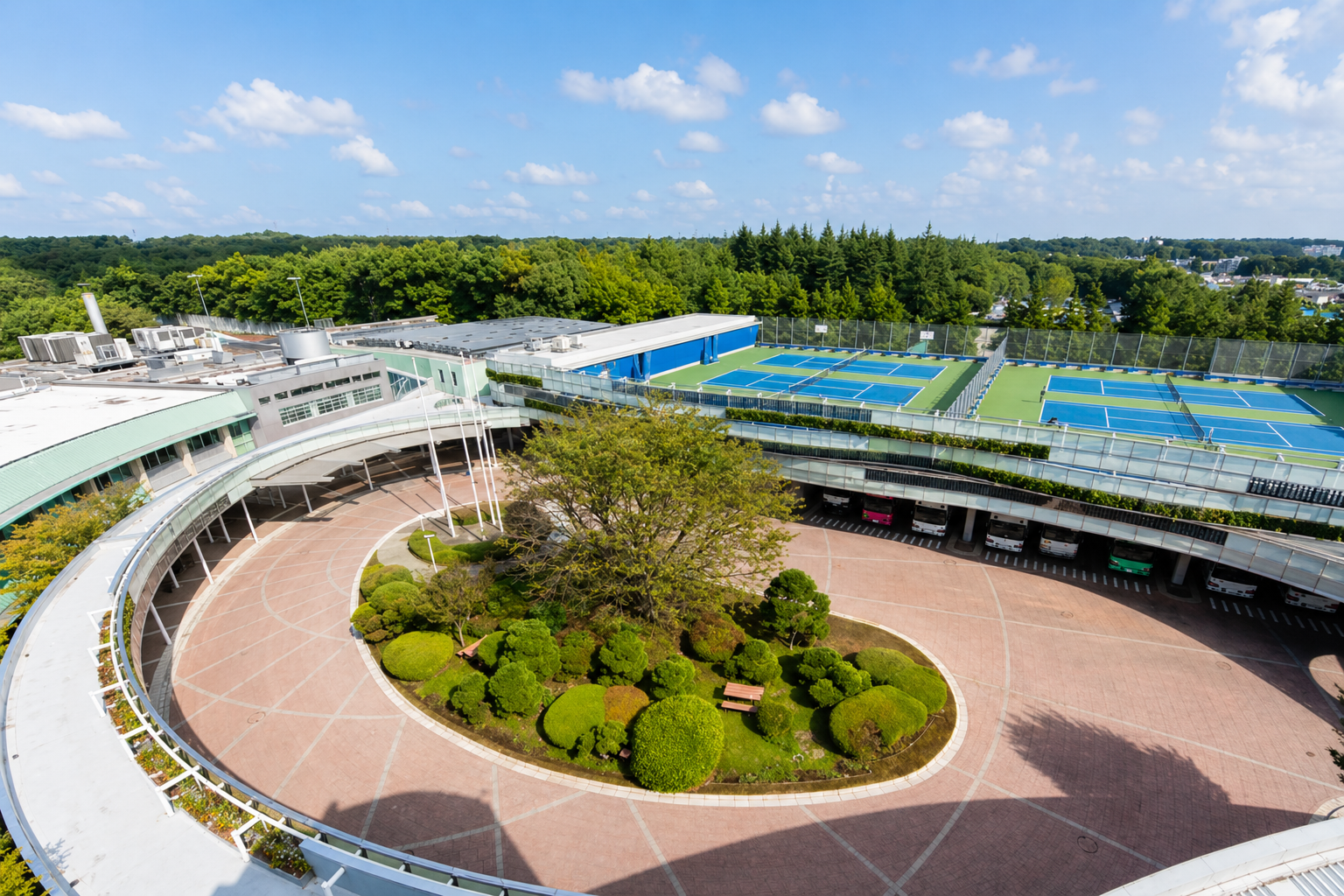
Primary facilities at the Chofu Main Campus:
Facility | Details |
|---|---|
Scale | 14.33 acres (approximately 58,000 m²) |
Sports Facilities | 3 gymnasiums |
Pool | Indoor heated pool |
Outdoor Facilities | Tennis courts, artificial turf field, track |
Theater | Large theater (for drama and music performances) |
ICT/STEM Facilities | Design Center (FAB Lab), multiple Science Labs |
Extracurricular Activities | Over 170 clubs and activities |
Class Hours | 8:00–15:00 |
Access | Bus from Chofu and Mitaka stations, or dedicated Mustang Bus from various locations in Tokyo |
ELT families frequently note that, among international schools they have toured in Tokyo, "the Chofu campus of ASIJ stands out—it is in a class of its own. The facilities rival those of Japan's leading private secondary schools."
Roppongi Early Learning Center (ELC, ages 3–5)
The ELC, located near Roppongi Hills in Minato Ward, Tokyo, is a dedicated early childhood education facility serving Nursery through Kindergarten students.
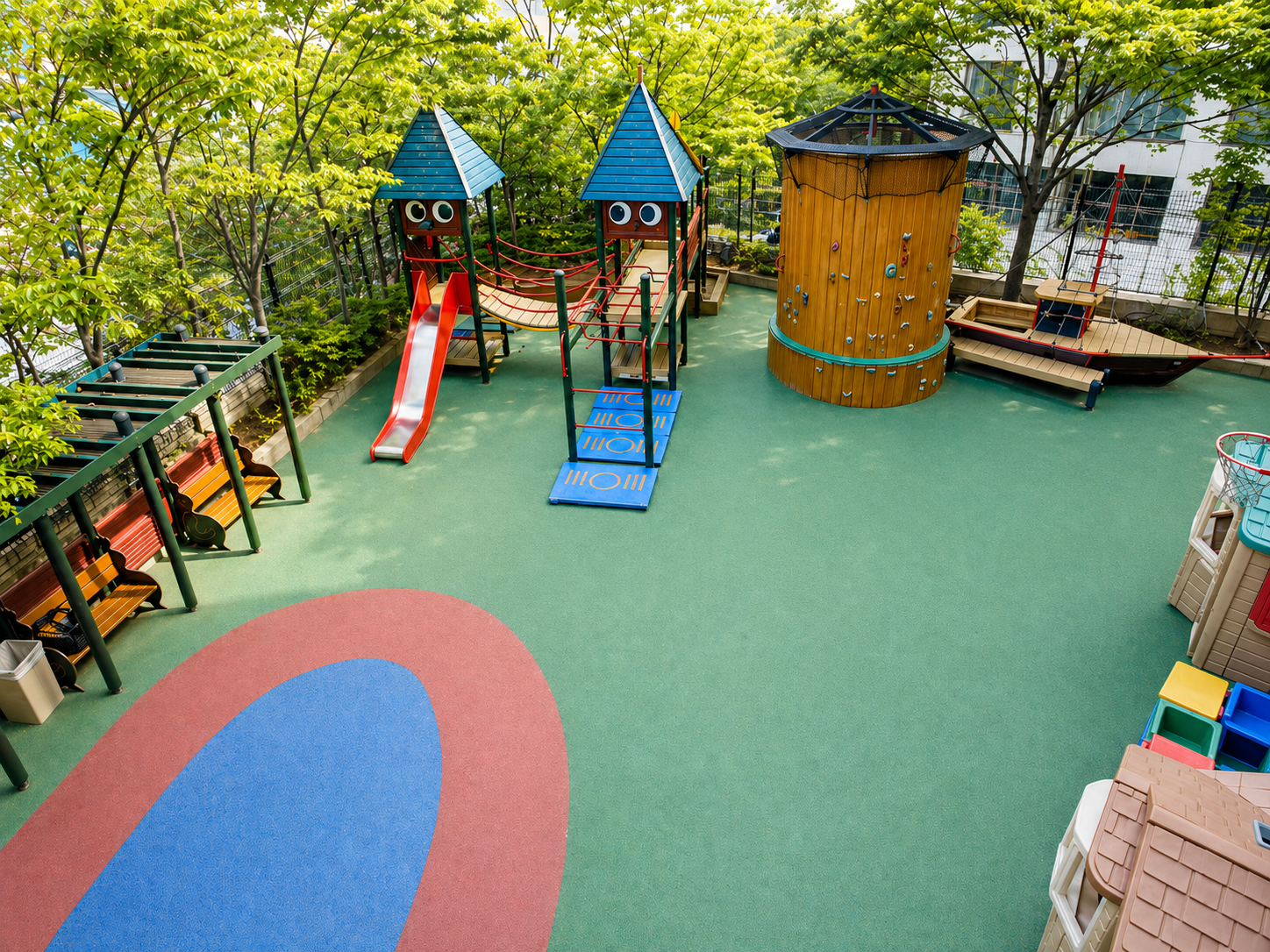
Characteristics of the Roppongi ELC:
Item | Details |
|---|---|
Scale | 145 students, approximately 1,736 m² |
Faculty | 18 teachers |
Nationalities | Over 20 countries |
Educational Philosophy | Purposeful play / Emergent curriculum / Reggio Emilia-inspired |
Class Hours | 8:30–14:30 |
Access | Prime central location; exceptionally convenient for families in Minato Ward, Shibuya Ward, and Chiyoda Ward |
The ELC implements child-led inquiry-based learning inspired by the Reggio Emilia approach from Italy. Its educational model centers on "learning through play," "children's agency," and "emergent curriculum—learning experiences that emerge from students' interests."
An Important Distinction: "Same School, Different Cultures"
Though the ELC and Chofu campus are both part of ASIJ, their daily environments differ significantly.
- ELC: Urban location, small scale, family-like atmosphere, specialized in early childhood education
- Chofu: 14-acre expansive campus, 170+ activities, American college-preparatory model, high activity level
When advancing to Grade 1, your child transitions from the intimate Roppongi environment to the expansive Chofu campus. This shift fundamentally transforms your family's daily routine—pickup/drop-off logistics, wake-up times, and preparation schedules change entirely.
The Reality of Commuting — The Largest Challenge for Urban Families
ASIJ's greatest logistical burden is commuting to the Chofu campus. According to official information, over 1,000 students use school buses (Mustang Bus, with a fleet of 33 vehicles), with designated stops throughout Tokyo.
Based on published parent testimonials, a one-way trip from the Roppongi area typically takes about 60 minutes; during peak traffic (especially Friday afternoons), it can extend to approximately 90 minutes. Combined with the official 8:00 a.m. start time, this means:
- Bus stop arrival: Late 6 a.m. to around 7 a.m.
- Arrival home: Early-to-mid 4 p.m. to around 5 p.m. (on congested days)
For families living in Minato Ward or Shibuya Ward, it is essential to understand this structure: the early years in the ELC (Roppongi) provide convenient access, while Grade 1 onwards requires adjustment to a commute-based rhythm.
The concern "Is a 2–3 hour daily commute burdensome for young children?" is entirely valid and is a frequent discussion point in ELT's counseling sessions.
3. ASIJ's Curriculum — American System + AP + Preparation for Top U.S. Universities
ASIJ's curriculum is built on American college-preparatory education + AP as its core, creating a curriculum optimized for university entrance in the United States.
Curriculum Structure by Grade Level
Grade Level | Curriculum |
|---|---|
Nursery–Pre-K | Reggio Emilia-inspired, Purposeful play |
Kindergarten–Grade 5 | Lower School, American foundational education |
Grade 6–8 | Middle School, introduction of subject-specific specialized instruction |
Grade 9–12 | High School, college-preparatory curriculum centered on AP courses |
ASIJ's Choice: Adopting AP (Not IB)
ASIJ has officially stated that it adopts AP rather than IB (International Baccalaureate). This is not a judgment that "AP is superior to IB," but rather a deliberate choice grounded in educational philosophy.
According to the official FAQ, the reasons for choosing AP are as follows.
AP (ASIJ's Choice) | IB Diploma |
|---|---|
Students can take individual courses independently | Six subjects must be taken concurrently over a two-year period |
No limit on number of exams (take more courses in strength areas) | Must select one subject from each of six subject groups |
Single-year completion model (each subject stands alone) | Two-year integrated program |
Deep rigor in single subjects | Integrated versatility |
Easily leads to university credit recognition | Widely recognized as university entrance qualification |
"To deepen expertise in your strength subjects and advance to a US university," choose AP (ASIJ's choice); "To gain comprehensive balance and earn credentials recognized by universities worldwide," choose IB, this is the decision framework.
A Deep Dive into the World's Top 3 Curricula | IB, A-Level, AP: Which One is Right for You?
AP Capstone Diploma — ASIJ's distinctive research program rivaling the IB
ASIJ offers the AP Capstone Diploma program, which combines "AP Seminar" and "AP Research"—ASIJ's distinctive research program equivalent to the IB's Extended Essay (EE).
- AP Seminar (Grade 11): Learn research methodology and inquiry techniques
- AP Research (Grade 12): Write an independent scholarly paper of 5,000 words
AP Capstone is a vital structure that addresses ASIJ's lack of IB offerings, and it receives evaluation equivalent to the IB Diploma at top US universities.
Distinctive programs for advancing top-performing students
Beyond AP, ASIJ operates multiple distinctive programs designed to maximize the potential of top-performing students.
Program | Content |
|---|---|
SUPA (Syracuse University Project Advance) | Earn Syracuse University credits while in high school |
GOA (Global Online Academy) | Online collaborative classes with prestigious schools worldwide |
Deep Learning Signature Program | ASIJ's distinctive inquiry-based and project-based program |
AP Capstone Diploma | Research program combining AP Seminar and AP Research |
These programs represent ASIJ's distinctive approach to cultivating top-performing students: not AP alone, but the opportunity to experience university-level learning during high school.
Please refer to the article below for more information on the AP curriculum.
The Complete Guide to AP (Advanced Placement) [2026 Edition] | Subject List, Exam Dates, Scores, and College Credit
Japanese Language Classes — Over 50 levels
ASIJ also stands out for its commitment to Japanese language education.
- Japanese language classes are organized into over 50 proficiency levels
- Native-level Japanese language classes for Japanese native speakers are held daily in the elementary division
- The curriculum is rigorous; ASIJ's most advanced Japanese classes are noted as "quite demanding even for native speakers from Japan"
- For non-native foreign students, separate JSL (Japanese as a Second Language) classes are offered
This system ensures that students—many of whom receive American-style education while living in Japan—are able to maintain and develop their Japanese language skills.
The limitations of ELL (English Language Learning)
ASIJ provides English language learning support (ELL) in Grades 1–8. However, there is an important caveat.
- From Grade 9 onward, formal ELL/EAL-like support is not prominently offered
- The school explicitly states: "a high level of English proficiency is needed to be successful in our program"
- For general admission from Grade 3 onward, starting with zero English is, in practical terms, extremely difficult
The expectation that "students will build English through ELL after admission" does not hold true from Grade 3 and above.
4. Latest 2025 Academic Performance
ASIJ's academic achievements are at a level comparable to top private schools in the United States itself.
2025 AP Exam Data
Indicator | Figure |
|---|---|
Upper School AP test-takers | 386 students |
Percentage of graduating students taking 6 or more AP courses | 72% |
Number of AP subjects offered | Over 20 subjects |
Source: ASIJ Official High School Page, Tokyo Academics "ASIJ Review"
Average SAT and ACT Scores
Test | ASIJ Average | US National Average (reference) |
|---|---|---|
SAT Total | 1340 | Approximately 1050 |
SAT ERW (Reading & Writing) | 650 | – |
SAT Math | 690 | – |
ACT Total | 30 | Approximately 20 |
Source: Tokyo Academics "ASIJ School Profile Review"
What these numbers mean
An average SAT score of 1340 is approximately 290 points above the US national average (around 1050), placing ASIJ students near the level of applicants to the most highly selective universities (Ivy League applicant range).
An ACT score of 30 similarly places students in the top 7% nationally.
The fact that 72% of students take 6 or more AP courses demonstrates that ASIJ is "academically demanding as a whole school." It is not a "lightweight international school"—rather, it has a culture where taking 6+ AP courses is the norm.
The "depth" of academic achievement
ASIJ stands out not in having only excellent top performers, but in having strong depth across the student body.
- 386 AP test-takers = nearly the entire Upper School takes AP exams
- 72% taking 6+ courses = students do not just take "3-4 AP courses"—taking "6 or more" is the standard
- AP Capstone, SUPA, GOA, Deep Learning Signature Program and more = additional programs to support deeper exploration for top-performing students
Parents at ELT frequently comment: "Once my child entered ASIJ, the entire peer group was taking 6+ AP courses, and the pace accelerated dramatically."
5. University Placement — Access to All Ivy League Schools (with important caveats)
The standout feature of ASIJ's university placement record is that it consistently produces acceptances to all eight Ivy League institutions.
【Important Note】Regarding Transparency of Public Information
While ASIJ officially publishes the names of recently accepted universities, the school does not publicly disclose year-by-year enrollment numbers (matriculation) by institution.
The official College Admissions page states: "For a full list, please see our High School Profile." Even when the High School Profile is requested, year-by-year data on university-specific enrollment numbers is typically not disclosed.
This is not because ASIJ hides information disadvantageous to the school, but rather reflects standard disclosure practices among US private schools. It is important to distinguish between "universities where acceptances occur" and "universities where students actually enroll"—these are not the same.
Officially documented university placements
Universities listed on ASIJ's College Admissions page as "recently accepted":
US Ivy League and Top Private Universities
University | Category |
|---|---|
Harvard University | Ivy League |
Yale University | Ivy League |
Princeton University | Ivy League |
Brown University | Ivy League |
Columbia University | Ivy League |
Cornell University | Ivy League |
Dartmouth College | Ivy League |
University of Pennsylvania | Ivy League |
Stanford University | Top US Private University |
Massachusetts Institute of Technology (MIT) | Top US Private University |
University of Chicago | Top US Private University |
Duke University | Top US Private University |
Northwestern University | Top US Private University |
Johns Hopkins University | Top US Private University |
Rice University | Top US Private University |
Georgetown University | Top US Private University |
To have "recently accepted" status at all eight Ivy League schools is itself rare among international schools in Japan.
University placements in Japan
University |
|---|
Keio University |
Waseda University |
Sophia University |
ICU (International Christian University) |
Osaka University, Nagoya University |
Meiji University, Temple University Japan |
Because ASIJ holds accreditation as a recognized school (ikkojo), graduates are eligible to apply to Japanese universities. However, the vast majority of graduates pursue universities abroad, particularly in the United States.
Geographic distribution of university placements
Analysis data from Tokyo Academics (recent graduating class):
Region | Enrollment Rate |
|---|---|
United States | 73% |
Canada | 6% |
United Kingdom | 6% |
Other International | 12% |
Japan | 3% |
What These Admissions Results Mean
Three key points deserve attention:
1. Admission to all eight Ivy League universities Acceptance to all of Harvard, Yale, Princeton, Brown, Columbia, Cornell, Dartmouth, and UPenn represents a particularly notable achievement for an international school in Tokyo.
2. Consistent admission to top U.S. private universities The school continuously produces matriculants to Stanford, MIT, Duke, Northwestern, Johns Hopkins, and similar institutions.
3. Japan admissions at 3% The enrollment data makes clear that ASIJ is the school of choice for families genuinely committed to U.S. university admission.
University Guidance Structure — College Counseling Office
ASIJ's university guidance represents close collaboration with admissions officers from U.S. universities and ranks among Tokyo's most comprehensive systems.
- More than 100 university admissions officers visit ASIJ annually
- Counselors provide one-to-one support to each student from university selection through application preparation
- Support across all three major pathways: UCAS (United Kingdom), Common App (United States), and Japanese returnee university admissions
- Alumni network leverage for accessing U.S. university information
ELT parents frequently comment that "ASIJ's counselors have extensive connections with U.S. universities, and university admission outcomes often depend on the counselor's capabilities. For families targeting U.S. universities, ASIJ is genuinely worth attending."
6. [Most Important] Comparison of Four U.S.-Curriculum International Schools Considered Alongside ASIJ
Families considering ASIJ almost invariably compare it with other U.S.-curriculum international and IB schools. This section presents a thorough comparison of ASIJ with the three schools most commonly evaluated in parallel.
Four-School Comparison Table
Category | ASIJ | Sacred Heart Girls' ISSH | St. Mary's International School | KIST |
|---|---|---|---|---|
Founded | 1902 | 1908 | 1954 | 1997 |
Location | Chofu | Hiroo, Shibuya | Seta, Setagaya | Koto, Shinonome |
Coeducational/Single-Sex | Coeducational | Girls | Boys | Coeducational |
Enrollment | Approximately 1,500–1,700 students | Approximately 580 students | Approximately 950 students | Approximately 900 students |
Curriculum | U.S. curriculum + AP | U.S. curriculum + AP (24 subjects) | U.S. curriculum + IB Diploma | IB continuum (PYP/MYP/DP) |
Accreditation | WASC | NEASC/CIS | CIS | IB/NEASC/CIS |
U.S. State Department Designated School | Yes | No | No | No |
Annual Tuition | Approximately ¥3.3 million | Approximately ¥3.92 million | Approximately ¥3.4 million | Approximately ¥2.8 million |
U.S. University Admission Rate | 73% | High (strong Ivy representation) | High | Distributed across U.S., UK, Europe |
Admission Difficulty | Extremely high | Extremely high | High | High |
Restrictions for Japanese Passport Families | CCP priority | Grades 10–12 only | None | None |
How to Choose Among the Four Schools
Why ASIJ is chosen:
- First choice for families genuinely committed to U.S. university admission
- International standing as a U.S. State Department designated school
- Strong track record of admission to all eight Ivy League universities
- 14.33-acre campus with 170+ activities
- Strong American expatriate community (primarily families on international assignment)
Why Seishin ISSH is chosen:
- International brand as an all-girls school
- Sacred Heart sister school network (over 160 schools worldwide)
- US curriculum + 24 AP subjects for strong preparation for top US universities
- Convenience of central Tokyo location (Hiroo)
Why St. Mary's is chosen:
- Educational environment as an all-boys school
- Tradition as a Catholic boys' school
- Flexibility to choose between IB and AP
- Strength in mathematics and sports
Why KIST is chosen:
- IB continuum education (PYP/MYP/DP)
- Coeducational and compact school size
- Relatively affordable tuition (approximately ¥2.8 million)
- Central Tokyo location in Koto Ward
The typical dilemma: "ASIJ or Seishin ISSH, ASIJ or St. Mary's"
Common points of uncertainty encountered in ELT counseling:
Case 1: Girls planning US university admission → Comparing ASIJ (coeducational, US curriculum) and Seishin ISSH (all-girls, US curriculum) → Large, diverse ASIJ or specialized all-girls ISSH?
Case 2: Boys planning US university admission → Comparing ASIJ (coeducational, US curriculum) and St. Mary's (all-boys, US curriculum + IB) → Large, diverse ASIJ or specialized all-boys St. Mary's?
Case 3: IB vs AP → Comparing ASIJ (AP) and KIST (IB continuum) → Specialized depth in AP or balanced comprehensive education in IB?
International School of the Sacred Heart (ISSH / Sacred Heart) Complete Guide: Tuition, AP Achievement, Comparison with Seisen, and Interview Preparation Explained【2026 Edition】
K International School Tokyo (KIST): Reputation vs. Reality | Inside Japan's Top IB School and Its Admission Difficulty
7. Complete guide to tuition: 2025-2026 academic year (precision version based on official data)
ASIJ tuition is positioned in the highest bracket among international schools in Tokyo. It is important to understand precisely the cost of receiving "world-class US education in Japan."
Official fee breakdown (2025-2026 academic year)
Item | Amount | Remarks |
|---|---|---|
Application Fee | ¥50,000 | At time of application; non-refundable |
Registration Fee | ¥300,000 | Upon acceptance; non-refundable |
Building Maintenance Fee | ¥1,525,000 | One-time fee at enrollment; non-refundable |
Capital Assessment | ¥250,000/year | Annual; non-refundable |
Tuition: Nursery–Pre-K | ¥2,987,000 | Annual |
Tuition: Kindergarten–Grade 5 | ¥3,269,000 | Annual |
Tuition: Grade 6-8 | ¥3,425,000 | Annual |
Tuition: Grade 9-12 | ¥3,533,000 | Annual |
Mustang Bus | ¥390,000/year | For Chofu campus users only |
Source: ASIJ Official Tuition & Fees Page (2025-2026 academic year)
First-year total cost simulation
The total first-year cost at ASIJ must include one-time enrollment fees (Registration Fee + Building Maintenance Fee) combined with tuition and miscellaneous expenses.
Grade band | Without bus | With bus | Comment |
|---|---|---|---|
Nursery–Pre-K | ¥5,112,000 | Not typically applicable | ELC (Roppongi) normally excludes bus service |
Kindergarten–Grade 5 | ¥5,394,000 | ¥5,784,000 | Grade 4-5 requires iPad |
Grade 6-8 | ¥5,550,000 | ¥5,940,000 | MacBook required |
Grade 9-12 | ¥5,658,000 | ¥6,048,000 | MacBook required |
Calculation: Application + Registration + Building Maintenance + Capital Assessment + Tuition + Bus (if applicable)
Do not overlook "hidden costs"
As stated on the official Tuition & Fees page, the following out-of-pocket expenses are not included in the total amount shown above:
- Travel Programs (As middle and secondary students engage in more expedition and exploratory programs, costs can reach several hundred thousand yen annually)
- Food Services (Individual purchases at the cafeteria; the ELC offers optional lunch delivery)
- ICT Equipment — Family Responsibility (Grade 4-5: iPad; Grade 6-12: MacBook with specified specifications)
- Sports Travel/Equipment (Club trips and equipment)
- Annual Fund Donation (Voluntary but strongly encouraged)
When these are factored in, it is realistic to estimate that the actual family burden in the first year amounts to approximately 5.8–6.5 million yen.
Annual Costs from Year Two Onwards
From the second year onward, initial costs (Registration Fee + Building Maintenance Fee = 1,825,000 yen) are no longer required, so annual costs settle at approximately 3.3–4 million yen.
However, the Capital Assessment (250,000 yen/year), bus fees (390,000 yen/year for those using the service), Travel Programs, Annual Fund, and similar charges continue annually.
Positioning of Tuition Levels — The Highest Tier Among Tokyo International Schools
School | Annual Tuition (Middle School Equivalent) | Assessment |
|---|---|---|
ASIJ | Approximately 3.43 million yen | Highest tier |
Sacred Heart ISSH | Approximately 3.92 million yen | Highest tier |
BST | Approximately 2.84 million yen | Mid-range tier |
Seisen SIS | Approximately 2.47 million yen | Mid-range tier |
There are reports from parents that ASIJ's tuition is being incrementally raised toward an annual level of 5 million yen, which is comparable to international schools in Singapore. Indeed, records show that tuition has risen by approximately 1 million yen over the past five years.
Understanding Donations Correctly — Not a "Back Door to Admission"
We clarify a common misconception regarding donations (Annual Fund) at ASIJ.
Misconception: "Donations make admission easier"
Official Fact:
- ASIJ's official Admissions FAQ explicitly states that "gifts from prospective families are not accepted during the admissions process"
- However, the Annual Fund after enrollment is "voluntary" but "earnestly requested"
- Since tuition alone does not cover educational costs, donations are an important component of school operations
In other words, the accurate understanding is: "Donations exist as a community culture after admission, but they are not a back-door card during the application process."
8. CCP (Corporate Contribution Program) — Correct Understanding of the Corporate Framework
The greatest structural feature that Japanese families often overlook in ASIJ admissions is the CCP (Corporate Contribution Program). This is a program established by ASIJ in 1978 specifically for the children of corporate expatriates.
What is the CCP?
The CCP (Corporate Contribution Program) is a donation-based tuition subsidy system in which corporations support tuition costs for their employees' children.
Item | Details |
|---|---|
Origin | Established by ASIJ in 1978 |
Mechanism | Corporations donate directly to ASIJ; the funds are applied as scholarships to students |
Tax Treatment | Not counted as taxable income to the employee (approved by the National Tax Agency) |
Benefit | Avoids the high income tax that would be triggered if corporations directly paid tuition |
Approved Schools | ASIJ and more than a dozen other major international schools operate the program under National Tax Agency approval |
CCP and Admissions Priority — A "Consideration Factor" Explicitly Stated in Official Guidelines
This is the most critical point. ASIJ's official Admissions Guidelines explicitly state that "applicants in the Corporate Contribution Program receive consideration" as a factor in admissions decisions.
This indicates that "expatriate families of CCP-participating corporations receive priority if their academic credentials are equivalent." Similarly, children of alumni and siblings of current students are explicitly identified as consideration factors.
Types of CCP-Participating Corporations
Corporations participating in the CCP are primarily of the following types:
Corporate Type | Examples |
|---|---|
U.S.-Based Corporations | Investment banks, consulting firms, tech companies, pharmaceuticals and other Japan-based operations |
European-Based Corporations | European banks, consulting firms, pharmaceuticals |
Major Japanese Corporations | Trading companies, financial institutions, manufacturing firms with overseas-stationed employees |
Embassies and International Organizations | U.S. Embassy, United Nations University in Japan, World Bank |
ASIJ's Admissions Guidelines present the CCP as "an alternative means of cost-efficiency, including Japanese personal income tax considerations." For families such as executives at foreign corporations, physicians in professional practices, and law firm partners—where the corporation can structure benefits packages—this is a highly relevant program.
Priority Difference Between CCP and General Applications
Based on admission data from successful candidates we have supported, the following patterns emerge:
Expatriate families from CCP-participating corporations:
- Acceptance is straightforward
- More favorable treatment than general applicants
- Considered in admissions decisions alongside sibling priority and alumni child priority
General applicant families (without CCP):
- Applicants who are U.S.-based or international family children, English native speakers, or students with SSAT scores of 95+ can compete in standard selection
- For families of Japanese background applying through general admissions, the admission threshold is extremely high
- Waiting list periods may be extended
Accessibility to Japanese Corporations
The CCP is not limited to U.S. corporations. Expatriate families from major Japanese corporations (trading companies, financial institutions, manufacturing firms, etc.) are also eligible to participate. However, participating corporations are limited to those that make donation commitments to ASIJ, so it is important to verify in advance whether your employer is a CCP-participating corporation.
Distinction from Individual Donations (Annual Fund)
Item | CCP | Annual Fund (Individual Donation) |
|---|---|---|
Principal | Corporation | Individual (Family) |
Consideration in Admissions | Yes (explicitly stated in official guidelines) | No (explicitly stated in official guidelines) |
Tax Treatment | No employee income tax | Eligible for charitable deduction |
Nature | Employee benefits program | Community contribution |
There is a clear distinction: the CCP is officially considered in admissions, while individual Annual Fund donations are not considered in admissions.
9. [Most Critical] The Greatest Admissions Challenge — Official Priority Order and "Family-School Alignment"
ASIJ admissions do not decide acceptances based on scores alone; rather, limited seats are competed for on the basis of English proficiency, alignment with school values, educational need, and potential contribution to the community.
ASIJ's Official Admissions Decision Factors
The consideration factors officially listed in ASIJ's Admissions Guidelines for admissions decisions:
Priority | Consideration Factor | Details |
|---|---|---|
1 | Family-school alignment | Congruence between school philosophy and family's educational values |
2 | Need for English-medium education | "A need for English-medium education" |
3 | Diversity balance | Balance in nationality, grade level, and gender composition |
4 | School's capacity to support | Whether ASIJ can effectively support the student with the education it provides |
5 | Consideration for alumni and CCP-participating corporations | Officially designated as consideration factors |
This means that "even a perfect SSAT score does not guarantee admission if family-school alignment is weak."
Admissions Content by Grade Level
ELC to Grade 2: Group Screening
There is no written examination; instead, group screening (behavioral observation) is the primary method. Teachers evaluate the following:
- Comprehension of English instructions (Classroom English such as "Tidy up," "Line up," "Can I play?")
- Cooperation with peers (Collaboration and social skills)
- Intellectual curiosity (Learning motivation and exploratory thinking)
- Independence (Ability to function for an hour in a group setting apart from parents, etc.)
A key requirement is that "classroom English flows naturally, even if the family uses Japanese at home."
Grade 3-5: Standardized Tests + Documentation
Required Documents | Details |
|---|---|
Previous Two Years of School Records | Translated into English |
Recommendation Letters | From current teacher or school principal |
Standardized Test Scores | MAP, SSAT, CogAT, Iowa, TerraNova, ISA, IGCSE, etc. |
Officially stated constraint of critical importance: "Language proficiency tests such as TOEFL or the Eiken English Test cannot substitute for standardized tests"
In other words, the argument "we have Eiken Grade 1 so English proficiency is sufficient" does not apply in ASIJ admissions.
Grade 6-12: Standardized Tests + Rigorous Documentation Review
For Middle School and High School admissions, the following are required:
- SSAT or MAP Score (Required)
- Previous Two Years of School Records
- Multiple Recommendation Letters
- Parent Statement (Parent Essay)
- Student Essay (Grade 6+)
- Parent-student Interview
What Is Asked in the Parent-Student Interview
The parent-student interview is one of the most important elements in ASIJ admissions. According to EGCIS's 2025/26 analysis, the core of ASIJ's Parent Questionnaire includes:
Evaluation Axis | Specific Content Explored |
|---|---|
Child's Future Vision | What kind of person you hope your child becomes |
Expectations for Modern Education | Clarity of your educational philosophy |
DEI Implementation at Home | Family commitment to diversity, equity, and inclusion |
Why ASIJ? | Your understanding of the school's mission |
Clear rationale beyond brand value alone
Why our family specifically
Potential to contribute to the community
Frequently asked questions:
- "Why a U.S. education specifically?" — Why choose a U.S.-based curriculum
- "How do you handle conflict at home?" — Conflict resolution at home
- "How will you contribute to the ASIJ community?" — Community contribution
- "What aspects of ASIJ's mission resonate with your family values?" — Alignment with school mission
The key to success: demonstrating commitment to community contribution
ASIJ's official position is clear: "Parents are not customers but partners in the ASIJ community." In the interview, families that articulate:
- Willingness to participate in PTA activities
- Coaching or volunteering with sports teams
- Participation in school events as volunteers
- Readiness to share parental expertise with the school
are the ones selected. This is not about "paying tuition and moving on"—rather, the admissions process assesses whether your family will become an active member of the school community.
Understanding the Waiting Pool
ASIJ's Waiting Pool is not simply a queue.
When spaces become available, the school selects from waitlisted candidates the child who best complements class diversity and academic balance. Admission decisions (or movement off the waiting list) depend not only on individual ability but also on classroom nationality composition and the ratio of native English speakers.
Upper school classes admit approximately 15-20% new students annually, with some transition in Grade 8, but how long you remain on the waiting list depends on timing and fit.
10. SSAT and MAP benchmarks and the reality of "zero English admission"
Based on ELT's historical data of successful applicants, here are the practical SSAT and MAP admission benchmarks.
Practical SSAT and MAP benchmark ranges
The school does not officially publish a borderline score. However, by combining ELT's successful applicant data with ASIJ's stated priorities, these practical benchmarks emerge:
Benchmark Range | Assessment | What it means for applicants |
|---|---|---|
SSAT 95th+ / MAP Math 99th percentile | "Very strong" range | If a seat is available, you are well-positioned |
SSAT 90-94th / MAP upper range | "Target admission range" | Competitive but carries waiting list risk |
SSAT 80s / MAP strong but not exceptional | "Weak in general admissions pool" | Requires exceptionally strong other factors (CCP, family fit) to succeed |
Language proficiency test only | Standardized testing incomplete | Not accepted; immediate preparation required |
English proficiency expectations by grade level
Grade Level | CEFR | Eiken Equivalent | SSAT/MAP |
|---|---|---|---|
ELC (ages 3–4) | A1 | – | – |
K–G2 | A1–A2 | – | – |
Grade 3–5 | A2–B1 | Grade 5 – Grade 3 | MAP upper range |
Grade 6–8 | B2 | Grade Pre-2 – Grade 2 | SSAT 90+, MAP Math 95th+ |
Grade 9–12 | B2–C1 | Grade 2 – Grade Pre-1 | SSAT 95+, SAT 1300+ target |
Correcting the misconception: "Students can start with zero English"
ASIJ's official Admissions FAQ contains two interesting statements.
Official statement ①: "Do you have to be a native English speaker to attend school at ASIJ? No."
Official statement ②: "A high level of English proficiency is needed to be successful in our program."
Reading these together reveals the structure: "You don't need to be a native speaker, but high English proficiency is essential."
"Zero English admission" reality by grade level
Grade Level | "Zero English admission" feasibility |
|---|---|
ELC (ages 3–4) | Possible in limited circumstances (if home environment includes English exposure) |
Kindergarten (age 5) | Assumes foundational English (classroom English comprehension is essential) |
Grade 1–2 | ELL support may bridge gaps (but support is limited) |
Grade 3+ | Practically not feasible |
Grade 6+ | Does not meet standardized testing requirements |
Grade 9+ | ELL support is not a primary pathway |
The idea of "entering Grade 3 or higher with zero English" is not realistic. ASIJ is not "a school where you learn English"—it is "a school where you do advanced academics in English."
Based on ELT's admission data, every successful Grade 3+ applicant possessed age-appropriate English proficiency at the time of application.
11. Parental English requirements and the mindset of "contributor"
The single largest hurdle that families often overlook in ASIJ admissions is the English proficiency requirement for parents.
Official requirement — "One or both parents need to be fluent in English"
This requirement is stated explicitly in ASIJ's Admissions Guidelines:
"One or both parents need to be fluent in English."
This does not mean "conversational English"—it means fluent in English.
Required level of English proficiency
Context | Required English level |
|---|---|
One-on-one discussion with teachers | Capable of substantive discussion |
Parent meetings and school events | Complete comprehension of content |
Emergency communication (health and safety) | Immediate and accurate understanding |
University counseling | Ability to engage in complex discussions about academic pathways |
Interview discussion | Ability to articulate educational philosophy and DEI in your own words |
By CEFR standards, this corresponds to B2–C1; by Eiken standards, Grade Pre-1 or higher is a useful benchmark.
ELT's analysis: The pinnacle of the "High Level" category
ELT classifies parental English requirements for international schools in Tokyo into three tiers, and ASIJ occupies the highest position within the "High Level" tier.
Parent Interviews at International Schools: How Much English is Required? A School-by-School Guide
Beyond "fluent English"—the demand for "articulating educational values and DEI"
According to EGCIS's 2025/26 analysis, the core of ASIJ parent interviews is not simply conversational English ability:
- Can you articulate your educational philosophy in your own words?
- Can you speak concretely about your family's DEI (Diversity, Equity, Inclusion) practices?
- Can you share your family's decision-making process?
- Can you propose specific ways your family will contribute to the school?
This is not the English you acquire at a conversation school—it is "the ability to express your values logically and persuasively in English."
"Contributor mindset"—parents undergo admissions review too
At ASIJ, families should understand that parents, like children, undergo an admissions process.
ELT's admitted families share these characteristics:
- A concrete plan for contributing to the school community (PTA, volunteering, offering expertise)
- Deep alignment with ASIJ's mission (Compassion, Courage, Curiosity)
- A clearly articulated family philosophy of education
- Ability to illustrate family DEI practices with concrete examples
- Demonstrated commitment to becoming a long-term member of the school community
Families are selected not for "answers memorized from interview prep" but for the values they embody and live out daily as a family.
"Perfectly polished answers from educational consultants" do not work
ASIJ explicitly states that "educational consultants do not determine admissions outcomes." What the school emphasizes instead is:
- Integrity
- Authentic voice
- Direct partnership with the school
ELT supports families in crafting authentic stories told in your own voice. The admissions truth is this: "authentic family narratives" win, not "polished consultant-prepared answers."
12. Grade-by-grade admission preparation roadmap
Based on preparation timelines from successful applicants ELT has supported, here is a practical roadmap for admission preparation.
ELC entrance (ages 3–4)
Timeline | Action items |
|---|---|
18 months before | Build English environment at home (books, songs, daily English routines) |
12 months before | Playdates and informal school exposure; practice classroom English |
6 months before | Group screening preparation; practice self-expression in English |
3 months before | Parent English interview preparation; clarify family's motivations |
1 month before | Mock screening; behavioral observation practice |
Kindergarten entrance (age 5)
Timeline | Action items |
|---|---|
12 months before | Foundational English proficiency (classroom English, basic conversation) |
6 months before | English self-expression, training in sociability and collaboration |
3 months before | Parent English interview preparation, understanding of ASIJ mission |
1 month before | Group screening mock training |
Elementary School Admission (Grade 1-5)
Timeline | Action Items |
|---|---|
12 months before | English to CEFR A2-B1, begin MAP preparation |
6 months before | ELT ASIJ preparation package enrollment recommended, English writing training |
3 months before | Secure MAP scores, English translation of grades from past 2 years, recommendation letters |
1 month before | Parent-child interview practice, confirm consistency of family's motivation |
Middle School Admission (Grade 6-8)
Timeline | Action Items |
|---|---|
18 months before | Begin SSAT preparation, English to CEFR B2 |
12 months before | Intensive SSAT 90+ preparation, English critical reading |
6 months before | SSAT exam, English essay training, request recommendation letters |
3 months before | Parent Statement preparation, parent-child interview training |
1 month before | Mock interview, specify family's contribution plan |
High School Admission (Grade 9-12)
Timeline | Action Items |
|---|---|
18 months before | Begin SSAT preparation, English to CEFR B2-C1 |
12 months before | SSAT 95+ target, begin SAT/PSAT preparation |
6 months before | SSAT exam, AP preliminary study, build narrative of academic direction |
3 months before | Personal Statement, Parent Statement, recommendation letters |
1 month before | Parent-child interview, final refinement of academic narrative |
13. Five Common Characteristics of ASIJ-Admitted Families — Analysis by ELT
From the many ASIJ-admitted families ELT has supported, we have identified 5 defining characteristics.
Characteristic 1: Can clearly articulate the "need for English-medium education"
These families can logically explain the "established need" for English-medium education as stated in ASIJ's official Admissions Decisions, within their family's own context.
- Returnee families: continuity of English education from overseas
- International families: one parent is a foreign national and household language is English
- Families aiming for overseas university study: strengthening English for U.S. university admission
- Expatriate families: preparing for future international postings
Families that frame their choice as "educational continuity" rather than prestige are more likely to be admitted.
Characteristic 2: Meet practical benchmark scores on SSAT and MAP
Admitted students typically secure by application:
- Grade 6-8: SSAT 90+, MAP Math 95th percentile or higher
- Grade 9-12: SSAT 95+, preliminary SAT score of 1300+
Success comes from families that build these scores before application, rather than planning to prepare afterward.
Characteristic 3: Meet the parental English requirement
At least one parent has English proficiency at CEFR B2-C1 level and is prepared to engage in discussions with teachers, participate in PTA activities, and manage university counselling conversations. In families with only Japanese nationality, many conduct parallel English coaching for parents.
Characteristic 4: Have a concrete plan for contribution to the ASIJ community
Admitted families consistently demonstrate the ability to articulate specific contributions to the community during interviews:
- Commitment to PTA participation
- Coaching or volunteering for sports teams
- Offering professional expertise (healthcare, law, arts, etc.) to the school
- Volunteer participation in school events
They view themselves not as "customers paying tuition" but as partners who constitute the school community.
Characteristic 5: Can authentically articulate "Family-school alignment"
These families can genuinely express resonance with ASIJ's mission (Compassion, Courage, Curiosity), translate DEI principles into family practice, and clarify their educational philosophy, speaking from lived family experience. Admitted families speak from values they embody daily as a family, rather than answers coached for the interview.
Typical Profiles of Admitted Students by Year Level
Typical profiles from families ELT has supported:
- ELC newcomers (ages 3-4): international families, expatriate families, or families with English exposure (ages 3-4)
- Grade 1-5 admission: returnee children or transfers from Tokyo international schools; CEFR A2-B1 level
- Grade 6-8 admission: returnee students or graduates of English-focused schools; SSAT 90+ achieved
- Grade 9-12 admission: IGCSE/MAP/SSAT standard benchmarks met, AP preparatory coursework completed
- Expatriate families from CCP-participating companies: smooth admission process across year levels
14. Which Families Are Well-Suited to ASIJ — and Which Are Not
To be candid, ASIJ is not the right school for every family. With annual tuition of approximately ¥3.3–3.53 million, first-year total costs around ¥5.8 million, a rigorous admissions process, and the commute to Chofu, families should carefully assess the alignment between their values, educational philosophy, and what ASIJ offers.
Well-Suited Families
- Families genuinely aiming for Ivy League and top U.S. private university admission
- Families seeking the depth of U.S. college-preparatory curriculum plus AP
- International families or those with overseas expatriate experience
- Expatriate or executive families from CCP-participating companies — officially considered in admissions
- Families with clearly defined educational philosophy, DEI commitment, and community contribution
- Families able to manage the Chofu commute — 60–90 minutes one-way from central Tokyo
- Families in which at least one parent can communicate functionally in English
- Families able to sustain educational investment of ¥5–6 million annually over the long term
Less Well-Suited Families
- Families where "English is just starting" or who want their child to begin from zero — practically impossible for Grade 3 and above
- Japanese national families where parents do not speak English — high emergency communication risk
- Families that have not prepared for SSAT/MAP standardized testing — language proficiency tests (TOEFL, etc.) are not acceptable substitutes
- Families with a "pay and be done" approach — community contribution is essential
- Families unable to sustain the Chofu commute from city residence
- Families seeking inquiry-based IB learning — KIST or BST may be better fits
- Families whose primary goal is university admission in multiple regions (UK, Canada, Asia)
- Families seeking depth in Catholic education — Sacred Heart ISS or St. Mary's may be better fits
Decision Framework: ASIJ vs. Sacred Heart / St. Mary's / KIST
When uncertain, these questions clarify the choice:
- Do you prefer coeducation or single-sex education?
- Do you prefer a large school (diversity, activity breadth) or a mid-sized school (family atmosphere)?
- Do you prefer AP (deep individual subject study) or IB (integrated, balanced curriculum)?
- Do you focus exclusively on U.S. university admission, or keep multiple regions in view?
- Can you utilize CCP benefits, or are you applying as a general candidate?
If three or more answers lean toward ASIJ, the school is likely a strong fit.
16. ELT's ASIJ Admissions Support: Comprehensive Preparation to Admission
ELT has supported ASIJ admission for students at every level—from ELC newcomers through Kindergarten and Grade 1–12 admission. We offer comprehensive, integrated support grounded in ASIJ's English proficiency requirements, SSAT/MAP standards, parent-child interviews, family-school alignment, and CCP strategy.
ELT's ASIJ Admissions Preparation: Key Features
- English language strengthening: classroom English for ELC–Kindergarten, foundational academic English for Grades 1–5, CEFR B2–C1 instruction for Grade 6+
- SSAT preparation: targeting 90+/95+, intensive instruction in Critical Reading, Writing, and Math
- MAP preparation: advanced math instruction targeting 99th percentile, reading comprehension strengthening to 90th percentile+
- English writing preparation: structured instruction in free-form English essays, which ASIJ admissions emphasizes
- Parent-child interview preparation: coaching on "Why ASIJ?", "How will you contribute?", and "Family-school alignment"
- Parent English coaching: developing fluent English (CEFR B2–C1)
- Parent Statement support: crafting authentic expression of resonance with ASIJ's mission
- CCP strategy counselling: confirming employer CCP participation and advising on optimal strategy
- Sixth Form admission preparation (Grade 9–12): AP preparatory study, development of academic narrative
Types of Families Who Choose ELT
- Families asking whether pure Japanese nationality families can be admitted to ASIJ
- Families unsure how to prepare for SSAT 90+/95+
- Families uncertain how to articulate family-school alignment
- Families needing parental English interview preparation
- Families seeking expert assessment of CCP eligibility and strategy
- Families unable to decide between ASIJ, Sacred Heart, St. Mary's, and KIST
- Families considering Grade 6+ admission but uncertain if current English proficiency is sufficient
- Families facing a previous rejection and developing a reapplication strategy
Free Consultation
"I want to know if my child's current English level and SSAT score will reach the admission threshold."
"I want to entrust parent-child interview preparation, Parent Statement writing, and family-school alignment strategy to a professional."
"I need guidance on whether ELC enrollment, Grade 1–5 admission, or Grade 6–12 admission is the best path."
For these and similar concerns, our experienced admissions consultants with a proven track record will provide individual guidance.


![The Complete Guide to AP (Advanced Placement) [2026 Edition] | Subject List, Exam Dates, Scores, and College Credit](/_next/image?url=https%3A%2F%2Fstorage.googleapis.com%2Felt-microcms-ai-automator-og-images%2Fcolumns%2Fadvanced-placement-guide%2Fen.png%3Fv%3D1775750138179&w=3840&q=75)
